How to choose a home rowing machine
A rower is the sleeper pick of home cardio: a genuinely full-body, genuinely low-impact workout that trains legs, back, arms and core in one motion, which is a rare combination in a machine you can put in a spare room. What separates them comes down to how they make drag, how much floor they occupy, what the console will tell you, and what the machine costs you every month after the box is empty.
The short buyer’s guide: six checks before you order
- Measure the room. Take the assembled length and add roughly two feet behind it to get on and off. The picks here run 63.2 in to 96 in, and Concept2 asks for a 9 ft by 4 ft clear area for the RowErg.
- Measure your legs, not your height. Sit on the floor with your legs straight, measure heel to seat bones, and compare that with the published slide-rail inseam.
- Buy capacity with headroom. Published limits here run from 300 lb to 500 lb, and one maker publishes none at all.
- Pick the resistance type by how much noise the room can take. Magnetic is the quietest, water makes a whoosh, and air is the loudest.
- Check the monitor for a 500 m split, stroke rate and distance. Those three are what let you pace a session and repeat it next week.
- Price in any membership. Only the Hydrow needs one here, and two years of it can cost more than a budget rower.
Each of those checks gets its own section below.
The four rower types: air, magnetic, water and hydraulic
Every rower makes its drag one of four ways, and the type decides the feel, the noise and the price floor before any model does.
- Air rowers (the Concept2, MERACH, Body-Solid and Sunny SF-RW520007 here) spin a caged fan, so drag is whatever you just did to the handle — pull harder and it pushes back harder, immediately. It is the most honest feel and the one competitive rowing runs on. It is also the loudest: on an air rower the fan noise is the resistance, so there is no quiet one.
- Magnetic rowers (the Sunny Dual Rail) set a fixed level with a magnet near the flywheel, touch nothing, and are the quietest type by a wide margin. The Hydrow is the computer-controlled version, electromagnetic: still magnetic drag, but a class can change it for you mid-session.
- Water rowers (the Phantom Hydro) drag paddles through a tank: the stroke self-scales like air, the sound is a broad whoosh rather than a fan whine, and the only setting is how much water is in the tank.
- Hydraulic rowers resist the arms with one or two pistons instead of a flywheel. They are the cheapest and most compact type, and none is on this page, for three reasons: piston resistance changes as the cylinder warms over a session, the arms often pivot independently rather than pulling one handle, and with the resistance at the arms the movement drifts toward upper-body work instead of the legs-first stroke that makes rowing worth doing. If budget is what points you at one, the entry-tier magnetic rower below is the better buy.
If one of those has already decided it for you, each type has its own roundup — air, magnetic and water — and types of rowing machines explains all four mechanisms from scratch.
Budget vs premium: what each tier actually buys
Rowers do not get better in a smooth line as the price climbs; they buy different things at different points. Prices move constantly, so the tiers below are described by what you get rather than by a number — the live price on each buy button is the only figure on this site we will quote.
- The entry tier is magnetic, almost always. That is where the Sunny Dual Rail SF-RW524079 sits, and what your money buys is a short frame, a real 500 m split on the console and 300 lb of published capacity. What it does not buy is rail: 45.7 in of slide with a 40.9 in inseam is the shortest here, and the reason a tall rower should read our rowing machines for tall people guide before ordering anything at this tier. Air does not get this cheap, because the fan, cage and chain cost more to build than a magnet on an arm.

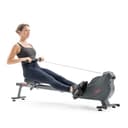
Sunny Dual Rail SF-RW524079
- The middle tier is where the console stops being decoration. The MERACH R50 Pro and the Phantom Hydro both report watts and a 500 m split, both publish a folded size, and both come with a free first-party app rather than a paywalled one. This is the tier most people should actually shop, and the R50 Pro’s 47.2 in rail inseam is the longest published seat travel on the page.

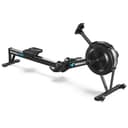
MERACH NovaRow R50 Pro

Sunny Phantom Hydro SMART
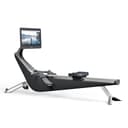
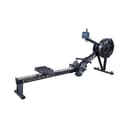
- The top tier splits in two, and they are not the same purchase. The Concept2 and the Body-Solid R300 spend the money on the machine: 500 lb capacities, portable data, and warranties measured in years or in lifetimes — though a lifetime warranty is not always the one it sounds like, which our commercial rowing machine roundup takes apart clause by clause. The Hydrow spends it on the experience — a 22 in pivoting screen, near-silent electromagnetic drag — and then keeps charging. Budget the Hydrow as the rower plus a year of membership, because that is the real price.

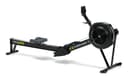
Concept2 RowErg

Body-Solid Endurance R300

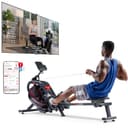
Hydrow Rowing Machine
Footprint and foldability: length first, storage second
Rowers are long, and the two numbers get confused constantly. Assembled length on this page runs from 63.2 in to 96 in, and you need roughly two more feet behind the machine to get on and off it — Concept2 asks for a 9 ft by 4 ft clear area. That is the number that decides whether a rower fits your room.
Storage is what the machine becomes afterwards, and makers use the words loosely. The Concept2 and the Body-Solid separate into pieces. The Sunny Dual Rail flips upright and the SF-RW520007 folds upright onto a 31.3 × 25.1 in floor patch. The Phantom Hydro genuinely folds, from 80.7 in down to a 42.9 in footprint. The Hydrow stands upright only if you buy the add-on kit. If the room has to go back to being a room, start with our rowing machines for small spaces guide, which ranks on exactly that.
Weight capacity: buy headroom, and notice who publishes nothing
Published maximum user weight is the maker’s structural rating for the frame, and the spread on this page is wide: 500 lb on the Concept2 and the Body-Solid R300, 375 lb on the Hydrow, 300 lb on all three Sunny machines, and nothing at all from MERACH for the R50 Pro — which is a finding, not a gap we should fill in for them. A rating is a ceiling rather than a target, so leave some margin under it, treat an unpublished number as unknown rather than as probably fine, and if several people will share the machine, buy for the heaviest of them. Past 500 lb, the WaterRower Oak in our water rower roundup publishes 700 lb, and exercise equipment for heavier beginners builds a whole shortlist around published capacity.
Rail inseam decides fit, not your height
The fit spec on a rower is the slide-rail inseam— the seat’s usable travel — and it is always shorter than the rail length makers advertise. Sunny publishes both, and the gap is instructive: 45.7 in of rail gives 40.9 in of inseam on the Dual Rail. Leg length varies too much at a given height to convert from one to the other, so sit on the floor with your legs straight, measure heel to seat bones, and compare that with the published inseam.
Noise: what you will actually hear
None of the seven publishes a decibel figure in the specs we read, so this is a ranking by mechanism rather than a measurement — but the mechanism is decisive. Magnetic and electromagnetic rowers are the quietest: nothing touches the flywheel, so the loudest sound is usually the seat rolling on the rail. That is the Sunny Dual Rail and the Hydrow here. Water makes a broad whoosh on every drive, which many people like, and which still makes the Phantom Hydro a poor fit for a shared wall at 6 a.m. Air is the loudest, and no setting changes that, because the fan noise is the resistance — the Concept2, MERACH, Body-Solid and SF-RW520007 all sit here.
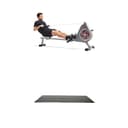
Rowing makes no footfall, which is the impact neighbors below hear most from a treadmill. A dense mat under the frame is still the cheapest way to cut the vibration that does travel through the floor, and our quietest cardio machines guide ranks every machine type on exactly this question.
The monitor and the app: three readouts matter, the rest is decoration
Screen size is not the measure of a rowing monitor. What matters is whether it reports time per 500 m, strokes per minute and a distance you can hold yourself to. Those three let you pace an interval, repeat the session next week and see whether anything is improving. Calories are a modeled estimate on every machine ever built and the worst possible thing to steer by. Four of the seven here publish a 500 m split; the Body-Solid oddly does not, despite reporting watts, and the SF-RW520007 reports neither.
The app is the other half of the monitor question. The Concept2’s PM5 connects over Bluetooth and ANT+. The MERACH pairs with MERACH’s own app and Kinomap over Bluetooth 5.0. All three Sunny machines pair with SunnyFit, which is free. The Body-Solid’s console is self-generating: it runs on your stroke with nothing to plug in, and goes dark when you stop rowing. The Hydrow is the outlier, with a 22 in pivoting touchscreen that is the product in its own right, and classes behind a membership.
Subscriptions, and which machines have none
Only one machine on this page needs a membership to do what it is for: the Hydrow, whose classes are the product. The Concept2, the Body-Solid and the MERACH are self-contained, and all three Sunny machines pair with SunnyFit, which is free. That is worth an explicit line on your spreadsheet, because two years of a class membership can cost more than the entire budget rower it would have replaced.
Is a rower the right machine at all?
Sometimes not, and it is cheaper to find that out now. A rower beats a treadmill on joints and on muscle recruited per minute, and loses on familiarity and on training for anything you do on your feet. Against an elliptical, the rower wins on upper body and data while the elliptical wins on ease — you step on and go, with no technique to learn. Against an assault bike, the rower is the machine you can do an hour on and the air bike is the one you can barely do ten minutes on. And an exercise bike is the lower- friction daily habit if you mostly want to pedal while watching something. If joints, balance or getting up off a low seat are the real constraint, read our rowing machines for seniors guide, which ranks on seat height first. If it is specifically your lower back, our rowing machines and back problems page ranks the same field on where the resistance peaks in the stroke, and makes the case for a recumbent bike instead. Building the whole room around this? Start with how to build a home gym.
Judging a rower by its maker
One filter sits underneath every pick on this page and is easy to check before the box arrives: what the brand is willing to commit to in writing. We separate nine rower brands on published warranty terms, and on who actually owns the company, in rowing machine brands.