Rowing Machine vs Assault Bike
Two air machines with the same self-scaling resistance and completely different jobs: one you can do for an hour, one you can barely do for ten minutes - and one needs half the floor.
These two machines make resistance the same way and are used for almost opposite things. Both are air: a caged fan that pushes back exactly as hard as you drive it, so there is no level to set and no ceiling to hit. Pull or pedal harder, and the machine gets harder, immediately and forever. That shared mechanism is why they sit next to each other in every CrossFit box, and why comparing them on “which is more intense” misses the point — both are as intense as you are.
The real split is duration and floor space. The Concept2 RowErg is a machine you can settle into for an hour: seated, rhythmic, full-body, with a monitor that reports pace per 500 m so a long steady session is measurable. The Titan Fitness Fan Bike is a machine most people cannot survive ten hard minutes on, driven by arms and legs at once through a caged fan, with interval programs built into the console because intervals are what it is for. And it does that in 50.25 in of floor length against the rower’s 96 in.
A note on the name. “Assault bike” is what nearly everyone calls this machine, after the Assault Fitness original that made the category. Assault sells direct, and on the day this page was last checked neither its AssaultBike Classic nor its Pro X had a purchasable listing at the retailer we link — so the air bike specced and linked below is the Titan Fitness Fan Bike, which is the same machine in every way this comparison turns on: a caged fan, dual-action handles, and no resistance setting at all. Where the two differ on paper — capacity, weight, warranty — the numbers below are Titan’s own, not the AssaultBike’s.
How this is funded: we earn a commission if you buy through our links, at no extra cost to you. It never changes which product we recommend, and we’ll tell you when we’d skip one. Full disclosure.
| Feature | Rowing machine | Air bike |
|---|---|---|
| Resistance | Air, spiral damper 1-10 | Air, no levels or damper |
| Motion | Seated full-body pull | Seated or standing push-pull |
| Session it is built for | 5 minutes to an hour | 20 seconds to 20 minutes |
| Console | Pace/500 m, watts, SPM, drag factor | Watts, RPM, calories, HR, distance, time, odometer |
| Interval programs built in | No | Yes, on the console |
| Assembled size | 96 x 24 in, needs ~9 x 4 ft | 50.25 x 20.375 x 50 in |
| Machine weight | Not published | 111 lb |
| Max user weight | 500 lb | 330 lb |
| Storage | Separates into two pieces | Does not fold |
| Published warranty | 5 yr frame / 2 yr parts | 1 year |
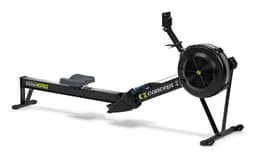
Rowing machine
Concept2 RowErg (Model D)
Buy this if: People who want one machine for the whole cardio week, low-impact full-body work, and numbers they can pace and repeat.
Strengths
- Seated and low-impact, so long sessions are sustainable
- PM5 reports pace per 500 m, watts and drag factor - portable between machines
- 500 lb published capacity, the higher of the two
- Separates into two pieces with no tools for storage
Trade-offs
- 96 in long and wants roughly a 9 by 4 ft clear lane
- The stroke is a skill; it takes a couple of weeks to get efficient
- No built-in interval programs - you run the intervals yourself
Price as of October 22, 2026. #ad How we’re funded
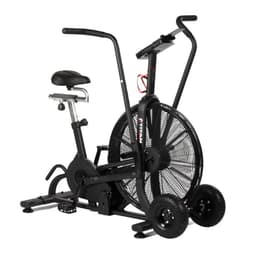
Air bike
Titan Fitness Fan Bike
Buy this if: Interval training, and anyone who wants maximum conditioning out of a machine that fits in a 50 by 21 in patch of floor.
Strengths
- 50.25 x 20.375 in - roughly half the floor length of a full-size rower
- Interval programs built into the console, alongside watts and RPM
- Arms and legs drive the fan together, so resistance never runs out
- Fully enclosed metal chain drive - nothing exposed at ankle height
Trade-offs
- 330 lb capacity against the Concept2's 500 lb
- No 500 m split or pace readout - watts and RPM are the pacing numbers
- 111 lb of steel that does not fold and has no published storage mode
- One year of published warranty, against five on the Concept2 frame
Price as of October 22, 2026. #ad How we’re funded
Same resistance, opposite jobs
Air resistance behaves identically on both machines, and it is worth being precise about what that means. A fan meets more air the faster it spins, so drag rises with effort automatically. There is no level, no ceiling and nothing to store — the resistance is whatever you just did. The Titan has no damper at all; the Concept2 has one, but the lever is gearing rather than resistance, changing how heavy each stroke feels while intensity stays entirely a function of how hard you pull. Concept2 says so on its own site and suggests most people settle between 3 and 5.
What differs is the shape of the session the machine is built to hold. Rowing is rhythmic and seated, so a 40-minute steady piece is a normal thing to do. An air bike with the arms working is close to a whole-body sprint, which is why its console ships with Tabata and custom interval programs and why almost nobody rides one for an hour. If you own one machine, the rower covers more of a training week. If you own two, this is the second one.
Floor space is where the air bike wins outright
This is the most practical difference on the page. The RowErg is 96 in by 24 in and Concept2 asks for roughly a 9 ft by 4 ft clear area to use it properly — and you need clear space behind the machine to get on and off. The Titan Fan Bike is 50.25 in by 20.375 in and you use it standing over that same footprint; nothing slides, so the space it occupies is the space it needs.
Storage flips the result. The Concept2 separates into two pieces with no tools and the halves stand against a wall. Titan publishes no storage mode for the Fan Bike, and it does not fold: 111 lb of steel stays where you put it. So the bike wins on floor in use and the rower wins on floor afterwards. Which matters depends entirely on whether the room has another job. If it does, our best rowing machine for small spaces guide covers rowers down to a 60 in frame that stores on end.
Data: a split against watts
Both consoles are serious, and they speak different languages. The PM5 reports time per 500 m, stroke rate, watts and drag factor. The split is the unit rowing programs are written in, and drag factor is what makes your 2 km on this erg comparable with your 2 km on any other. The Titan console reports watts, RPM, calories, heart rate, distance, time and an odometer, plus its interval programs. There is no pace-per-distance readout, so on an air bike you pace by watts or by calories-per-hour, and the fair comparison between two sessions is watts, not the calorie total. Calories on any machine are a model, not a measurement.
Capacity, and who each machine excludes
Concept2 publishes 500 lb for the RowErg. Titan publishes 330 lb for the Fan Bike. Both are honest published figures, and the 170 lb gap is the single spec most likely to decide this for a heavier buyer — on an air bike you also stand on the pedals through the hardest efforts, which is exactly when a capacity limit matters. If you are near or above 330 lb, the rower is the machine that is rated for you, and our equipment guide for heavier beginners covers the rest of the room.
Neither one is quiet
Say this plainly: there is no quiet air machine of either kind, because on both of them the fan noise is the resistance. A caged steel fan moving air under a hard effort is loud, and so is a rowing flywheel. Nothing about the setting, the floor mat or the technique changes that much. If you are above a sleeping household or sharing a wall, the answer is not to choose between these two — it is to buy a magnetic rower, which is the type designed around the problem, and to read air vs magnetic rower first.
Upkeep and warranty
The published warranties are the one place these two are not close. Concept2 covers the RowErg frame for five years and its moving parts and monitor for two. Titan publishes one year on the Fan Bike. That is a real difference and it is worth pricing in. The maintenance is more alike: both are chain-driven, and Titan encloses its chain fully, which is the detail that matters in a room where the machine sits at ankle height. Mechanically both are about as simple as home cardio gets — a fan, a chain and a bearing set. Neither has a motor and neither needs an outlet, which is one reason machines like these outlive fancier ones.
So which one?
If this is your only cardio machine, buy the rower: it does long and short, it is rated to 500 lb, its data is the most useful in home cardio, and it packs away. If your training is already interval-shaped, if you have a corner rather than a lane, or if you want a machine that can genuinely end you in eight minutes, buy the air bike. Both clear the weekly aerobic activity health authorities recommend easily, and neither replaces strength work. Compare specific rowers in our best home rowing machines roundup, or see how a rower fares against the more common machines in rowing vs treadmill and rowing vs exercise bike.
Wellness guidance, not medical advice. Pulse & Plate is written by a fitness enthusiast, not a doctor. Wearable heart-rate, SpO2, ECG and sleep readings are for general wellness, not diagnosis. For a heart concern, a symptom, or before starting a new exercise program, talk to a qualified professional.
Frequently asked questions
Is a rowing machine or an assault bike better?
For one machine covering a whole cardio week, the rower - it handles long steady sessions and intervals, works legs, back, arms and core, publishes a 500 lb capacity and gives you a 500 m split to pace by. The assault bike is a specialist: unmatched for short, brutal intervals, and it needs roughly half the floor length. Most home gyms are better served by the rower first and the air bike second.
Which is harder, a rowing machine or an assault bike?
Both are air machines, so both are exactly as hard as you make them - the fan pushes back in proportion to your effort and there is no ceiling. In practice most people find the air bike harder to sustain, because the arms and legs drive it together and there is no coast phase. The rower is harder to do well, because the stroke is a skill, and easier to hold for 40 minutes.
Does an assault bike work your upper body?
Yes, more than most cardio machines. The handlebars are linked to the same fan the pedals drive, so pushing and pulling them adds real work rather than assistance. It is not strength training - the load is your own effort against air - but it does mean arms, shoulders and back are contributing, which is why an air bike raises your heart rate faster than a bike with fixed handlebars.
How much space does an assault bike need compared with a rower?
The Titan Fitness Fan Bike is 50.25 x 20.375 in and you use it over that same footprint, so it is roughly half the floor length a full-size rower needs. The Concept2 RowErg is 96 x 24 in and Concept2 asks for about a 9 by 4 ft clear area, plus room behind to get on and off. Storage reverses it: the rower separates into two pieces, the air bike does not fold and has no published storage mode.
Are assault bikes and rowers loud?
Both, and for the same reason - on an air machine the fan noise is the resistance, so there is no quiet setting and it gets louder exactly when you work hardest. A 27 in steel fan under a hard effort is not an apartment-at-6am machine, and neither is an air rower. If quiet is the constraint, buy a magnetic rower instead; nothing touches the flywheel, so it is near-silent.
Can you still buy an Assault Fitness AssaultBike?
From Assault Fitness directly, yes - the AssaultBike line is not discontinued. What changed is the retailer we link: on our last check neither the AssaultBike Classic nor the Pro X had a purchasable listing there, so we link the Titan Fitness Fan Bike instead rather than send you to a page you cannot buy from. Everything this comparison turns on - a caged fan, dual-action handles, no resistance setting - is true of both.
Can I use an assault bike for long steady cardio?
You can, but it is not what the machine is shaped for. Without a coast phase and with the arms working, a steady hour on an air bike is unusually taxing, and the console reports watts and RPM rather than a pace-per-distance split, so a long piece is harder to structure. A rower, an exercise bike or a treadmill all suit long steady work better; the air bike earns its place on the hard, short end.
Sources
- American Heart Association — Recommendations for Physical Activity in Adults — AHA's 150 min/week moderate aerobic + 2 days strength recommendation (accessed July 19, 2026)
- U.S. HHS / ODPHP — Physical Activity Guidelines for Americans (2nd ed.) — Federal guideline: 150–300 min/week moderate aerobic + muscle strengthening 2+ days (accessed July 19, 2026)
- Concept2 — RowErg warranty — Five years on frame parts, two years on moving parts and the monitor (accessed July 20, 2026)
- Concept2 — What Damper Setting and Drag Factor to Use on the RowErg — The maker's own explanation that the damper is gearing, not resistance: it changes how the stroke feels, while drag factor is what the monitor measures and Concept2 suggests starting at 3-5 (accessed August 31, 2026)
- Titan Fitness - Fan Bike (published specifications and warranty) — 50.25 x 20.375 in footprint, 50 in overall height, 111 lb, 330 lb max user weight, fully enclosed metal chain drive, console reporting time, distance, heart rate, RPM, calories, watts and an odometer plus interval programs, seat adjustable 33-42.75 in, 1-year warranty (accessed September 4, 2026)
Keep reading
Best Home Rowing Machines
Seven rowers compared on console readouts, floor length, capacity, seat height and subscription cost.
See the rower picksBest Air Rowing Machines
If the air feel is what you want, the five air rowers ranked on console data and footprint.
See the air picksAir vs Magnetic Rower
Self-scaling air against quiet, settable magnetic - the noise decision, made properly.
Compare resistanceRowing Machine vs Exercise Bike
The gentler version of this matchup, if a standard indoor bike is what you were picturing.
Compare theseRowing Machine vs Elliptical
Two zero-impact machines, and what actually separates them once joints are a draw.
Compare theseQuietest Cardio Machines
What actually makes a machine loud, and the quietest option in each category.
Read the guide