How to choose a magnetic rower
Rowing is the rare home machine that is genuinely full-body and genuinely low-impact at the same time, which is why it keeps showing up in guidance about getting enough weekly activity without wrecking your knees. Magnetic is the version of it that fits an ordinary house. These are the specs that decide which one to buy, roughly in the order they should decide it.
Resistance levels: a range, not a score
Every machine here advertises a level count — eight on the Stamina, 16 on both Sunnys and the MERACH, and a computer-set range on the Hydrow. It is the most quoted number in the category and the least useful, because nobody publishes what a level is worth. Eight levels on one machine can span the same total drag as 16 on another; all the extra levels guarantee is finer steps between them.
What the count does tell you is how granular your progression can be. If you plan to do intervals where you change resistance between efforts, more steps mean fewer awkward jumps. If you plan to set a level once and row, eight is plenty. What matters far more is that the resistance is fixed: unlike an air rower, easing off does not make a magnetic machine lighter, so a lazy stroke stays as hard as an honest one. That is a feature for steady-state work and a limitation for sprints, and it is the single biggest behavioral difference between the resistance types. We walk through all four in types of rowing machines.
Rail inseam is the fit spec, not rail length
This is the number buyers regret ignoring, and it is the one makers bury. Sunny publishes two figures for every rower: a slide rail length and a slide rail inseam. The first is how long the tube is. The second is how far the seat can actually travel, and it is always shorter — 45.7 in of rail gives 40.9 in of inseam on the SF-RW524079, and 51.3 in of rail gives 45.7 in on the MotionMax. If your legs cannot fully extend inside the inseam, you are rowing a shortened stroke forever, and no amount of resistance fixes that.
There is no honest way to convert a person’s height into a required inseam, because leg length varies enormously at the same height. The useful move is to measure: sit on the floor with your legs straight, and measure from your heels to your seat bones. If that figure is close to a machine’s published inseam, step up. Of the picks here, the MotionMax has the longest usable travel at 45.7 in; the Stamina publishes no inseam at all, which on a 60 in frame is itself informative.
Weight capacity is a stability number
Published capacity is a proxy for how much frame you are buying, not a cliff you fall off. The spread here is wide: 250 lb on the Stamina, 300 lb on the Sunny Dual Rail, 330 lb on the MotionMax, 350 lb on the MERACH and 375 lb on the Hydrow. A rower is loaded dynamically — you drive backwards against the seat with your whole body — so a frame near its limit flexes and creaks, and a machine that creaks is a machine you stop using. Give yourself headroom rather than buying to the number. Our high-capacity equipment guide sorts the wider catalog the same way.
The monitor: three readouts, and everything else is decoration
Console quality is where the price differences on this page become visible, and screen size is not the measure. What matters is whether the console reports time per 500 m, strokes per minute and a distance you can hold yourself to. Those three let you pace an interval, repeat a session next week and see whether you are actually improving. Calories are a modeled estimate on every machine ever built and are the worst possible thing to steer by.
Both Sunny picks publish a 500 m split and stroke rate alongside distance, strokes and a pulse field. The Stamina publishes total strokes, strokes per minute, time, distance and calories — complete enough to train with, minus the split. MERACH publishes an LCD and does not say what it shows, which is a real gap on an otherwise well-specified budget machine. If your training is heart-rate-led, note that none of these bundles a chest strap, so plan on adding one from our heart-rate monitor roundup.
Fold, flip, or stand: three different storage answers
A rower is a long object and it has to go somewhere. The three mechanisms are not interchangeable, and makers use the words loosely. Folding hinges the rail up toward the flywheel, cutting the length roughly in half. Upright storage tips the whole frame onto its end, trading floor length for height — the MotionMax and the Hydrow both do this. Flipping, which is what the Sunny Dual Rail does, stands the machine against a wall without a hinge at all.
The practical question is which shape your room has spare. A tall narrow gap beside a bookcase suits upright; a low space under a window suits folded. And read the published numbers rather than the word: Sunny publishes no folded dimensions for either pick here, MERACH publishes none at all, and Stamina says only that the 1110 “stores easily on end.” The one thing they all have is transport wheels, which is the difference between storing a rower and leaving it out. If floor space is the binding constraint, our small-apartment equipment guide covers the trade-off across every category.
Noise: this is the category’s real advantage
A magnetic rower has no fan and no water, so there is nothing to make a sound except the seat rolling on the rail and the belt returning the handle. That is quieter than a treadmill’s footfall, quieter than the whoosh of a water rower, and dramatically quieter than the fan roar of an air erg. If a shared wall, a sleeping household or a downstairs neighbor is the reason you are shopping at all, magnetic is the answer and the only remaining question is which one. We rank the whole category on that question in the quietest cardio machines.
Electromagnetic is still magnetic — the Hydrow question
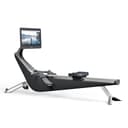
The Hydrow sits on this page for a reason that is easy to miss: its drag is magnetic too. The difference is that a computer moves the magnet instead of your hand, which is what lets a class instructor set your resistance for you and what lets the machine hold a level as your stroke rate changes. Everything true of a manual magnetic rower — near-silence, fixed resistance, no consumables — is true of it as well.
What you are paying for on top is a 22-inch pivoting touchscreen and a library of filmed rowing content, and that content sits behind a membership. Hydrow does provide a subscription-free “just row” mode, so the machine is not a brick without it, but nobody buys a Hydrow for just-row mode. Price it as the machine plus a couple of years of membership and compare that total against a Sunny plus the free SunnyFit app, and the decision usually makes itself. Our connected equipment guide lays out which brands charge for what.
Why the cheapest machine here is not the best one
The MERACH Q1S is the lowest price on this page and carries the highest published capacity of any manual pick, which looks like it should end the argument. It does not, for one reason: MERACH publishes almost nothing else. There are no assembled dimensions, no folded dimensions, no monitor readouts and no warranty terms on the listing, and MERACH sells several different machines under the Q1S name whose specs its own pages do not keep apart. That is survivable if you have the room and simply want a quiet rower cheaply. It is not survivable if you are measuring a tight corner, because you cannot measure against a number nobody has printed.
The Sunny Dual Rail costs a little more and answers every one of those questions: 63.2 in assembled, 45.7 in of rail on a 40.9 in inseam, 13.4 in seat height, 41.5 lb, three years on the frame. That is why it is the overall pick rather than the cheapest one. Buying blind is a discount, and it is worth knowing that is what you are buying.
Read the warranty per model, not per brand
Coverage on this page ranges from generous to absent, and it does not track price in the way you would expect. Sunny publishes three years on the structural frame and 180 days on other parts and components, with labor and shipping excluded and the cover non-transferable — the same terms on the $200 machine and the $600 one. Stamina writes its warranty per model rather than per brand: the 1110 gets three years on the frame and 90 days on parts, while cheaper Stamina rowers get one year on the frame. MERACH publishes no warranty terms on the listing at all, which is the usual trade at the bottom of the range and worth knowing before rather than after.
Who should skip magnetic entirely
Two groups should. If you want your numbers to be comparable with other rowers — a club erg test, an online leaderboard, a coach’s program written in splits and watts — buy an air rower with a performance monitor instead, and accept the noise; our best air rowing machines roundup ranks that field on exactly that question. And if what you actually want is the feel of being on the water, with a stroke that gets heavier exactly as fast as you pull, magnetic will always feel synthetic next to a tank; start with water vs magnetic before you spend. For the full field across all three resistance types, the best home rowing machines roundup covers everything in one place.