How to buy a rowing machine when you are tall
Inseam, not height
Makers advertise a rail length because it is the bigger number. What you sit on is the inseam — the distance the seat can actually travel — and the two are different because the carriage, the stops and the seat itself all occupy rail. Sunny is unusually honest here and publishes them as two separate figures on every machine: 45.7 in of rail and 40.9 in of inseam on the compact Dual Rail; 51.3 in and 45.7 in on the MotionMax. MERACH publishes both in millimeters: 1,365 mm of track, 1,200 mm of inseam. Concept2, Body-Solid, WaterRower and YOSUDA publish neither.
Height is a poor proxy for any of this, because leg length varies enormously at a given height. Two people at 6 ft 2 in can differ by four inches of femur, and it is the femur that runs out of rail at the catch.
Measure your own inseam in about a minute
Sit on the floor with your legs straight out in front of you and your back against a wall. Measure from your heels to the point your seat bones contact the floor. That figure is what has to fit inside the machine’s published inseam, with a little room to spare so you are not slamming the seat into the front stop on every stroke. Compare it against the published number rather than against a “fits users up to 6 ft 6 in” marketing claim, which is a claim rather than a measurement — YOSUDA makes exactly that claim and publishes no dimensions at all to check it against.
What actually goes wrong when the rail is short
You do not simply feel cramped. At the catch, the seat hits its forward stop before your shins are vertical, so you either shorten the stroke — losing the leg drive that is 60% of the power — or over-compress your ankles and knees to reach the handle. Both make the machine less effective and less comfortable, and the shortened stroke is the one most people default to without noticing. The console then dutifully reports a worse split for the same effort, which is discouraging in a way that has nothing to do with fitness.
Frame length is the fallback when inseam is not published
For the four machines here that publish no inseam, assembled length is the next-best signal: a 95 or 96 in machine has rail to spare in a way a 63 in one does not. That is why the Concept2 and the Body-Solid R300 sit high on this page despite the missing figure. It is a proxy and we should call it one — but combined with a 500 lb published capacity on both, it is a defensible proxy. Note the exception: the Sunny MotionMax is only 78.6 in assembled yet publishes the second-longest inseam here, because it puts more of its length into rail and less into flywheel housing. Published numbers beat proxies every time they exist.
Capacity often travels with height, and the ceilings vary
Taller frequently means heavier, and the published capacities here run from 330 lb to 700 lb — with MERACH publishing no user weight limit at all for the R50 Pro, which is a genuine omission on an otherwise well-documented machine. The WaterRower Oak’s 700 lb is more than double anything else, and the Concept2 and Body-Solid’s 500 lb is the practical answer for most tall and heavy rowers. Our equipment guide for heavier beginners applies the same logic to the rest of a home gym.
Seat height and ceiling clearance
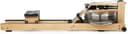
Two secondary specs bite tall rowers specifically. A very low seat — the WaterRower Oak publishes 9 in — is a longer way down and back up when your legs are long, so it is worth knowing before you fall in love with the oak frame. And if you plan to store a rower on end, check your ceiling: the Oak stands 82.25 in tall upright, which is over 6 ft 10 in and clears a normal ceiling but not a sloped attic wall. Our small-space rower guide has the stored dimensions for every machine that publishes them.
The rowers to skip if you are tall
Naming them is more useful than a general warning. The Sunny Dual Rail SF-RW524079 publishes a 40.9 in inseam and the Sunny SF-RW520007 air rower publishes 38.5 in — the two shortest usable travels on this site, and both excellent machines for the compact rooms they are designed for. The Sunny SF-RW5515 pairs a short rail with a 250 lb cap. None of these are bad rowers; they are simply built for a different body, and the same short frames are exactly why they win our small-space roundup. If your room is genuinely too short for a 93 in machine, that trade — storage over length — is the one to make, rather than accepting a compressed stroke.
One caveat on the MotionMax
The Sunny MotionMax earns its place on inseam and on being magnetic, which is the quietest resistance type. It is also a full-motion rower: two independent handles that travel in an arc rather than a single bar. That frees the shoulders and is genuinely pleasant, but it is a different skill from a standard erg, your split will not transfer, and the frame is 30.5 in wide against 17.7 in for the standard Sunny. Buy it because you want that movement, not only because of the rail.