Rowing Machine vs Elliptical
Two machines that put no impact through your joints at all - and almost nothing else in common. Muscles worked, technique, console data, footprint and ceiling height compared.
This is the one cardio matchup where the joint argument is a draw. A rowing machine is seated and non-impact; an elliptical keeps your feet on the pedals the whole time, so nothing lands. Neither sends a shock through your knees, hips or ankles. That removes the usual tiebreaker and leaves the real question: how much of you does the machine actually work, and how much are you willing to learn?
A rower — here the Concept2 RowErg, the widely cited home standard — is a full-body pull. Every stroke is roughly a leg drive, a back swing and an arm pull, and the PM5 monitor reports pace, watts and drag factor, so what you did is measurable and repeatable. An elliptical — the Sunny Health & Fitness Upright Magnetic Elliptical, with the 16 in stride most home machines cut to save money — is a standing stride with moving handles. You step on and go. There is no technique to get wrong, which for a lot of people is the entire reason the machine gets used.
How this is funded: we earn a commission if you buy through our links, at no extra cost to you. It never changes which product we recommend, and we’ll tell you when we’d skip one. Full disclosure.
| Feature | Rowing machine | Elliptical |
|---|---|---|
| Motion | Seated full-body pull | Standing stride, moving handles |
| Muscles worked | Legs, back, arms, core | Legs and glutes, arms if you push |
| Joint impact | Zero - seated, nothing lands | Zero - feet never leave the pedals |
| Technique to learn | Yes, the stroke is a skill | No, step on and go |
| Resistance | Air, spiral damper 1-10 | Magnetic, 16 levels, belt drive |
| Console | Pace/500 m, watts, SPM, drag factor | Time, speed, distance, calories, pulse |
| Assembled size | 96 x 24 in, needs ~9 x 4 ft | 48 x 25.8 x 64.8 in |
| Max user weight | 500 lb | Not published |
| Storage | Separates into two pieces | Does not fold |
| Noise | Loud - the fan is the resistance | Quiet - nothing touches the flywheel |
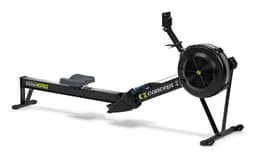
Rowing machine
Concept2 RowErg (Model D)
Buy this if: People who want the most complete zero-impact workout available from one machine, and numbers they can actually train against.
Strengths
- Works legs, back, arms and core in a single motion
- PM5 reports pace per 500 m, watts and drag factor - portable between machines
- 500 lb published capacity and five years of published frame warranty
- Separates into two pieces with no tools for storage
Trade-offs
- The stroke is a skill; a sloppy one is inefficient and can nag the lower back
- Air resistance is loud - the fan noise is the resistance
- Needs a long clear lane, roughly 9 by 4 ft, to use properly
Price as of October 22, 2026. #ad How we’re funded
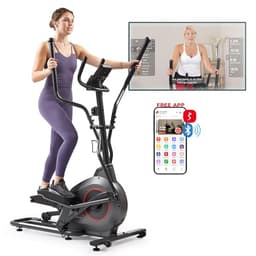
Elliptical
Sunny Health & Fitness Upright Magnetic Elliptical (16 in Stride)
Buy this if: People who want zero-impact cardio they can start today, hold a conversation through, and share with anyone in the house.
Strengths
- No technique to learn - step on and the motion is correct by design
- 16 in stride is long enough for taller users to walk rather than shuffle
- 16 magnetic resistance levels on a belt drive, so it is quiet and there are no friction pads to wear
- Moving handles put the arms to work if you push them
Trade-offs
- The listing does not publish a user weight capacity - a real gap on a machine you stand on
- Console reads time, speed, distance, calories and pulse: no watts, no split
- 48 x 25.8 in of floor and it does not fold
Price as of October 22, 2026. #ad How we’re funded
Zero impact both ways, so what actually separates them
Start by dropping the argument you came for. Rowing is seated and non-impact. Elliptical striding keeps both feet in contact with the pedals through the whole cycle, so there is no landing phase and nothing to absorb. Compared with running, both are gentle; compared with each other, neither wins. What separates them is how much of your body is doing work, and how much skill it takes to get that work out of the machine.
Muscle recruited per minute
The rower wins this one clearly, and it is the single strongest argument for buying one. A stroke is about 60% legs, 20% core and back swing, 20% arm pull, and all of it happens in sequence within about two seconds. That makes rowing cardio and light strength-endurance at the same time — your lats, rhomboids and grip finish a session having done something.
An elliptical is a leg-and-glute machine with an optional upper-body contribution. The handles move, and pushing them genuinely adds work, but the arc is short and the load is light: it is assistance, not a pull-up. If you want one machine that keeps your back and arms in the conversation, that is the rower’s advantage and the elliptical cannot answer it. If you already lift, or the cardio machine is only ever going to be a cardio machine, that advantage matters much less than it sounds.
The learning curve is the real trade
An elliptical is correct by construction. The pedals travel a fixed path, so your first minute looks like your thousandth and there is no way to do it badly enough to hurt yourself. That is worth more than it gets credit for — a machine you use four times a week beats a better machine you use once.
Rowing is a skill. The order is legs, then back, then arms on the drive, and the reverse coming back, and getting that wrong looks like yanking with the arms and rounding the lower back. It takes most people a couple of weeks of paying attention. The payoff is that the same technique makes the machine efficient, and the PM5 tells you honestly whether you are improving. If nobody in the house will watch a technique video, the elliptical is the more realistic purchase.
What the console will tell you
This is not close. The Concept2 reports time per 500 m, stroke rate, watts and drag factor — drag factor being the reading that makes a split on one erg comparable with a split on another, which is why rowing programs are written in those units at all. The Sunny elliptical publishes time, speed, distance, calories and a handlebar pulse reading. That is enough to know you did something; it is not enough to pace an interval or repeat a session precisely. Calories, on either machine, are a modeled estimate and the worst thing to steer by.
Space: one machine is long, the other is tall
The rower is a length problem. The RowErg is 96 in by 24 in and Concept2 asks for roughly a 9 ft by 4 ft clear area, though it separates into two pieces afterwards and the pieces stand against a wall. The elliptical is a height and footprint problem: 48 × 25.8 in of permanent floor at 64.8 in tall, and you stand on top of that, so a low ceiling or a sloped attic wall genuinely rules it out. It does not fold. Measure the lane for the rower and the headroom for the elliptical. If floor is the binding constraint, our best rowing machine for small spaces guide ranks rowers on exactly that, down to a 60 in frame.
Noise, and the thing nobody mentions
The elliptical wins on noise and it is not close either. Magnetic resistance on a belt drive touches nothing, so the loudest thing in the room is you. The Concept2 is an air rower, which means the fan noise is the resistance — there is no setting that makes it quiet, and it scales up exactly when you work hardest. Above a sleeping household or a shared wall that is a real constraint, and the answer is usually a magnetic rower rather than an elliptical: see the magnetic rower roundup or the quietest cardio machines.
The capacity gap, stated plainly
Concept2 publishes 500 lb for the RowErg. Sunny publishes no user weight capacity at all for this elliptical, which is a notable omission on a machine you stand and push on rather than sit in. We print “Not published” rather than guessing, and for a heavier buyer that gap is itself the answer — either pick a machine whose maker states a number, such as the 400 lb Niceday in our elliptical roundup, or take the rower.
So which one?
Buy the rower if you want the most work per minute, real data, a 500 lb frame, and you are willing to spend two weeks learning a stroke. Buy the elliptical if you want quiet, zero-impact cardio that starts working the moment you step on and that anyone in the house can use without instruction. Both comfortably cover the weekly aerobic activity public health guidance asks for; neither replaces strength training. Compare specific models in our best home rowing machines and best ellipticals roundups, or see how the elliptical fares against the other familiar machine in elliptical vs treadmill.
Wellness guidance, not medical advice. Pulse & Plate is written by a fitness enthusiast, not a doctor. Wearable heart-rate, SpO2, ECG and sleep readings are for general wellness, not diagnosis. For a heart concern, a symptom, or before starting a new exercise program, talk to a qualified professional.
Frequently asked questions
Is a rowing machine or an elliptical better?
Neither is better in the abstract - they are both zero-impact, so the usual joint tiebreaker does not apply. A rower works legs, back, arms and core in one motion and gives you pace, watts and drag factor to train against. An elliptical works legs and glutes with a light arm contribution, and needs no technique at all. Pick the rower for the most complete workout and real data; pick the elliptical for the lowest-friction habit.
Which burns more calories, rowing or an elliptical?
Effort decides it far more than the machine does, and every calorie figure a console prints is a model rather than a measurement. That said, rowing recruits more muscle per minute, so for the same perceived effort it typically does more total work. The elliptical's advantage is that many people find it easier to sustain for longer without thinking about form, which can even the total out over a week.
Is an elliptical or a rower easier on the knees?
Both are about as easy as home cardio gets. Rowing is seated, so your knees carry no bodyweight at all, though a deep catch position does bend them fully - which is worth knowing if deep flexion is what bothers you. An elliptical keeps your feet on the pedals the whole time, so nothing lands, but you are standing and the knee tracks a fixed arc. Neither pounds the joint the way running does.
Does an elliptical work your upper body?
Partly. The moving handles genuinely add arm and shoulder work if you push and pull them rather than resting on them, but the arc is short and the load is light. It is assistance to a leg-driven motion, not upper-body training. A rowing stroke, by contrast, ends with a real arm pull against the full drag of the flywheel, which is why the rower is the stronger choice if upper-body involvement is the point.
Which takes up less space, a rower or an elliptical?
They take up space differently. The Concept2 rower is 96 x 24 in and wants about a 9 by 4 ft clear lane in use, but it separates into two pieces afterwards. The Sunny elliptical occupies 48 x 25.8 in permanently, does not fold, and stands 64.8 in tall - and you stand on top of that, so headroom matters. A rower usually wins on stored space; an elliptical usually wins on floor length.
Which is quieter, a rowing machine or an elliptical?
The elliptical, comfortably. Magnetic resistance on a belt drive touches nothing, so it is near-silent. The Concept2 is an air rower and the fan noise is the resistance itself, scaling up exactly when you work hardest. If quiet is the constraint but you still want to row, buy a magnetic rower rather than an air one - that is the type designed around the problem.
Sources
- American Heart Association — Recommendations for Physical Activity in Adults — AHA's 150 min/week moderate aerobic + 2 days strength recommendation (accessed July 19, 2026)
- U.S. HHS / ODPHP — Physical Activity Guidelines for Americans (2nd ed.) — Federal guideline: 150–300 min/week moderate aerobic + muscle strengthening 2+ days (accessed July 19, 2026)
- Concept2 — RowErg warranty — Five years on frame parts, two years on moving parts and the monitor (accessed July 20, 2026)
- Concept2 — What Damper Setting and Drag Factor to Use on the RowErg — The maker's own explanation that the damper is gearing, not resistance: it changes how the stroke feels, while drag factor is what the monitor measures and Concept2 suggests starting at 3-5 (accessed August 31, 2026)
- Sunny Health & Fitness — Warranty policy — Cycles, rowers and treadmills: 3-year frame, 180-day parts, labor and shipping excluded, non-transferable (accessed July 20, 2026)
Keep reading
Best Home Rowing Machines
Seven rowers compared on console readouts, floor length, capacity, seat height and subscription cost.
See the rower picksBest Ellipticals
Stride length decides whether an elliptical feels like walking or shuffling - five machines compared.
See the elliptical picksElliptical vs Treadmill
Zero impact and quiet, or weight-bearing and specific - the other elliptical matchup.
Compare theseRowing Machine vs Treadmill
Full-body low-impact rowing against the most familiar cardio machine there is.
Compare theseBest Rowing Machine for Seniors
If joints and getting up off a low seat are the real constraint, seat height is the first spec.
Read the guideRowing Machine vs Assault Bike
An hour machine against a ten-minute machine, both driven by air.
Compare these