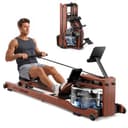
How to choose a water rower
Water rowers are marketed on romance — the sound, the wood, the on-the-lake feel. All of that is real, and none of it tells you which one to buy. These are the specs that do.
The tank, and why nobody sells you “levels”
On a magnetic rower a lever moves a magnet closer to a steel flywheel, and the resistance you set is the resistance you get whether you pull hard or drift. A water rower has no such control. Drag is produced by paddles pushing water aside, so it rises steeply the faster the handle moves: ease off and the stroke goes light, attack it and the stroke fights back. That self-scaling behavior is the single best thing about the category, because it means one machine suits a warm-up and an all-out sprint without anyone touching anything.
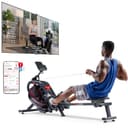
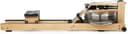
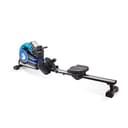
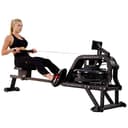
The one thing you can change is how much water is in the tank. More water means more mass to move and a heavier stroke floor; less water means a lighter, faster-spinning feel. It is a setup decision rather than a mid-session one — you are siphoning or topping up a tank, not flicking a lever — which is why tank volume is worth reading. The budget YOSUDA runs a 22 L tank, the largest here; Sunny’s Phantom Hydro uses a 16-blade tank set at a 60-degree incline; the WaterRower uses its own shaped flywheel in a horizontal tank. Bigger is not automatically better, but a bigger tank gives you more room to tune the machine to a heavier rower.
Noise: quieter than air, louder than magnetic
Be clear-eyed about this before you buy for an apartment. A water rower makes a broad, low whoosh on every stroke, and that sound is the product — it is what people who love these machines are paying for. It is a friendlier noise than the fan roar of an air rower and it does not travel through a floor the way treadmill footfall does. But it is emphatically not silent, and if a sleeping household or a shared wall is the real constraint, a magnetic machine is the honest answer. We work through the whole category on that question in the quietest cardio machines.
Rail length, seat height, and getting back up
Two numbers decide whether the machine fits you rather than your room. The first is rail length, which sets how far the seat can travel and therefore whether a tall rower reaches full leg extension. Most full-size water rowers land between 76 and 83 inches overall; the Stamina Wave is the shortest here at 76 in, the WaterRower the longest at 82.25 in. WaterRower itself recommends its XL rails for anyone over 2 m (about 6 ft 7 in), which is a useful signal that the standard rail is not infinite. YOSUDA states a 6 ft 6 in ceiling on its listing — treat that as the maker’s claim, not a measured figure, because it is exactly the kind of number that never comes with a method.
The second is seat height, and it is the spec buyers regret ignoring. Rowing itself is low-impact and joint-friendly; standing up off a low seat afterwards is not. The WaterRower’s seat sits at 9 in, which is close to the floor and a genuine obstacle for stiff knees and hips. Sunny’s Obsidian Surge sits at 17 in — roughly chair height, and the reason it earns a place here even though it has the lowest capacity in the group. The Phantom Hydro splits the difference at 15.4 in. If mobility is part of the decision, our equipment guide for seniors covers the same trade-off across other machine types.
Weight capacity is a stability spec, not just a limit
Published capacity tells you how much frame you are buying, and on water rowers the spread is enormous: 250 lb on the Obsidian Surge, 300 lb on both the Phantom Hydro and the Stamina Wave, 400 lb on the YOSUDA, and 700 lb on the WaterRower. A frame flexing under load is how a machine becomes a clothes rack, so give yourself headroom rather than buying to the limit. That is doubly true here, because a filled water rower already carries 30 to 40 lb of water before you sit on it. Heavier rowers should start with the WaterRower or the YOSUDA; our high-capacity equipment guide sorts the wider catalog the same way.
How it stores — upright, folded, or not at all
An 80-inch machine has to go somewhere. There are two real answers and they suit different rooms. Upright storage tips the whole frame onto its end: the WaterRower goes from 82.25 in of floor length to a 20 in footprint, and it looks like a piece of furniture standing against a wall. Folding hinges the rail up toward the tank instead: the Phantom Hydro drops from 80.7 in to 42.9 in, and the YOSUDA folds 180 degrees against itself. Both need transport wheels to be worth anything, and all of these have them. What matters is which shape your room has room for — a tall narrow gap beside a bookcase suits upright, a low space under a window suits folded.
The monitor: three numbers, and everything else is decoration
Consoles on water rowers range from a two-line LCD to something close to a proper performance monitor, and the difference is not screen size. It is whether the console reports watts, time per 500 m and strokes per minute. Those three let you pace an interval, repeat a session honestly and see whether you are actually improving. Calories are a modeled estimate on every machine ever made and are the worst thing to steer by. The Phantom Hydro is the only pick here that publishes watts and a 500 m split; the Stamina Wave reads calories, time, strokes, distance and pulse; the WaterRower’s S4 gives stroke rate, intensity, duration and distance. If your training is heart-rate based, the Stamina is the only one that includes a chest strap — otherwise you are adding one from our heart-rate monitor roundup.
The maintenance nobody mentions in the ad
A water rower is the only rower with a consumable. The tank needs treating so the water stays clear — makers ship purification tablets and expect you to drop one in periodically — and the level needs occasional topping up. It is a few minutes a couple of times a year, not a chore, but it is more than a magnetic rower asks of you, which is nothing. Moving the machine is the other consideration: you either drain it or wheel it, and a filled Phantom Hydro is 88.2 lb of machine plus water. Plan on emptying the tank before it goes up or down stairs.
Is water the right resistance type for you?
Water wins on feel and on how the machine looks in a room you also live in. It self-scales, it needs no setup between efforts, and the tank hides in plain sight in a way a steel flywheel does not. Air wins on data and on ceiling: a proper air erg with a performance monitor gives you comparable, repeatable numbers, which is why competitive rowers train on one. Magnetic wins on silence, on price, and on folding into the smallest package. None of the three is more serious than the others — they are answers to different constraints. If you have not yet settled the question, start with the four rowing machine types, or go straight to the head-to-head in water vs magnetic. And if you want the full field rather than water alone, the best home rowing machines roundup covers every resistance type in one place.
Why two Sunny machines are on this list
It is a fair question, and the answer is that they solve different problems. The Phantom Hydro SMART is the better machine on almost every measure — capacity, monitor, folded footprint, published specs — and it costs meaningfully more. The Obsidian Surge is here for one reason that no other pick matches: a 17 in seat. If getting on and off the machine is the thing standing between you and using it, that single number outranks watts, tank volume and everything else on this page. We would rather say that plainly than pad the list with a fifth brand that adds nothing.
What you are not buying
None of these machines needs a subscription to work, and we would flag one that did. Sunny’s SunnyFit app is free, and the Phantom Hydro’s console works with no account at all. Stamina bundles access to its müüv coaching app — treat that as an extra Stamina is including rather than something you own outright, because müüv sells its own paid plans. YOSUDA’s app is a companion to the LCD, not a replacement for it. The WaterRower is the purest of the lot: batteries, a monitor and no account anywhere.
Read the warranties per model rather than per brand, because they differ sharply. Sunny publishes three years on the structural frame and 180 days on other parts, with labor and shipping excluded. WaterRower ships a one-year limited warranty that upgrades to five years on the frame and three on components — but only if you register the machine within the first year, which is a real task you have to remember to do. Stamina does not publish warranty terms on the listing we read, and YOSUDA publishes none at all. That is the usual trade at the bottom of the price range, and it is worth knowing before rather than after.