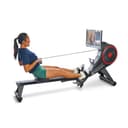
How to choose a rowing machine screen
1. Decide whether you want numbers or video
Be honest with yourself about which one gets you onto the machine, because the two buys pull in opposite directions. If you will row on your own and want to improve, you want a console that reports watts and time per 500 m, and the screen size is irrelevant. If you will only row when somebody is talking to you, you want a large panel and a class library, and the pacing readouts are a bonus you may never look at.
Here is why watts and split specifically. Watts is an absolute measure of power output — 150 W on one machine is the same work as 150 W on another. Time per 500 m is the pace unit every published rowing workout is written in, from a 2 km test to an interval session. Calories, by contrast, is an estimate the console derives from power using assumptions it does not show you, and a stroke count tells you how many times you moved rather than how hard. A console that reports only time, distance, strokes and calories cannot run a real rowing program. Three of the five machines here report watts and split; two do not publish whether they do.
2. Work out what disappears if you stop paying
This is the test that separates the two categories, and it is worth applying before you buy rather than a year in. Ask: with no subscription and no account, what does this machine still do?
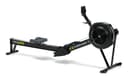
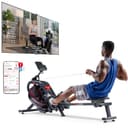
On the Concept2, everything. The PM5 is self-contained, it works with no phone present, and ErgData — which Concept2 describes as “our free app that connects you to the Concept2 community” — syncs to the Online Logbook and forwards workouts to Strava and Garmin Connect at no cost. On the Sunny Phantom Hydro SMART, everything: Sunny publishes the SunnyFit app as free, and the console’s watts and split readouts are on the machine itself. On the Hydrow and the Echelon, the classes stop — both makers state that their content requires a paid membership — and what you are left with is a well-built rower with a screen on it. The MERACH sits in between: its own app is included, while Kinomap, the scenic-route app it also pairs with, is a separate paid subscription of its own.
This is a pattern across connected fitness rather than a rower quirk, and the makers are not uniform about it. Horizon states flatly that it “does not require any subscription services to operate your fitness equipment”. NordicTrack publishes that iFIT is not mandatory and that the machine runs in manual mode without it, with a limited library. Garmin, on the wearables side, committed that “all existing features and data in Garmin Connect will remain free” when it launched a paid tier. Read the maker’s own words on this, not the box.
3. If you want a console, check drag factor
Drag factor is the most useful readout almost nobody knows to look for, and only two machines here report it. On an air rower, the damper lever changes how much air the fan moves, which changes how the stroke feels— Concept2 is explicit that the damper is gearing rather than resistance, and suggests starting between 3 and 5. Drag factor is the number the monitor measures by watching how fast the flywheel slows between strokes, so it describes the actual load regardless of where the lever sits or how dusty the fan cage is.
That matters for one practical reason: a drag factor makes two sessions comparable. A workout done at damper 4 on a clean machine and damper 4 on a dusty one are different workouts; the same drag factor on both is the same workout. The Concept2 PM5 publishes it, and MERACH publishes it on a 5.3 in LCD at a mid-range price, which is genuinely unusual at that money.
4. If you want classes, check the screen hardware and the footprint
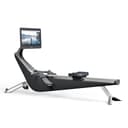
Class machines are decided by the panel and the room rather than the readouts. Hydrow publishes a 22 in HD touchscreen that pivots, which is the feature that lets the machine double as a floor-workout display rather than a rower you stare past. The cost is an 86 in × 25 in footprint, 145 lb of machine, and upright storage that needs an add-on kit you buy separately.
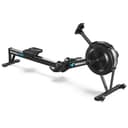
Echelon takes the other route: a frame that folds for storage, with the screen situation varying by version. Echelon sells the rower as the Row Sport, Row-S and Row-4s, and the display is a device holder on some and built in on others, with different published weight limits too. That is a genuine buying hazard rather than a footnote — confirm the exact version on the listing you are ordering, because “Echelon Smart Rower” alone does not tell you whether a screen is included.
The option this page is quietly recommending
A small console plus your own tablet. The PM5 or the Phantom Hydro’s LCD gives you the pacing numbers; a phone or iPad on a stand gives you any video you like, including free ones, and you can change your mind about the content without replacing a rowing machine. The thing a built-in class screen buys over that arrangement is convenience and the on-screen metrics overlay. The thing it costs is a monthly fee and a machine whose best feature is tied to one company’s continued existence.
It is also worth saying which way we would spend a fixed budget: on the frame and the console, not the panel. A rower is a mechanical object that should last a decade, and a ten-year-old PM5 still reports watts correctly. A ten-year-old Android tablet bolted to a rower is a ten-year-old Android tablet. If the screen is what you are paying for, our Concept2 alternativespage is worth reading too — it ranks machines by the reason a buyer leaves the RowErg, and “it has no screen” is one of the four.
What a screen will not fix
No console makes a rower quiet, and the screen tends to correlate with the noise rather than against it. The Hydrow’s electromagnetic drag is the quietest resistance in this group; the Concept2’s fan is the loudest. If a shared wall or a sleeping child is the real constraint, quietest cardio machines is the page that ranks on it.
And no screen changes the dose. The federal guideline is 150–300 minutes of moderate aerobic activity a week plus muscle-strengthening on two or more days, and a class library helps only insofar as it gets you to those minutes. If instructor-led video is what makes that happen for you, the membership is cheap. If it is not, the console machine is the better buy and the saved subscription pays for a set of adjustable dumbbells for the strength half of the recommendation.