How to spend $200 on a tracker
Pick the job first. Under this ceiling the devices are genuinely different machines, and buying the wrong shape is a much more expensive mistake than buying the wrong brand.
1. If you want one device for everything, buy the watch and accept the charger
The Galaxy Watch 7is the only pick here with a full app platform, dual-frequency GPS and an ECG together, and it is the only one that will take a call and answer a message properly. What it costs you is published plainly: a 300 mAh battery on the 40 mm case and 425 mAh on the 44 mm, which Samsung describes as about a day. That means a nightly charge, which means sleep tracking becomes a scheduling exercise.
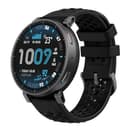
The Amazfit Active Maxis the interesting counter-argument. It is also a smartwatch with built-in positioning across five satellite systems, 4 GB of storage, free downloadable offline maps and 170+ workout modes — and Amazfit states up to 25 days of battery. The trade is the Zepp software ecosystem, which has far fewer third-party apps than Wear OS, and no ECG app. If weeks between charges is the thing you actually want, that is the pick, and our long-battery roundup ranks the whole field on that figure alone.
2. If you want the health sensors, the band is the cheap route
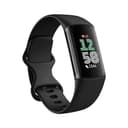
The Fitbit Charge 6 is the only device under this ceiling with an FDA-cleared ECG app, and it also has built-in GPS, SpO2, EDA stress sensing and up to 7 days of battery in a slim band. On published specs that is more cleared health hardware for the money than anything else here.
It is also the device with the clearest asterisk. Fitbit’s full sleep and health analytics require a paid Fitbit Premium subscription (a six-month trial is included), so the number on the price tag is not the number you pay. Buy it knowing you will either pay monthly or live with the free tier. If a cleared ECG is specifically what you are shopping for, compare the field in best ECG smartwatches— and note that the Galaxy Watch 7 has one too, but Samsung states it needs a paired Samsung Galaxy phone, so on a Pixel or an iPhone that feature is simply unavailable to you.
3. If the job is sleep, buy a sleep device
This is the recommendation most people in this price band do not expect. The Fitbit Air is a 5.2 gscreenless pebble on a textile band — 12 g with the strap — that records sleep stages, HRV, resting heart rate, SpO2, skin-temperature variation and Afib alerts for up to 7 days per charge, and Google states five minutes on the charger buys a day. It pairs with an iPhone as well as Android, which most cheap bands do not.
What it does not do is track workouts: no screen, no built-in GPS. Google’s own launch material describes it as designed to be worn all night and alternated with a Pixel Watch by day, which is an unusually honest description of a two-device pattern. If sleep is the whole reason you are buying, the dedicated bands are better at it than any watch, and best sleep tracker bands ranks them properly.
4. Check the GPS row and the platform row before you pay
Two specs on this page silently decide what a device can do, and both are easy to miss.
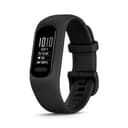
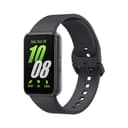
Connected GPS is not GPS. The vivosmart 5 and the Galaxy Fit3 both publish it, which means neither has a receiver: leave your phone at home and there is no route, and distance comes from the accelerometer. The Charge 6, Galaxy Watch 7 and Active Max all have real receivers. And the Galaxy Fit3 is Android only— Samsung does not support iPhone pairing for it at all, so for an iPhone owner it is not a cheap option, it is not an option. Our iPhone roundup and Android roundup split the field by platform if that is your constraint.
What $200 still does not buy
Three things. It does not buy a smartwatch that lasts a week— the Active Max is the exception and it gets there by running simpler software. It does not buy hypertension or sleep apnea notifications, which on this registry are Apple Watch features at two to three times this ceiling; see best Apple Watches if that is the target. And it does not buy a smart ring— the cheapest in our registry is above this band, and the form factor is covered in best smart rings.
One honest limit on every device here: these are wellness devices, not medical instruments. Optical wrist heart rate degrades during intervals and lifting, where the wrist moves and the muscle tenses, so if you train by heart rate a chest strap is worth more than any upgrade on this page — and a good one costs well under $100. That argument is laid out in chest strap vs wrist heart rate.
What we would buy
On a Samsung phone: the Galaxy Watch 7, because it is the only device here where the full sensor set actually works for you, and because dual-band GPS under $200 is a genuine bargain. On any other Android phone or an iPhone: the Fitbit Charge 6 if you want the cleared ECG and built-in GPS and will make peace with Premium, or the Amazfit Active Max if 25 days of battery and offline maps beat an app store for you. If you refuse to pay a subscription on principle: the Garmin vivosmart 5, which paywalls nothing — just remember it borrows your phone’s GPS. And if the brief is “cheapest thing that actually works” and the phone is an Android: the Galaxy Fit3.