How to buy a tracker under $100
At this price nothing is a compromised version of a flagship. These are five genuinely different devices that happen to share a price, and three questions sort them out.
1. Decide whether you want to look at it
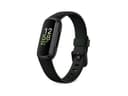
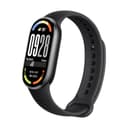
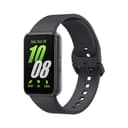
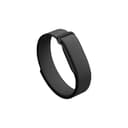
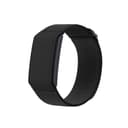
This is the question, and most buying advice skips it. A screenmeans you glance at your wrist mid-walk and see your heart rate, your steps and the time — which is most of why people wear a tracker at all, and why the Inspire 3, the Galaxy Fit3 and the Xiaomi Band 10 are the normal answer. No screenmeans the device disappears: the Fitbit Air is 5.2 g of housing and 12 g with its textile band, and the Amazfit Helio Strap is a nylon strap you forget you are wearing. You read the data in the morning, in the app, as a report.
Both are right, for different people. If the point is to see the number, buy a screen. If the point is sleep and recovery data and you hate wearing a watch to bed, buy a strap — and know that you are buying a sleep band, not a workout tracker. Google says so about the Air itself: no screen and no built-in GPS. We rank that whole category separately on best sleep tracker bands.
2. Check the app before the band, because two of them pick your phone for you
This is where cheap trackers bite. The Samsung Galaxy Fit3 is Android only — it will not pair with an iPhone, full stop, and that is the single most important sentence on this page for about half of the people reading it. The Fitbit Air needs a Google Account plus Android 11 or later or iOS 16.4 or later. The Xiaomi Fit app is metric-only, so if you want pounds and feet you are bridging it through Google Fit, which works but is a chore nobody mentions in the listing.
The two that care least which phone you carry are the Amazfit Helio Strap (iOS 15 or later or Android 7 or later, and it syncs out to Apple Health, Google Fit and Strava) and the Fitbit Inspire 3. If you are on an iPhone, start from best fitness trackers for iPhone; on Android, from best fitness trackers for Android.
3. Read the subscription row as part of the price
A $70 tracker with a paid tier is not a $70 tracker if you end up paying for the tier every month for three years. Two devices here have one. The Inspire 3records the data but its best sleep and health insights sit on the paid tier, with a trial in the box — so the honest way to buy it is to use the trial and then decide, rather than assume. The Fitbit Air is the better-behaved of the two: Google publishes the whole core night report as free in the Google Health app, including sleep stages, HRV, resting heart rate, SpO2, skin temperature variation and atrial fibrillation alerts, and only the Health Coach sits behind Google Health Premium.
The other three charge nothing for what they record. Samsung Health gives away sleep stages, snore detection, hourly stress and 100-plus exercise modes. Zepp gives away sleep stages including REM, naps, sleep breathing quality, a sleep score and overnight HRV, plus a BioCharge energy score. Xiaomi’s app gives away staged sleep analysis. If you want that guarantee at every price rather than just this one, read sleep trackers without a subscription.
What $100 does not buy
Three things, stated plainly, because the gap between this page and the one above it is specific rather than vague.
Built-in GPS.Not one device here has it. The Inspire 3 and the Galaxy Fit3 both use connected GPS, which means your phone draws the map; the Xiaomi listing publishes no GPS at all, and Xiaomi’s GPS model in this family is the separate Band 10 Pro; the two screenless bands have none. If you run and want the route without carrying a phone, this entire band is the wrong band and best running watches is the page.
A cleared ECG. None of these five takes an ECG. The Fitbit Air does publish atrial fibrillation heart-rhythm alerts from its optical sensor, which is a different and lesser thing than a wrist ECG. If a rhythm feature is why you are shopping, read best ECG smartwatches and spend more — and talk to a doctor rather than a tracker.
Full disclosure on the cheapest device. The Xiaomi Band 10 has the best headline numbers in this group and the thinnest spec sheet: no published water rating and no published GPS. That is the trade for the lowest price here, and it is a real one.
What we would buy
The Fitbit Inspire 3, for most people: color AMOLED, 10 days, SpO2, 50 m, either phone, and the lowest-friction first tracker in the band — as long as you treat the paid tier as optional and actually test that during the trial. The Xiaomi Smart Band 10 if you want the most screen and the most battery for the least money and can live with a metric-only app. The Samsung Galaxy Fit3if you carry an Android phone and want 13 days with nothing paywalled — it is the best value here on that basis alone. The Fitbit Air if you want a screenless sleep band from a mainstream app and you are on either platform. And the Amazfit Helio Strap if you want the WHOOP shape with no membership at all, and the option to move it to your upper arm for training.