How to choose an Apple Watch for training
Four questions, in the order that actually saves you money. Note that none of them is about workout tracking — that part is identical across the range, which is exactly why the range is confusing.
1. Will you use the ECG app, or just own it?
This is the biggest fork in the Apple Watch line, and it splits it cleanly: every Series model has the ECG app and no SE model does. Apple’s own footnotes limit the ECG app to Series 4 and later and exclude every SE. The feature is a real piece of regulated hardware — the FDA granted the first over-the-counter irregular-rhythm notification feature a De Novo classification, and Apple announced the first direct-to-consumer wrist ECG in 2018 — so it is not marketing. But it is a heart rhythm feature, not a training feature. It will not make your intervals better.
The honest test: are you, or is the person you are buying for, in a group that has been told to watch for atrial fibrillation? If yes, a Series watch is worth the premium and the ECG app is the reason. If no, the money is better spent elsewhere, and the SE 3 does everything else on this page. We work through the same sensor question across brands in best ECG smartwatches.
2. Want to wear it asleep? Read the charge-speed row, not the battery row.
Every watch here is rated for either 18 or 24 hours. That is the Apple Watch trade: a bright always-on screen and a full app platform cost you the week-long battery a band or a ring gives you. Sleep tracking on any Apple Watch therefore depends entirely on when you top it up, not on how big the battery is.
Which is why the most practically useful number Apple publishes is the Series 12 figure: 15 minutes on the charger buys up to 12 hours, and 80% takes about 30 minutes. A shower covers a night. The SE 3 publishes 80% in about 45 minutes, which still works but wants a longer window. If charging daily is a dealbreaker rather than an annoyance, buy a different form factor entirely — our sleep tracker bands roundup ranks devices that run for days, and smart rings go a week.
3. Check your iPhone before you check the price
Apple publishes a per-model requirement table, and it is unusually strict. The Series 12 requirement is stated as an iPhone 11 or later, including iPhone SE (2nd generation or later), with iOS 27 or later. Series 11 and SE 3 ask for an iPhone 11 or later on iOS 26. Series 10 goes back furthest, to an iPhone XS.
Two consequences people hit after the box is open. First, an older iPhone is not a degraded experience — it is a watch that will not set up. Second, every row in that table names an iPhone, so there is no Android path at any price. If you are weighing platforms rather than models, Apple Watch vs Samsung Galaxy Watch is the comparison, and Apple Watch vs Garmin is the one to read if battery life is what is bothering you.
4. Then, and only then, the case and the screen
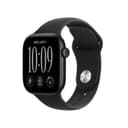
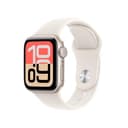
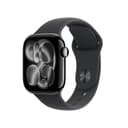
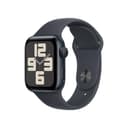
Size is the one spec you should judge on your own wrist, and Apple gives you the numbers to do it: the SE 3 specs state that the 40 mm case fits 130–200 mm wristsand the 44 mm case fits 140–245 mm. That is the most complete fit disclosure of any wearable we cover, and it takes a tape measure and ten seconds to use. Series 11 and Series 12 come in 42 mm and 46 mm cases.
Brightness is the other real difference: Series 11 and Series 12 publish up to 2,000 nits against the SE 3’s 1,000. In a gym that is invisible. On a bright road at midday it is the difference between glancing at a pace field and stopping to shade the screen. Series 10 remains the thinnest Apple Watch with the largest wide-angle display, which is why it is still worth buying at a discount if screen size is what you care about.
Who should skip the Apple Watch entirely
Three cases, stated plainly. If you own an Android phone, no Apple Watch will pair — that is the end of the conversation, not a workaround. If what you want is recovery and sleep data without a nightly charge, a ring or a band is the better machine for the job and costs less; we compare the form factors in smart ring vs smartwatch. And if your training is specifically running, a dedicated running watch publishes longer GPS endurance than any Apple Watch does — our running watch roundup ranks on exactly that.
One more honest limit on all five: these are wellness devices with some cleared medical features bolted on, not diagnostic instruments. Optical wrist heart rate is less reliable during high-intensity and strength work than a chest strap, which is why we still recommend a strap for interval training in our heart rate monitor roundup, and why chest strap vs wrist heart rate exists as its own page.
What we would buy
For most readers: the SE 3. It is the cheapest watch here, it has the always-on screen that used to be the reason to spend up, and the only things it gives up are two sensors most people check once and then never open again.
For anyone who wants the health stack: the Series 12, because it is the only model carrying hypertension notifications, sleep apnea notifications, a sleep score and a readiness score together, and because its charge speed is the only one on this page that makes overnight wear practical rather than theoretical. The Series 11 is the same 24-hour battery and the same ECG for less money, and the Series 10 is the value play if you find it discounted and do not need hypertension alerts. If your ceiling is lower than any of them, read best fitness trackers under $200 before you stretch.