How to choose a Samsung wearable
Three questions, and the first one is about your phone rather than the device.
1. Which phone is in your pocket?
This decides more here than it does with any other brand, because Samsung’s features are tiered against its own hardware. Both watches have an ECG, and Samsung publishes that it requires a paired Samsung Galaxy phone— so on a Pixel, a Motorola or an iPhone, the sensor is in the watch and the feature is not available to you. The Galaxy Ring’s full feature set likewise favours a Galaxy phone. And the Galaxy Fit3 is Android only: Samsung does not support iPhone pairing for it, so for an iPhone owner it is not a cheap option, it is not an option.
Also worth knowing: Samsung’s blood-pressure feature is not available in the USon these watches. If any of that is a dealbreaker, the honest answer is a different brand — best fitness trackers for iPhone and best fitness trackers for Android split the whole field by platform.
2. Watch, ring or band? That is a battery decision.
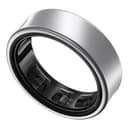
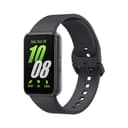
The published spread across these four is nearly fourteen to one, and it maps exactly onto how much screen you are carrying. The Fit3 publishes up to 13 days on a 208 mAh cell. The Galaxy Ring publishes up to 7 days. Both watches are about a day — 390 or 445 mAh on the Watch9, 300 or 425 mAh on the Watch 7.
That matters most for sleep. A watch you charge every evening is a watch that is not on your wrist at bedtime, which is the whole reason Samsung sells a ring. If sleep and recovery data is the main thing you want, buy the Galaxy Ringand stop reading — or read best sleep tracker bands for the cross-brand field. If you want notifications, workouts and a map on your wrist, buy a watch and plan the charger into your evening. The form-factor trade is argued properly in smart ring vs smartwatch.
3. BIA body composition is Samsung’s genuinely unique feature
Both watches carry bioelectrical impedance analysis, which estimates body fat, skeletal muscle and body water from a small current passed between two fingers and the watch. No other wearable in our registry offers it. That is a real point of difference and the main reason to prefer a Galaxy watch over a Pixel Watch or a Garmin on sensors alone.
Be realistic about it, though. Wrist BIA is sensitive to hydration, time of day and how recently you ate, so the useful thing is the trend over weekstaken under the same conditions — not any single reading, and not a number you should compare against a clinical body-composition scan. Treat it as a wellness metric like the stress score, which is how Samsung positions it. For context on what wrist sensors can and cannot know, how accurate are fitness trackers is worth reading first.
Watch9 or Watch 7? The honest answer
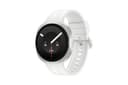
On published specs the two watches are closer than the price gap suggests. Both have built-in dual-frequency GPS, the ECG, SpO2, skin temperature and BIA, both are 5 ATM plus IP68, and both put their data in free Samsung Health with nothing paywalled.
What the Watch9 adds is Wear OS 7 with One UI 9 Watch, a Super AMOLED quoted at up to 3,000 nitspeak, a slightly larger battery in both case sizes, a MIL-STD-810H durability rating alongside the IP68, and the Snapdragon Wear Elite platform in a cushion-shaped case. Those are real upgrades — 3,000 nits is the difference between reading a pace field in direct sun and shading the screen with your hand — but none of them is a new sensor.
So: buy the Watch 7 unless screen brightness, the newer platform or the durability rating is specifically worth the difference to you. It is the better value of the two by a wide margin and it measures the same things. If you are choosing across brands rather than within Samsung, Apple Watch vs Samsung Galaxy Watch and Samsung Galaxy Watch vs Pixel Watch are the two comparisons that matter.
Who should skip Samsung
Three cases. iPhone owners, for the reasons above — the ECG will not run, the Fit3 will not pair, and the ring is at its best on a Galaxy phone. Anyone whose priority is days between charges with a real screen: Samsung does not make that device, and Garmin and Amazfit do, which is the argument in best fitness trackers with long battery life. And anyone who wants hypertension or sleep apnea notifications, which on this registry are Apple Watch features; see best ECG smartwatches for who publishes what.
One limit that applies to all four: these are wellness devices, not medical instruments, and optical wrist heart rate degrades during intervals and heavy lifting. If you train by heart rate, a chest strap is a better upgrade than any watch on this page, and a good one costs less than the Fit3 — see best heart rate monitors and chest strap vs wrist heart rate.
What we would buy
On a Galaxy phone with a nightly charger: the Galaxy Watch 7 for most people, because it measures exactly what the Watch9 measures for considerably less, or the Watch9 if a 3,000-nit screen and the newer platform are worth the premium. If you will not wear a watch to bed: the Galaxy Ring. If the brief is the cheapest thing that genuinely tracks: the Galaxy Fit3, up to 13 days per charge, nothing paywalled — and Android only.