How to choose a Garmin
Garmin’s own line-up is the hardest part of buying one — the names do not tell you what tier you are in, and two watches a hundred dollars apart can publish the same battery figure. Three questions sort it.
1. Built-in GPS or connected GPS? This is the real price break.
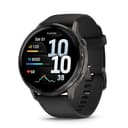
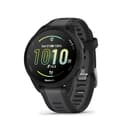
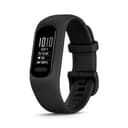
It is the one spec difference on this page that changes what you can physically do. The Venu 4, Venu 3 and Forerunner 165 all have a GPS receiver inside the watch: you leave the house with nothing but the watch and it records a route, a distance and a pace. The vivosmart 5 publishes “Connected GPS (uses phone)”— it has no receiver, so without a phone in your pocket there is no route and distance comes from the accelerometer.
For a gym-and-steps user that is a non-issue and the saving is real. For anyone who runs, rides or walks a route they care about, it is the reason to spend up to the Forerunner 165, whose published 19 hours of GPS battery is the only GPS-mode figure Garmin states for any watch on this page. We go deeper on the running-specific decision in best running watches.
2. Read the battery figure, then read which mode it is for
Garmin’s battery numbers are the brand’s biggest advantage over watchOS and Wear OS, which are both rated in hours rather than days — and they are also the easiest figure to misread. Every number in row one of the table above is smartwatch mode: screen on an interval, sensors sampling, notifications arriving, no GPS. Turn GPS on for a long session and all four come down hard.
The published ranking is clean: the Venu 3 at up to 14 days, the Venu 4 at up to 12 for the 45 mm case, the Forerunner 165 at up to 11, and the vivosmart 5 at up to 7. Note the direction of that list: the newer, more expensive Venu 4 publishes fewer days than the Venu 3 it replaced, because a brighter screen, multi-band GPS and a speaker all draw current. That is the kind of thing a spec sheet tells you and a product page does not. If days per charge is your whole reason for shopping, our long-battery roundup ranks the whole field on exactly that figure.
3. Decide whether you need the ECG app
Two of these four carry it. Garmin lists an FDA-cleared ECG appon the Venu 4 and the Venu 3, and does not list one on the Forerunner 165 or the vivosmart 5. As with every wrist ECG, this is a heart-rhythm feature rather than a training feature: the FDA’s De Novo classification for over-the-counter irregular-rhythm notification is what makes it more than a graph, and it is worth paying for if atrial fibrillation is something you have been told to watch for. It will not improve a single workout.
If the ECG is the feature you are shopping for rather than the brand, compare across makers first — best ECG smartwatches puts the Garmins next to Apple, Samsung, Google and Withings on the same row.
The subscription question, which is why people buy Garmin
All four watches here state the same thing in their specs: Subscription: none. Sleep stages, HRV status, Body Battery, stress, Pulse Ox, training load and the whole history are readable in the free Garmin Connect app. Garmin does offer a paid Connect+ tier with extra coaching and insight features on top, so “no subscription” means the device’s own metrics are not paywalledrather than “Garmin sells nothing by the month”.
That distinction is the whole reason this brand keeps showing up in our no-subscription picks. A competing band can cost less up front and then rent you your own sleep score; over three years that is the larger number. We do the arithmetic in best fitness trackers without a subscription, where the vivosmart 5 is the overall pick for exactly this reason.
Who should skip Garmin
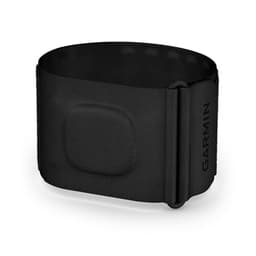
Three honest cases. If you want a watch that answers texts, takes calls well and runs the apps your phone runs, a Wear OS or watchOS watch does that better — Garmin’s strength is sensors and battery, not a phone on your wrist. If you want sleep and recovery data without wearing a watch to bed, Garmin itself makes the better answer in a different shape, and it is in the accessory strip below. And if the Venu-tier price is the problem, do not drop to the vivosmart 5 expecting a small Venu — it is a monochrome band with no GPS receiver. Look at what $200 buys across all brands instead.
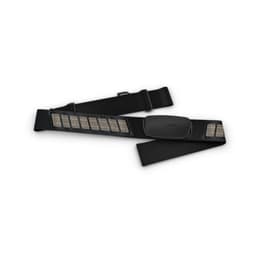
One limitation that applies to all four: wrist optical heart rate is the weakest sensor on any of these watches during intervals and heavy lifting, where the wrist moves and the muscle tenses. Garmin’s own ecosystem solves it by pairing a chest strap, which is why one sits in the accessories below and why chest strap vs wrist heart rate is worth five minutes before you train by heart rate at all.
What we would buy
The Venu 4 if you want one device for everything and will pay for it; the Venu 3 over it if you find the older model discounted, because you gain two published battery days and keep the ECG; the Forerunner 165 if running is the point and you want the only published GPS-mode endurance figure here; and the vivosmart 5if the job is steps, sleep and Body Battery on a slim band for the least money — with your phone in your pocket on run days.