How to choose your first yoga mat
1. Thickness: 5 to 6 mm, and here is why
Thickness is the spec that decides whether your first few sessions are uncomfortable, and the beginner answer is different from the experienced one.
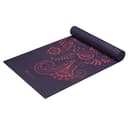
A new practitioner spends a disproportionate amount of time with a knee, a shin or a wrist pressed into the floor: table top, cat-cow, low lunge, kneeling twists, the transitions that a more flexible body passes through quickly. On a hard floor, a thin mat makes those positions hurt, and “yoga hurt my knees” is a very common reason people stop after three weeks. 6 mm— the Gaiam and the Manduka PRO — is genuinely more comfortable there.
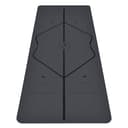
The counter-argument is balance, and it is real but overstated for a beginner. A thicker mat is a slightly less stable platform in standing poses, which is why experienced practitioners often prefer 4–5 mm and why the Liforme sits at about 4.2 mm. At the point where tree pose on a 6 mm mat is the thing limiting you, you will know enough to choose your second mat on your own terms. Until then, cushioning wins. Our yoga mat thickness guideworks through the whole range, including when 3 mm and 1 mm make sense.
2. Grip: match the mat to how much you sweat, not to the reviews
Grip in this category is decided by one physical property, and once you know it the marketing becomes readable.
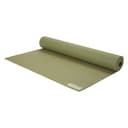
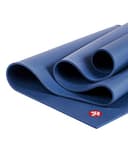
Open-cellsurfaces — natural rubber, like the JadeYoga — have pores that take up moisture, so they get grippier as you get damp. That is why rubber is the standard recommendation for sweaty or heated practice. Closed-cellsurfaces keep moisture out, which makes them hygienic and easy to wipe, and which also means sweat sits on top. Manduka states this consequence itself, plainly, in its own Use & Care notes: “Because the PRO’s closed-cell surface does not absorb moisture, the mat may feel slick if you’re prone to sweat,” and it recommends pairing the mat with a towel. Polyurethane tops— the IUGA and the Liforme — are engineered to grip wet, and Liforme publishes a non-absorbent barrier layer between the PU top and the rubber base that stops sweat reaching the rubber.
For a beginner in a normal-temperature room, the Gaiam’s moderate grip is fine. For a beginner who sweats heavily or has booked a warm class, go to the Jade or the IUGA and skip the learning experience. If the class is genuinely hot yoga, read yoga mats for hot yogainstead — it is a different problem with a different answer.
3. Measure yourself against the mat
The standard yoga mat is 68 inlong, and the standard mat is too short for a lot of adults. The test is simple: in savasana, your heels and the back of your head should both be on the mat. At about 5 ft 10 in and above, a 68 in mat puts one of them on the floor.
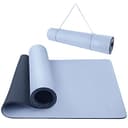
Three mats here are longer. The IUGA publishes 72 in, the Liforme 72.8 in, and the Manduka PRO 71 in with the widest standard width of the budget-to-mid group at 26 in. Width matters less than length for most people, but it matters in wide-legged poses and in anything where your hands go outside your shoulders. For a taller beginner, the IUGA is the obvious pick: it is the only mat here that is both long and mid-priced, and it ships with a carry strap.
4. Weight, if the mat has to leave the house
This is the spec that quietly decides whether a mat gets used, and it only matters if you are going to a class. The published range here is wide: the Gaiam is about 3.3 lb, the Jade about 5.2 lb, the Liforme about 5.5 lb and the Manduka PRO about 7.5 lb.
Seven and a half pounds is a real weight to carry on a bike or a fifteen-minute walk, twice a week, and Manduka does not pretend otherwise — it is a studio-and-home mat rather than a travel one. If your mat lives rolled up in a corner of your own living room, ignore this section entirely. If it goes in a bag, the Gaiam is the only mat here that is genuinely light.
5. Ignore the folk remedies
One piece of advice circulates constantly for new mat owners and the maker it is most often aimed at explicitly rejects it. The “salt method” — scrubbing a new mat with coarse salt to break in the surface — is widely recommended for the Manduka PRO. Manduka’s own position is unambiguous: “We don’t recommend the salt method or other treatments, and no special preparation is required.”
Take that at face value and it clarifies the whole beginner question. The PRO’s surface changes with use rather than with treatment. If you want a mat that grips immediately, the answer is not to abrade an expensive mat — it is to buy a mat whose surface grips immediately. That is the ranking on this page.
What you do not need to buy yet
Three things to skip on a first purchase, and one worth having. Skip blocks and a strap until a teacher tells you which you need; most studios have both, and a stack of books works at home. Skip a mat bag— the IUGA’s included strap is the whole function. Skip a premium mat: the honest case for the Manduka and the Liforme is that they are mats you buy when you know you are staying, and the Manduka’s published lifetime guarantee is what makes that a reasonable bet rather than a splurge.
The thing worth having is a towel, and not only if you buy the Manduka. A thin hand towel across the top third of the mat solves slippery palms in down dog on any mat, costs almost nothing, and washes.
Beyond the mat, the useful next purchases are not yoga-specific at all: a foam roller does more for tight hips and a stiff back than any mat upgrade will. And if you are assembling a first home setup more broadly, our fitness equipment for beginners guide covers the order to buy in — yoga is one of the few activities where the federal recommendation of muscle-strengthening work on two or more days a week can be met with no equipment beyond something comfortable to kneel on.
When to upgrade, and to what
Keep your first mat until one specific thing happens: you notice yourself working around it. Sliding in down dog every session, bracing against a mat that has gone soft, or avoiding a pose because the surface is not stable enough. That is the signal, and it usually arrives somewhere between six months and two years.
At that point the choice is readable. If the problem is grip, go to natural rubber or a PU top — the Manduka PRO vs Liforme and JadeYoga Harmony vs Manduka PRO comparisons are the two decisions most people face. If the problem is that the mat has worn out in a year, the durability answer is the Manduka. If the material itself has become the question, our eco-friendly yoga mats page ranks on what each maker will put in writing. And the full field, unfiltered, is in best yoga mats.