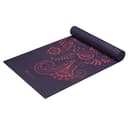
How to choose a mat for a heated room
Open cell and closed cell is the whole argument
Two mats can be the same thickness, the same size and the same price and behave completely differently in a 95-degree room, and the reason is whether the top surface is open or closed. An open-cell surface has microscopic texture that moisture can sit inside. Sweat gets drawn into that texture and the mechanical grip survives — which is exactly what JadeYoga is describing when it lists its Harmony mat’s grip as open-cell natural rubber. A closed-cell surface is sealed. Nothing goes in, which is why Manduka can promise that sweat, moisture and bacteria stay out of the mat and that it wipes clean, and it is also why water sits on top of it in a film. A film of water between your palm and a sealed surface is, mechanically, a lubricant.
The practical reading is simple. For a hot class, pick open-cell rubber or a polyurethane top. For a dry class on a floor you want to protect for ten years, or for a mat that gets shared and needs disinfecting, closed-cell PVC is the better engineering. Neither is a bad mat. They are opposite answers to the same question, and the only way to get this wrong is not to know which one you bought.
Polyurethane tops are the modern hot-yoga answer
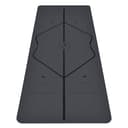
Both of the top two mats here use a polyurethane layer rather than bare rubber, and the reason is that PU gets tackier as it dampens rather than slicker. Liforme has gone furthest in publishing how its mat is built: a natural rubber base for strength and cushioning, an ultra-thin eco-polyurethane top, and in between a patented CleanGrip layer the company calls non-absorbent and credits with stopping sweat reaching the rubber. That middle layer is a hygiene claim as much as a grip claim — an absorbent rubber base in a heated studio is the thing that eventually smells.
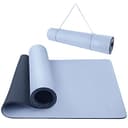
The IUGA mat gets to a similar place for a fraction of the money with a polyurethane-topped surface listed as moisture-wicking, at 72 x 24 in with a carry strap in the box. The honest caveats are in the listing too: 5 mm is firmer under the knees than a 6 mm mat, PU tops wear with heavy daily use, and the grip needs an occasional wipe-down to stay what it was. If this is your first heated-class mat and you are not sure the habit will stick, it is the sensible buy.
Natural rubber: the grip you pay for in smell and allergy
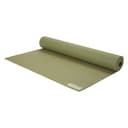
The JadeYoga Harmony is the purist’s hot-yoga mat and it comes with two published warnings worth knowing before you buy. JadeYoga states the mats contain no PVC, EVA or other synthetic rubber and are made in the United States from rubber tapped from rubber trees — and that, while they are “99% latex free,” there “may be trace amounts of latex proteins in the mats so we recommend persons with latex allergies avoid contact.” If anyone in your household has a latex allergy, that line settles it; the Manduka PRO and the Gaiam are both listed as latex-free.
The second warning is about storage, and it catches people who practise outdoors in summer: JadeYoga says the mats “are not intended for use outdoors and should not be exposed to sunlight.” Natural rubber degrades under UV. A mat left in a hot car or on a sunny balcony is being damaged. JadeYoga also carries a third-party accolade on its own page — it says the Harmony was “Named Best Mat for Grip by Yoga Journal for 2024.” We pass that on as the maker’s claim, attributed, because it is not a test of ours and we do not issue awards.
What the thickness actually changes here
Thickness is the spec buyers ask about first and it is close to irrelevant to the question this page answers. What it changes is stability versus cushioning: the 4.2 mm Liforme and the 5 mm Jade and IUGA mats put you closer to the floor, which makes standing balances steadier, while the 6 mm Manduka and Gaiam are kinder to knees and wrists and slightly more wobbly in a single-leg pose. In a heated class, where you are moving continuously and sweating, we would take the stability. If your knees are the limiting factor rather than your grip, we have written the trade-off up properly in our yoga mat thickness guide.
Weight matters more than people expect if you are carrying the mat to a studio. The 7.5 lb Manduka PRO is a mat you leave in one place; the 3.3 lb Gaiam is the easiest to carry and the weakest when wet, which is an unfortunate combination for a studio mat. The Liforme at about 5.5 lb and the Jade at about 5.2 lb sit in the middle.
The towel question, and the salt method
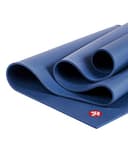
A yoga towel over the mat is not an admission of defeat — for a closed-cell mat in a heated room it is the maker’s own recommendation, and Manduka names the products it suggests pairing with the PRO. If you already own a PRO and have just signed up for hot classes, buying a towel is a far better decision than buying a second mat.
One widely repeated piece of folk advice is worth killing here, because Manduka kills it on its own page. The “salt method” — scrubbing a new PRO with coarse salt to break in the surface — is explicitly not endorsed by the manufacturer: “We don’t recommend the salt method or other treatments, and no special preparation is required.” What Manduka recommends instead is simply practising on the mat. If you were planning to treat a new mat with anything, check the maker’s care notes first; on a polyurethane top in particular, an abrasive or an oily cleaner is how you destroy the grip you paid for.
Which one to actually buy
If hot yoga is your main practice and you will keep the mat for years, buy the Liforme and accept the price — the published construction is the most deliberate answer to wet grip in this group, and the alignment markings are useful in a room where you cannot see the front of the class through the steam. If you want the same grip philosophy without polyurethane, buy the JadeYoga Harmony, with the latex and sunlight caveats above. If you are trying heated classes and do not want to spend premium money yet, buy the IUGA. If you already own the Manduka PRO, keep it and buy a towel. And if the Gaiam is what is in your budget, buy it with clear eyes: its own listing says the grip fades once you sweat, so plan on a towel from day one. The wider field, ranked without the heat, is in our main yoga mat roundup, and the two premium grip mats go head to head in JadeYoga Harmony vs Manduka PRO.