JadeYoga Harmony vs Manduka PRO
Open-cell natural rubber against closed-cell PVC. These are not two versions of the same mat - they are opposite answers to sweat, and each maker states which one it built.
These are the two mats people land on when they decide to stop buying cheap mats, and the comparison is usually framed as premium-versus-premium. It is not. The Jade Harmony and the Manduka PRO are built on opposite decisions about one variable — whether the top surface lets moisture in — and that single difference decides which of them is right for you, how long it lasts, what it weighs, how you clean it and whether anyone in your house can safely touch it.
Everything below comes from the two makers’ own product pages, read on 2026-10-05, plus the Amazon listings linked under each card. We own neither mat and have tested neither. The useful thing about this particular pair is that both companies are unusually direct about the trade they have made, including Manduka, which publishes the one sentence most reviews of the PRO leave out.
How this is funded: we earn a commission if you buy through our links, at no extra cost to you. It never changes which product we recommend, and we’ll tell you when we’d skip one. Full disclosure.
| Feature | JadeYoga Harmony | Manduka PRO |
|---|---|---|
| Top surface | Open-cell natural rubber | Closed-cell PVC |
| What the maker says about sweat | Grip and traction are the headline claim; the surface takes moisture in | Keeps sweat and moisture out of the mat - and 'may feel slick if you're prone to sweat' |
| Thickness | 3/16 in (about 5 mm) | 6 mm |
| Dimensions | 68 or 74 in long x 24 in wide | 71 x 26 in (Standard) |
| Weight | About 5 lb | 7.5 lb (3.4 kg) |
| Material | Natural rubber, no PVC or EVA | PVC, made in Germany |
| Latex | 99% latex free; trace latex proteins possible | Latex-free |
| Certification | Not published | STANDARD 100 by OEKO-TEX (12.HUS.17706) |
| Warranty | Not published | Lifetime guarantee (Manduka) |
| Sunlight | Not for outdoor use; keep out of sunlight | Not published |
| Made in | United States | Germany |
| Towel needed for hot yoga | No | Yes, per Manduka |
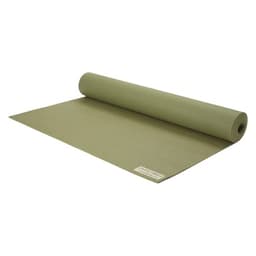
JadeYoga Harmony
JadeYoga Harmony Yoga Mat
Buy this if: You sweat, you practise vinyasa or heated classes, and grip is the thing you are actually buying. Also the pick if you want a mat with no PVC in it, made in the United States.
Strengths
- Open-cell natural rubber: the surface type that keeps mechanical grip as it dampens
- 3/16 in thick, 24 in wide, 68 in or 74 in long and about 5 lb - lighter than the PRO to carry
- JadeYoga states the mats contain no PVC, EVA or other synthetic rubber and are made in the USA
- The maker's page cites a 2024 Yoga Journal 'Best Mat for Grip' accolade (JadeYoga's claim, not a test of ours)
Trade-offs
- JadeYoga states the mats are '99% latex free' but may contain trace latex proteins, and advises people with latex allergies to avoid contact
- JadeYoga states the mats are not for outdoor use and should not be exposed to sunlight
- Natural rubber has a distinct smell, and an absorbent surface is the one that eventually holds odour
- Less durable than closed-cell PVC under heavy daily use
Price as of October 12, 2026. #ad How we’re funded
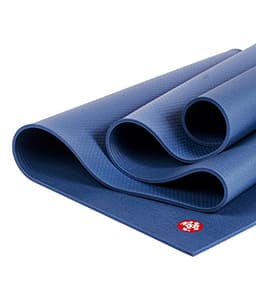
Manduka PRO
Manduka PRO Yoga Mat
Buy this if: You want to buy one mat and stop thinking about mats. Dry practice, a hard floor you want protected, 6 mm under the knees, and a surface you can disinfect properly.
Strengths
- Dense 6 mm cushioning at 71 x 26 in - the most joint protection of the two
- Closed-cell surface that Manduka says keeps sweat, moisture and bacteria out of the mat and wipes clean
- PVC crafted in Germany, certified STANDARD 100 by OEKO-TEX (12.HUS.17706), latex-free
- Manduka publishes a lifetime guarantee on it
Trade-offs
- Manduka itself warns the mat 'may feel slick if you're prone to sweat' and recommends pairing it with a hand towel
- 7.5 lb (3.4 kg) - a mat you leave in one place rather than carry to class
- Manduka rejects the salt method and says no preparation is required, so the grip is what it is from day one
- Premium price, and a PVC mat rather than a natural-material one
Price as of October 12, 2026. #ad How we’re funded
The one difference everything else follows from
Open-cell and closed-cell describe whether the mat’s top surface is porous. The Jade Harmony’s natural rubber surface is open: it has microscopic texture that moisture can enter, so when your palms sweat the water is drawn into the surface and the mechanical grip between skin and rubber survives. The Manduka PRO’s surface is sealed, which is precisely what Manduka is selling — a “hygienic, closed-cell surface” that “keeps sweat, moisture, and bacteria out of your mat, making it easy to clean and maintain for long-term performance.”
Both of those are real engineering achievements aimed at different problems. Sealed surfaces last longer, resist bacteria, survive being wiped with something stronger than water, and do not degrade from the inside. Porous surfaces grip when wet. You cannot have both in one layer, which is why the premium mats that try to deliver both — including the Liforme, with its patented non-absorbent barrier layer between a polyurethane top and a rubber base — do it by stacking three layers instead of two. We cover that mat in best yoga mats for hot yoga and head to head with the PRO in Manduka PRO vs Liforme.
What the Jade gives up
Two of JadeYoga’s own statements should settle the decision for some readers before grip enters into it. The first is about latex: the company says that although “Jade mats are 99% latex free,” because they come from rubber trees “there may be trace amounts of latex proteins in the mats so we recommend persons with latex allergies avoid contact with our mats.” If that is you, or someone you share a home with, the PRO is latex-free and the decision is made.
The second is about storage. JadeYoga states the mats “are not intended for use outdoors and should not be exposed to sunlight.” Natural rubber degrades under UV, so a mat that lives in a hot car boot or dries on a sunny balcony is being used up. Manduka publishes no equivalent warning for the PRO. If your practice is outdoors in summer, that is a durability difference you will feel within a season.
There is also the smell, which is an honest cost of a natural material rather than a defect, and the general durability gap: a porous surface in daily use wears faster than a sealed one, and only one of these two mats comes with a lifetime guarantee.
What the Manduka gives up
Grip when wet, and weight. The grip part is not our assessment to make — Manduka makes it: “Because the PRO’s closed-cell surface does not absorb moisture, the mat may feel slick if you’re prone to sweat. We recommend pairing it with an Equa or Yogitoes hand” towel. Read that as a system rather than a flaw. Manduka sells the mat and the towel because together they do what the Jade does alone, with better hygiene and far better longevity.
It is also worth knowing what Manduka says about the famous break-in ritual, because it contradicts most of the advice on the internet: “We don’t recommend the salt method or other treatments, and no special preparation is required.” The company’s recommendation is simply to practise on the mat regularly. If you were planning to scrub a new PRO with coarse salt to make it grip, the manufacturer is telling you not to.
Then there is the 7.5 lb. That is the dense-cushioning tax and it is the single best reason to choose the Jade if you carry your mat to a studio twice a week. For a mat that lives unrolled in a spare room, it is irrelevant — and the extra millimetre of thickness is the better deal for knees and wrists. Our yoga mat thickness guide sets out that trade-off across the whole range.
Price is the one thing we will not fix in writing
Both mats sit in the premium band and both move around on price, which is why every figure on this page comes from the live price layer with the date stamped under the button rather than being typed into the copy. Check both numbers before you decide: at some points in the year these two are close enough that the specs decide it, and at others the gap is wide enough to decide it for you. If both are more than you want to spend, the honest alternative is the polyurethane-topped IUGA for wet grip or the Gaiam for cushioning on a budget, and both are in our main yoga mat roundup.
Our call
If you sweat — and most people who end up on this page are here because they are sliding on a mat they already own — the Jade Harmony is the answer, with the latex and sunlight caveats understood. If you are buying the last yoga mat you intend to purchase, want 6 mm under your knees, want to be able to disinfect it properly, and are willing to lay a towel over it for hot classes, the Manduka PRO is the better object and the better long-term purchase. There is no wrong answer here, only a wrong match.
Frequently asked questions
Which is better for hot yoga, the Jade Harmony or the Manduka PRO?
The Jade Harmony, and Manduka's own product page is why. Jade's open-cell natural rubber keeps mechanical grip as it dampens, while Manduka describes a closed-cell surface that keeps moisture out of the mat and then warns that it 'may feel slick if you're prone to sweat', recommending one of its hand towels alongside it. The PRO is the better-built mat; the Jade is the right mat for a heated room.
Which lasts longer?
Almost certainly the Manduka PRO. A sealed closed-cell PVC surface does not take moisture into the material, resists bacteria and tolerates proper cleaning, and Manduka publishes a lifetime guarantee on the mat. JadeYoga publishes no warranty figure we can cite, and adds that its mats should not be exposed to sunlight because natural rubber degrades under UV. If longevity is the priority, that is a clear result.
Is the Jade Harmony safe if I have a latex allergy?
JadeYoga's own guidance is to avoid it. The company states the mats are '99% latex free' but that, as they come from rubber trees, 'there may be trace amounts of latex proteins in the mats so we recommend persons with latex allergies avoid contact with our mats'. The Manduka PRO is listed as latex-free, which makes it the straightforward choice in that situation.
How thick is each mat?
JadeYoga publishes 3/16 in for the Harmony, which is about 5 mm, at 24 in wide in 68 in and 74 in lengths. Manduka publishes 6 mm for the Standard PRO at 71 x 26 in. The extra millimetre on the PRO is more cushioning for knees and wrists; the Jade's slightly lower profile feels marginally more stable in standing balances.
Should I use the salt method on a new Manduka PRO?
No, according to Manduka. Its care notes say plainly: 'We don't recommend the salt method or other treatments, and no special preparation is required.' The company's advice is to practise on the mat regularly, and it notes that while some people call this a break-in period, nothing special needs doing to the surface.
Which is easier to carry to a class?
The Jade, by about 2.5 lb. JadeYoga publishes roughly 5 lb for the Harmony; Manduka publishes 7.5 lb (3.4 kg) for the Standard PRO and 9.5 lb for the Long version. That is the main practical reason to pick the Jade if your mat commutes - and the main reason the weight is irrelevant if your mat lives in one room.
Can I use either mat outdoors?
Not the Jade - JadeYoga states the mats 'are not intended for use outdoors and should not be exposed to sunlight', because UV degrades natural rubber. Manduka publishes no equivalent restriction for the PRO, and a closed-cell PVC surface is less vulnerable to moisture, though we would still not store any mat in direct sun or a hot car.
Sources
- JadeYoga — Harmony Mat — JadeYoga publishes 3/16 in thick, 24 in wide, 68 in and 74 in lengths, about 5 lb, natural rubber tapped from rubber trees, and 'no PVC, EVA or other synthetic rubber', made in the United States. Two cautions are the maker's own: the mats 'are not intended for use outdoors and should not be exposed to sunlight', and although 'Jade mats are 99% latex free... there may be trace amounts of latex proteins in the mats so we recommend persons with latex allergies avoid contact'. The page also carries JadeYoga's claim to have been 'Named Best Mat for Grip by Yoga Journal for 2024' - a third-party award, reported here as the maker's claim and not as a test of ours (accessed October 5, 2026)
- Manduka — PRO Yoga Mat 6mm — Manduka's own product page, and the most useful admission any mat maker makes: 'A hygienic, closed-cell surface keeps sweat, moisture, and bacteria out of your mat', and then, under Use & Care, 'Because the PRO's closed-cell surface does not absorb moisture, the mat may feel slick if you're prone to sweat. We recommend pairing it with an Equa or Yogitoes hand' towel. Manduka also rejects the folk break-in method outright - 'We don't recommend the salt method or other treatments, and no special preparation is required' - and publishes Standard 71 in x 26 in, 7.5 lb (3.4 kg), PVC crafted in Germany, latex-free, certified STANDARD 100 by OEKO-TEX (12.HUS.17706 | Hohenstein), with a lifetime guarantee (accessed October 5, 2026)
- Liforme — CleanGrip Technology — Liforme's own description of the three-layer build that decides how its mat behaves wet: 'a stable, sustainably sourced natural rubber base, providing strength and cushioning', an 'ultra-thin top layer... crafted from our proprietary eco-polyurethane', and between them 'our patented CleanGrip barrier layer. A non-absorbent' sheet that stops sweat reaching the rubber. Liforme's published specification for the Original mat is 185 cm x 68 cm, approx. 4.2 mm thick, approx. 2.5 kg (accessed October 5, 2026)
Keep reading
Best Eco-Friendly Yoga Mats
Natural rubber against certified PVC across the whole field, not just these two.
See the picksBest Yoga Mats for Hot Yoga
Five mats ranked on what the maker says the surface does when it is wet.
See the hot-yoga picksBest Yoga Mats
The whole field, including the budget mats these two are a step up from.
See all the picksManduka PRO vs Liforme
The PRO against the three-layer polyurethane mat built specifically for sweat.
Compare theseYoga Mat Thickness Guide
5 mm vs 6 mm is a stability-versus-cushioning trade, not a quality one.
Pick a thickness