Elliptical vs Treadmill
Zero impact and quiet, or weight-bearing and specific? The two machines compared on joints, noise, space, upper body work and what each one actually trains.
These two machines get cross-shopped constantly because they answer the same question — how do I get 30 minutes of cardio at home — in opposite ways. A treadmill makes you carry your bodyweight and land on it thousands of times. An elliptical never lets your feet leave the pedals, so the landing simply does not happen.
That single difference drives everything else: noise, joint load, what the machine trains, and whether the people downstairs notice. Here is how they actually compare, using the Sunny 16 in elliptical and the Horizon T101 as the reference machines, because both sit in the same mid-price band and neither requires a subscription.
How this is funded: we earn a commission if you buy through our links, at no extra cost to you. It never changes which product we recommend, and we’ll tell you when we’d skip one. Full disclosure.
| Feature | Elliptical | Treadmill |
|---|---|---|
| Joint impact | None - feet stay on the pedals | Weight-bearing, repeated landings |
| Noise | Magnetic, near-silent | Motor plus footfall |
| Upper body | Moving handles involve arms and back | Legs only |
| Incline / hills | Resistance levels only | 0-10% powered incline |
| Folds away | No | Yes (hydraulic deck) |
| Footprint | 48 x 25.8 in | Folds, but longer in use |
| Subscription | None (SunnyFit app is free) | None required |
| Best for | Joints, flats, all-body low impact | Walkers, runners, incline training |
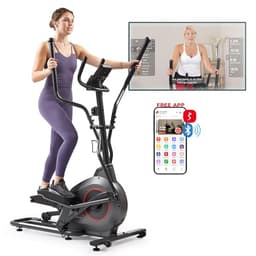
Elliptical
Sunny Health & Fitness Upright Magnetic Elliptical (16 in Stride)
Buy this if: you want low-impact cardio that is quiet enough for a flat, and you like the arms being involved.
Strengths
- Zero landing impact - the feet never leave the pedals
- Moving handles recruit the upper body as well as the legs
- Magnetic resistance is near-silent, with no motor and no belt noise
- 16 resistance levels give a wide intensity range without changing speed
Trade-offs
- Does not fold, and the footprint is fixed at 48 x 25.8 in
- Standing on the pedals adds 8-10 in to your height - check ceilings
- Stride length is fixed, so the machine has to fit your legs
Price as of October 13, 2026. #ad How we’re funded
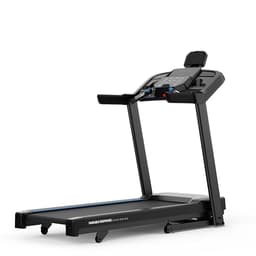
Treadmill
Horizon Fitness T101 Treadmill
Buy this if: you walk or run outside and want the training to transfer, or you want incline work.
Strengths
- Weight-bearing, which is the closest match to walking and running outdoors
- 2.5 CHP motor with 0-10% powered incline for hill work
- FeatherLight hydraulic deck folds up to give the floor back
- No subscription required to use the machine
Trade-offs
- Every step is an impact - the hardest machine here on knees and hips
- A motor plus footfalls makes it the loudest option for shared floors
- 55 in belt crowds taller runners at faster paces
Impact is the whole argument
Running is a series of controlled landings, each one loading the ankle, knee and hip. That loading is not inherently bad — it is part of why weight-bearing exercise supports bone density — but it is the reason a treadmill aggravates an already-sore knee and an elliptical usually does not. If you are managing a joint problem, coming back from injury, or simply carrying more weight than you want to land on repeatedly, the elliptical removes the variable entirely while still letting you work hard enough to hit the federal guideline of 150 to 300 minutes of moderate activity a week.
The flip side matters too. If you are training forwalking or running — a first 5K, a hiking trip, staying steady on your feet as you age — the treadmill is the specific tool. An elliptical will build the engine but not the landing mechanics.
Noise, and the neighbors
An elliptical makes essentially two sounds: the belt drive turning and the pedals moving. There is no motor, no impact, and nothing being dropped. A treadmill adds a motor under load plus your own footfalls transmitting straight into the floor — which is why the treadmill is the machine that generates complaints in flats. If the room is above someone else’s ceiling, that alone can settle the decision; our quietest cardio machines guide covers the mats and placement that help with either machine.
What each one trains
The elliptical’s moving handles genuinely involve the upper body, so a session spreads the effort across more muscle. That makes a given heart rate feel easier to hold, which is useful for long steady work and a common reason people find ellipticals more sustainable. A treadmill is legs-only, but adds incline: at 8 to 10% grade, walking becomes a serious effort without any running at all, which is the best trick in this comparison for people who want intensity without impact on a treadmill.
Space, storage and stairs
The treadmill folds; the elliptical does not. If the machine has to disappear between sessions, that is decisive. But note the other half of the story: a folded treadmill is still a heavy object in the room, and treadmills are the harder of the two to move upstairs. Ellipticals are lighter than their size suggests and roll on transport wheels once assembled.
Cost over time
Neither reference machine requires a subscription, which is the main ongoing cost trap in connected cardio. Beyond purchase, treadmills carry the higher maintenance burden: belts need lubricating and eventually replacing, and motors are the part that fails. An elliptical’s magnetic resistance has no contact wear at all. If you want the connected-class experience on either, price the membership across two years before deciding — we work that arithmetic through in how much a home gym costs.
The honest verdict
Most people buying their first home cardio machine for general fitness, weight management and joint-friendly conditioning are better served by the elliptical — it is quieter, kinder and involves more of the body. Buy the treadmill when walking or running is the actual goal, when you want incline as your intensity dial, or when the machine has to fold flat. If you are still torn, the third option is worth a look: a rower asks even more muscles for the same minute and is quieter than both, which we cover in the types of rowing machines.
Frequently asked questions
Does an elliptical or a treadmill burn more calories?
For the same perceived effort they are close, with the treadmill usually edging it because you are carrying your bodyweight. The bigger factor is which one you will do for 30 minutes, four times a week. An elliptical that gets used beats a treadmill that gets folded away.
Is an elliptical good for bad knees?
It is the standard recommendation for exactly that reason: the pedals move with your feet, so there is no landing impact. Balance and hip range still matter, and if standing for the session is itself the problem, a recumbent cross trainer or an exercise bike is the better call.
Which is quieter for an apartment?
The elliptical, clearly. It has no motor and no impact, so what you hear is a belt drive. A treadmill adds motor noise plus footfalls straight into the floor structure, which is what neighbors below actually notice.
Can you run on an elliptical?
You can move fast on one, but it is not running: your feet stay in contact with the pedals throughout. If your goal is running outdoors or a race, train on a treadmill or outside and use the elliptical as low-impact volume on recovery days.
Which takes up less space?
The treadmill, once folded — its deck lifts and locks upright. In use it is longer than an elliptical. An elliptical does not fold at all, so it needs a permanent 4 x 2.5 ft patch of floor plus room to step on and off.
Sources
- U.S. HHS / ODPHP — Physical Activity Guidelines for Americans (2nd ed.) — Federal guideline: 150–300 min/week moderate aerobic + muscle strengthening 2+ days (accessed July 19, 2026)
- American Heart Association — Recommendations for Physical Activity in Adults — AHA's 150 min/week moderate aerobic + 2 days strength recommendation (accessed July 19, 2026)
- CDC — Adult Activity: An Overview — CDC on muscle-strengthening 2+ days/week, 8–12 reps, all major muscle groups (accessed July 19, 2026)
- Horizon Fitness — Connected tech — “Horizon Fitness does not require any subscription services to operate your fitness equipment” (accessed July 20, 2026)
Keep reading
Best ellipticals
Five home ellipticals compared on stride length, resistance and weight capacity, with live prices.
See the elliptical picksBest treadmills
Motors, belt sizes and folding decks compared - including which ones need a subscription.
See the treadmill picksTreadmill vs exercise bike
The other classic cardio decision, compared on impact, footprint and cost.
Compare those twoQuietest cardio machines
What makes a machine loud, and the quietest option in each category for shared walls.
Read the noise guide