How to choose an elliptical
Four specs decide whether you keep using the machine. Everything else — screens, apps, preset programs — is a preference.
Stride length
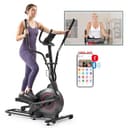
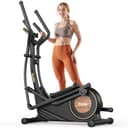
This is the distance the pedals travel front to back, and it is the single number that separates a natural gait from a stunted one. Commercial gym machines run around 20 in. At home, 16 in suits most adults, 18 in suits taller users, and anything near 11 in will feel tight and circular unless you are shorter than about 5 ft 6 in. Manufacturers rarely advertise the shortfall — they advertise the price — so read the stride figure before anything else. Where a maker states a maximum user height, as Niceday does at 6 ft 4 in, treat it as the maker’s claim rather than a measured result, but do use it as a sizing hint.
Resistance: how many levels, and how they are made
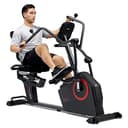
Every machine here uses magnets rather than friction pads, which is why they are quiet and why nothing wears out rubbing. What varies is granularity: 8 levels is a coarse ladder that a fit user climbs out of, 16 levels gives you somewhere to go. Electromagnetic resistance, on the recumbent model, is adjusted by the console rather than a knob, which is what makes preset interval programs possible.
Weight capacity and frame
On a machine you stand and push on, capacity is a stability spec as much as a safety limit. The Niceday publishes 400 lb on a carbon steel base; the seated Sunny publishes 300 lb; both Sunny uprights leave capacity unpublished on the listing, which we flag on the spec tables rather than guess at. If you are close to any published limit, size up — a frame flexing under you is the fastest route to a machine you stop using. Our high-capacity equipment guide works through this in more detail.
Footprint, and where it will actually live
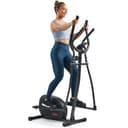
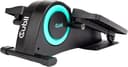
Ellipticals do not fold. A 48 x 25.8 in upright needs that floor plus room to stand on it, and the recumbent cross trainer is 71.7 in long — longer than most rowing machines. Measure before you buy, and remember you need clearance above your head too: standing on the pedals adds roughly 8 to 10 in to your height. If the room genuinely will not take a standing machine, the under-desk option is not a compromise so much as a different job description.
Elliptical vs the other cardio machines
An elliptical wins on joint impact and noise, and it involves the arms, which treadmills do not. A treadmill wins on specificity if you want to walk or run outdoors, and it is easier to push to a genuinely hard effort. A bike wins on footprint and on price per pound of machine. A rower wins on how much muscle it recruits per minute. We compare the two closest calls directly in elliptical vs treadmill, and the noise question across every machine type in the quietest cardio machines.
What you are not buying
None of these machines needs a subscription to work, and we would not recommend one that did without saying so. Sunny’s app library is free; the Niceday connects to Kinomap, whose own plans are paid, so treat that as a bonus rather than a feature you are buying. Check the warranty term for the exact model too: Sunny’s published policy covers cycles, rowers and treadmills at three years on the frame and 180 days on parts, with labor and shipping excluded, while the compact elliptical listing states one year on the structural frame. Those are different terms for machines from the same brand, which is exactly why we read them per product.