Water vs Magnetic Rowing Machine
One sounds like a boat and scales with how hard you pull; the other is near-silent and folds away. How water and magnetic rowers actually differ on feel, noise, upkeep and price.
Rowers are sorted by how they make you work, and the two most cross-shopped types are water and magnetic. A water rower drags paddles through a tank, so resistance rises the harder you pull — and it makes the whoosh people either love or cannot live with. A magnetic rower moves a magnet nearer a steel flywheel, so resistance is set by a lever and stays put no matter how hard you pull.
Both are in the rowing machine roundup, and here they are side by side: Sunny’s Obsidian Surge water rower against Sunny’s own SF-RW5515 magnetic machine, so brand and support are held constant and only the resistance type varies.
How this is funded: we earn a commission if you buy through our links, at no extra cost to you. It never changes which product we recommend, and we’ll tell you when we’d skip one. Full disclosure.
| Feature | Water | Magnetic |
|---|---|---|
| Resistance source | Water tank, 16 blades | Magnet near a flywheel, 8 levels |
| Scales with effort | Yes - harder pull, more drag | No - level is fixed until you change it |
| Noise | Whoosh on every stroke | Near-silent |
| Max user weight | 250 lb | 250 lb |
| Storage | Upright against a wall | Folds and rolls |
| Maintenance | Top up and treat the water | Essentially none |
| Monitor | LCD, heart-rate compatible | LCD (time, count, calories) |
| Best for | Feel, aesthetics, harder efforts | Quiet, small rooms, lower budget |
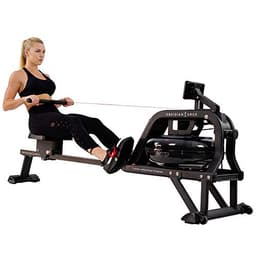
Water
Sunny Health & Fitness Obsidian Surge Water Rowing Machine
Buy this if: you want the on-water feel and sound, and the machine has to look good in a living room.
Strengths
- Resistance scales with effort - pull harder, get more, with no lever to touch
- 16-blade tank gives the whoosh and glide people buy a water rower for
- 17 in seat height is the easiest here to get on and off
- Stores upright against a wall
Trade-offs
- The sound is the product - it is noticeably louder than magnetic
- 250 lb user capacity, and no app or class integration
- Water needs topping up and treating over time
Price as of October 13, 2026. #ad How we’re funded
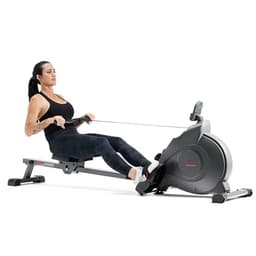
Magnetic
Sunny Health & Fitness SF-RW5515 Magnetic Rowing Machine
Buy this if: you row early, late or above someone else's ceiling, and you need the machine to fold away.
Strengths
- Near-silent - the quietest resistance type in home rowing
- 8 set levels, so intensity is repeatable session to session
- Folds and rolls away between sessions
- The cheapest honest way into rowing
Trade-offs
- Fixed resistance does not reward a harder pull the way water does
- Short rail crowds taller rowers on the drive
- Basic LCD with no app connectivity
Price as of October 13, 2026. #ad How we’re funded
How each one creates resistance
A water rower has paddles inside a sealed tank. Water resists faster movement more than slow movement, so the stroke you feel is a direct function of the stroke you pull — exactly like a boat. There is no intensity dial, because your effort is the dial. Add or remove water and you shift the baseline, but within a session the machine simply answers what you give it.
A magnetic rower moves a magnet closer to or further from a spinning steel flywheel. The braking force is set by that gap, so level 5 feels the same today as it did last week regardless of how hard you pull. That repeatability is genuinely useful for structured training, and it is why magnetic resistance is also the standard on quiet exercise bikes.
Noise: the deciding factor for most buyers
This is the reason the two get compared at all. The water rower’s sound is part of the appeal — a rhythmic whoosh that many people find easier to row to than silence. It is also a real sound in a real room, roughly comparable to a steady tap running, and it repeats every few seconds. A magnetic rower makes almost nothing beyond the seat rolling on the rail.
If you row at 6 a.m. in a flat, or beside a sleeping household, magnetic wins without further argument. If the rower lives in a garage or a spare room, the noise question mostly evaporates and you can choose on feel. See quietest cardio machines for how the two compare against bikes, walking pads and treadmills.
Feel, and who each stroke suits
Water suits people who want the machine to push back when they push it — sprint intervals feel dramatic and satisfying, and there is nothing to adjust mid-piece. Magnetic suits people who want to set a number and hold it, which is easier for steady-state work and for beginners still learning to pace a 20-minute row. Neither type teaches you to row well on its own; if the stroke is new, spend the first sessions on technique at an easy setting rather than chasing the display.
Upkeep and long-term ownership
Magnetic resistance has no contact at all, so there is nothing to wear beyond the seat rollers and strap. A water tank needs its level checked, and the water treated periodically to keep it clear — a small, real chore that does not exist on a magnetic machine. Sunny publishes a three-year frame and 180-day parts term across its cycles, rowers and treadmills, with labor and shipping excluded, and the warranty is non-transferable, so buy in your own name if you want it to count.
Price and what you give up
Magnetic is the cheaper way in. The Obsidian Surge sits a tier above the SF-RW5515, and what the extra money buys is the tank, the feel and the look — not more capacity, since both publish 250 lb, and not better data, since both use a basic LCD. If you want the on-water feel and serious data, that is an argument for an air rower with a performance monitor instead; we compare that family in air vs magnetic and lay out all four resistance types in types of rowing machines. If water has already won the argument, our best water rowing machines roundup ranks that category on its own terms — tank size, rail length, seat height and published capacity.
Frequently asked questions
Which is better, a water rower or a magnetic rower?
Neither is universally better. Water gives a self-scaling stroke and the on-water sound, which makes hard efforts feel more natural; magnetic is near-silent, repeatable level to level, folds for storage and costs less. Choose water for feel, magnetic for quiet and space.
Are water rowers loud?
They make a distinct whoosh on every stroke — the sound of paddles moving water. Most owners like it, but it is a real noise in a quiet flat and it repeats every few seconds. A magnetic rower is far quieter, since nothing touches the flywheel.
Do water rowers need maintenance?
A little. You check the water level and periodically treat the tank to keep the water clear. That is the main ownership chore. A magnetic rower has no equivalent — the resistance mechanism never makes contact, so there is nothing to service.
Which rower is best for a small apartment?
The magnetic one, on two counts: it is quiet enough for shared floors and it folds and rolls away between sessions. The water rower does store upright, which helps, but it is still a full-length frame and the sound carries.
Does a water rower give a better workout?
It gives a different one. Because resistance rises with pull speed, a hard stroke is met with more drag, which suits interval work. A magnetic rower holds a fixed level, which is easier to pace steady sessions on. The workout you actually complete matters more than the resistance type.
Sources
- American Heart Association — Recommendations for Physical Activity in Adults — AHA's 150 min/week moderate aerobic + 2 days strength recommendation (accessed July 19, 2026)
- U.S. HHS / ODPHP — Physical Activity Guidelines for Americans (2nd ed.) — Federal guideline: 150–300 min/week moderate aerobic + muscle strengthening 2+ days (accessed July 19, 2026)
- Sunny Health & Fitness — Warranty policy — Cycles, rowers and treadmills: 3-year frame, 180-day parts, labor and shipping excluded, non-transferable (accessed July 20, 2026)
Keep reading
Best home rowing machines
Every resistance type ranked, with live prices and the capacity and rail-length details that decide fit.
See the rower picksBest magnetic rowing machines
If the quiet side won: magnetic rowers ranked on resistance levels, rail inseam, published capacity and storage shape.
See the magnetic picksTypes of rowing machines
Air, magnetic, water and hydraulic explained in plain terms, with who each one suits.
Learn the four typesAir vs magnetic rower
The other big resistance decision, including why air rowers dominate serious training.
Compare those twoRowing machine vs treadmill
Full-body low impact against weight-bearing specificity, compared on space and joints.
Read the comparison