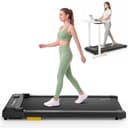
How to choose a folding treadmill
Four questions, in this order. Note that none of them is about the motor — that is the other page’s job.
1. What does the fold weigh, and what helps you?
A treadmill deck is the heaviest hinged object most people own. Folding one means tilting a long steel frame up on a pivot, and the amount of that frame you actually carry depends entirely on the mechanism.
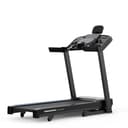
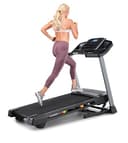
A hydraulic fold— what Horizon calls FeatherLight on the T101, and describes as one-step — puts a gas strut in the hinge, so the cylinder takes most of the deck and your job is to start the movement and guide it. It also controls the deck on the way down, which is the half of the job nobody thinks about until a 180 lb frame gets away from them. NordicTrack’s EasyLift assistis the same idea and the company claims the most about it: its folding-treadmill pages say the assist reduces what you handle from roughly 50–60 lb to about 20–25 lb. Worth reading carefully — that figure is published for the folding line in general, not for the EXP 7i specifically, and we have not measured it.
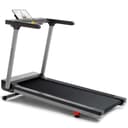
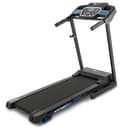
A one-click fold, which is what Sunny publishes for its auto-incline deck, is a latch-and-release rather than a power assist: quick, but you are still the lift. And a plain manual fold— the XTERRA TRX1000 — is exactly what it sounds like. On a cheap, light machine that is a fair trade; it is also the reason a budget folding treadmill often stops being folded.
2. The folded footprint, and the number almost nobody prints
Here is the arithmetic that matters and that you can only do for one machine on this page. Horizon publishes the T101 at 70.5 × 33.5 in open and 46 × 34 infolded. So folding reclaims about two feet of length and nothing at all of width — and it raises the machine to 61 in tall, which is two inches TALLER than it stands open. That is the sentence the product photography never says out loud: a folded treadmill is not a flat panel against a wall, it is a tall narrow tower, and in a room with a sloped ceiling or a low shelf the folded height is the constraint, not the folded length.
Sunny, XTERRA and UREVO publish no folded dimension on the listings we read. NordicTrack is the awkward case: it publishes one footprint, 70.8 × 34.9 × 59.7 in, and does not state whether that is the open or the folded figure. Given it is within an inch of the T101’s open size, treat it as the open footprint and assume you will measure the folded machine yourself.
Two practical checks before you buy anything here, and they cost nothing. Measure the folded height against whatever is above the spot you plan to park it. And measure the path— a folded treadmill still has to roll through a doorway on its transport wheels, and the width does not shrink when the deck goes up. If the room is genuinely tight, our small-apartment equipment guide works through what fits where in more detail.
3. Does it arrive assembled? (The fold you never see)
This is the most underrated spec in the category and only one maker here can claim it. The Sunny auto-incline treadmill ships fully assembled, and the UREVO pad effectively does too. Everything else is a flat-pack: the T101, the EXP 7i and the TRX1000 all arrive as a frame, a console mast, hardware and a long instruction sheet, and the box weights are the clue to how much of a job that is — NordicTrack publishes 228 lb in the boxfor the EXP 7i, and Horizon publishes a 73 × 30 × 12 in carton at an estimated 220 lb shipping weight for the T101.
Two consequences. The first is obvious: a two-person, one-to-two-hour build before your first walk. The second is not, and it is the one that catches people out — a flat-pack carton does not fit through every door and up every stair, and a 220 lb box is not something to carry up a flight alone. If the treadmill is going upstairs or into a basement, the box dimensions deserve as much attention as the folded ones.
4. Then, and only then, the deck you are folding
Folding is a storage feature, not a workout feature, so it should never be the reason you accept a deck that does not fit you. The belts here run from 16 × 50 in on the XTERRA to 20 × 55 inon the Horizon and NordicTrack, and that difference is not cosmetic: a 16-inch width gives you less room for a natural arm-swing wobble, and a 50-inch belt crowds a long stride at jogging pace. NordicTrack is worth one caution here too — its own pages state the EXP 7i belt as both 20 × 55 and 20 × 60 in, and give the top speed as both 10 and 12 mph depending on which page you read, so the deck figure above is the more conservative of the two.
Published maximum user weight runs 250 to 300 lb across these five. That is a structural rating and worth taking seriously on a machine with a hinge in the middle of the frame: if you are near the limit, the folding mechanism is precisely the part you do not want working at its margin. Our guide for heavier beginners ranks equipment on published capacity specifically.
The case for not buying a folding treadmill at all
Worth saying plainly, because it is the right answer more often than this category admits. If what you actually want is to walk— steps during the work day, a way to not sit for nine hours — then the folding mechanism is solving a problem you can avoid instead. A walking pad is 4 to 5 inches tall, slides under a desk or a bed without folding anything, and costs a fraction of a folding deck. The UREVO pad on this page tops out at a walking pace with no incline and a published 265 lb capacity, and for a desk worker that ceiling is a feature rather than a limit.
The honest trade is that a pad will not let you run, has no handrail to hold and nothing to grab if you stumble, and gives you no incline — and incline is the cheapest way to make a slow walk meaningfully hard. We lay the whole comparison out in treadmill vs walking pad. If you are still choosing between cardio categories rather than between treadmills, treadmill vs exercise bike and rowing machine vs treadmill are the two decisions that come before this page.
What to skip
Skip any folding treadmill whose listing shows the folded machine in a photograph but states no folded dimensionif your space is the reason you are buying a folding deck — that is the one scenario where the missing number is the whole decision. Skip a manual-fold machine if the person folding it has a bad back or if it has to be folded daily rather than weekly; the assist is worth real money in that case. Skip the cheapest frames if you plan to run rather than walk, because a hinge in the middle of a long frame is exactly where a thin, cheap frame tells on itself over years.
And be deliberate about subscription-dependent machines. The EXP 7i is a good deck whose trainer-controlled incline and classes ride on an iFIT membership, so the real price is the machine plus years of membership; the Horizon and the Sunny both work fully without paying anyone monthly, and SunnyFit is free. If that is the axis you care about most, our screens-and-subscriptions breakdown applies the same test to rowers, where the paywalls are even more aggressive. One maintenance note for every machine on this page: belt-to-deck friction is what kills treadmill motors, and deck lubrication is the job nobody does — check the manual, because some decks are pre-lubricated and must not be treated.