How to choose a cardio machine for an older adult
1. Board it sitting down if you can
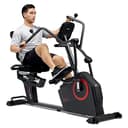
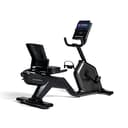
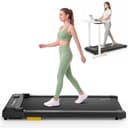
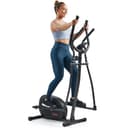
Every machine here falls into one of three boarding types, and they are not close to equivalent. A step-through seated machine— the recumbent elliptical and the recumbent bike — lets you walk into an open frame, sit, and then start. Nothing is moving while you are transferring your weight, and there is no leg to swing over a frame. A floor-level machine— the walking pad — asks nothing of you to board but gives you nothing to hold. A step-up machine— the treadmill deck, the elliptical pedals — asks you to raise a foot several inches and put weight on it while standing on one leg, which is the single most balance-dependent thing that happens in a home workout.
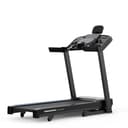
None of that makes a step-up machine wrong. The treadmill is on this page precisely because walking is the exercise most older adults will actually keep doing, and its handrails are a genuine advantage over a walking pad once you are on it. But if balance is the concern rather than the goal, buy the machine you sit down on.
2. Read the lowest setting, not the highest
Listings advertise ceilings: 25 resistance levels, 10% incline, 10 mph. For this buyer the floor is the number that matters. The Horizon T101 starts at 0.5 mph, which is slower than a shuffle and is what makes a treadmill usable in a first week. The Schwinn 290’s level 1 of 25 is a very light pedal, and 25 levels means the steps between settings are small, so progression is gradual rather than a jump. The compact elliptical has 8 levelson a twist knob, so each step up is a bigger change, and the walking pad tops out at a walking pace by design — which is a feature here, not a limitation.
Public-health guidance for older adults asks for moderate aerobic activity across the week plus muscle-strengthening work and, notably, balance training— and it says explicitly that any amount is better than none. A machine whose easiest setting is still hard does not get you there. One whose easiest setting feels like nothing does.
3. Published capacity, and the one machine that does not state it
Maximum user weight is a structural rating, and it is the spec most worth checking because exceeding it voids what warranty there is and changes how the frame behaves over years. Across these six the published range runs 265 lb to 350 lb: the MERACH rower publishes the highest at 350 lb, the Schwinn 290 is 330 lb, the recumbent elliptical and the T101 are both 300 lb, the walking pad is 265 lb, and Sunny publishes no capacity at all for the compact elliptical. That silence is the reason it sits last here despite being the easiest machine to fit in a room. If you are near any of these numbers, our guide for heavier beginners ranks equipment on published capacity specifically.
4. The console, and the subscription question
Two separate things get confused here. The first is legibility: the Schwinn publishes a 7 in LCD, which is the largest display of the six, and the recumbent elliptical publishes the most complete readout — time, speed, RPM, distance, watts, calories and heart rate. The second is whether the machine needs anything else to work. The Schwinn’s resistance and programs work with no app at all, but JRNY and Zwift are separate paid subscriptions; the T101 works fully unconnected; and Sunny’s app is free. For a buyer who does not want a phone involved in exercising, that distinction matters more than any number on the box — and it is the same logic behind our tracker picks for seniors, which rank on what you can read and operate without a phone.
Where to put it, and why that decides whether it gets used
The largest machine on this page is the recumbent elliptical at 71.7 × 33.3 in— nearly 6 ft long — and it does not fold. The Schwinn 290 is 66.4 × 28 in, does not fold, and weighs 107.6 lb, so it goes where you build it. The T101 folds hydraulically, the walking pad stores flat against a wall, and the compact elliptical is the only machine here under 41 in long.
The practical rule that beats all of these numbers: put the machine in a room you already go into every day, with a clear path to it, a light switch you can reach and something to hold on the way past. A machine in a cold garage behind a door is a machine that stops being used in November. If space is the binding constraint, our small-apartment picks work through folded footprints in more detail.
Which type suits which problem
Knees and hips. Seated and no-impact wins: the recumbent elliptical or the recumbent bike. Both keep your body weight off the joint and let you set a load so light it is effectively a warm-up. Our bad-knees guide goes further into what each machine asks of the joint.
Balance and falls.Sit down to exercise, and keep the standing balance work separate and supervised — a machine is not balance training. If you want to walk, the treadmill’s handrails are a real advantage over the walking pad’s lack of them.
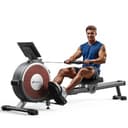
Back. A backrest changes a session, which is why both recumbent machines are at the top. A rower is the opposite case: it is a repeated hip hinge performed seated, and getting up off a low seat afterwards is its own event. We wrote about that at length in rowing machines and back problems and rowing machines for seniors.
Breathlessness or low starting fitness.Buy the machine with the most settings at the bottom end and the least friction to start — the walking pad, used for ten minutes at a time, is a genuinely good answer and the cheapest thing here. Nobody needs a 2.5 CHP motor to walk at 2 mph.
What not to buy
Skip mini pedal exercisers that sit under a chair unless a clinician specifically suggested one; they are cheap, and they are also where the money goes to die, because the resistance is too light to do anything and the device slides on hard floors. Skip any machine whose maker publishes no user weight capacity if you are near the limits. Skip a machine that needs a subscription to display a numberif the buyer does not want a phone in the room. And be skeptical of anything marketed as senior-specific at a premium: what you are paying for should be a step-through frame, a backrest, a big display and a low floor setting — all of which are visible on a spec sheet, and none of which require the word “senior” on the box.
Finally, the honest limit of this whole page: a machine buys you aerobic work and nothing else. Guidance for older adults asks for muscle strengthening and balance work as well, and neither comes from a bike. A set of light bands next to the machine covers the first, and the second belongs with a professional. Our wider equipment guide for seniors covers the bands, the light dumbbells and the mat that go around the machine.