How to buy an elliptical under $500
This is a band where one spec does almost all the work, and two more decide whether you can live with the machine.
1. Stride length, measured against your height, decides everything
An elliptical’s stride is how far the pedals travel front to back, and it is the difference between a natural walking gait and a short circular shuffle. For most adults, 16 in is the comfortable minimum; 18 in suits people around 6 ft and taller; and a stride near 11 to 13 in feels tight and choppy unless you are under roughly 5 ft 6 in. Gym machines usually run near 20 in, which is exactly why a cheap home elliptical can feel like a different exercise from the one you remember.
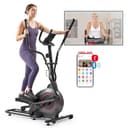
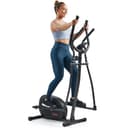
Under $500 you get one machine at 16 in and one at 11 in, and the price gap between them is real but smaller than the experience gap. Sunny is refreshingly direct about this in its own listings — the compact machine’s own description concedes the short, circular step for taller users. Buy the 11 in machine deliberately, for a shorter user or a tight room, not as a way to save money on the same product. If you are tall, the honest advice is to step over this page’s ceiling for the 18 in machine on best ellipticals, which also states a fit up to 6 ft 4 in.
2. Count the resistance levels, and measure the height as well as the floor
Resistance levels are the other place this band splits: 16 levels on the upright machine against 8 on the compact one. That is not just granularity, it is a ceiling — eight levels run out sooner as you get fitter, which is the most common reason a cheap cardio machine stops getting used in year two. Both are magnetic and belt-driven, which is the right mechanism at any price: nothing contacts anything, so there is no pad to wear out, and level 11 means the same thing next month as it does today. That is the quiet mechanism, too, which is covered across every machine type in quietest cardio machines.
On space, both Sunny machines publish their footprints and neither folds: 48 × 25.8 in for the 16 in machine and 40.7 × 26.4 in for the compact. Note that the compact is seven inches shorter but slightly wider, so “compact” is about length only. And measure upward as well: these stand 64.8 in and 59.8 in tall before you climb on, and standing on the pedals adds roughly 8 to 10 in to your own height, so a basement with low joists or a room with a sloped ceiling is a real constraint. More on fitting machines into rooms that have to go back to being rooms in fitness equipment for small apartments.
3. Treat the missing capacity figure as a cost
All three listings here omit a maximum user weight. That is not a reason to assume the machines are flimsy, and it is not something we will guess at — but it is a genuine unknown on equipment you stand on and drive through with your whole body weight plus momentum, and it is the single most common reason a budget cardio machine gets returned. If you are near the point where that matters, buy a machine that publishes the number. The 18 in Niceday states 400 lb and sits just above this ceiling, which is the clearest case on this site for stretching a budget by a few dollars.
The Cubii is not a cheap elliptical, and that is the point
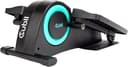
The Cubii JR1is the third machine under $500 and it belongs in a different conversation. It is a seated under-desk elliptical measuring 23.15 × 17.56 × 10 in, with an LCD that counts strides, distance and calories, and a low-slung elliptical pedal path rather than a bike’s circular one — which is precisely what keeps your knees from hitting the underside of a desk.
Judged as a cardio machine it loses to both Sunny machines on every axis, and we are not going to pretend otherwise: seated pedaling is light work, it supplements a cardio plan rather than being one, the listing publishes no resistance level count, and the Cubii app relies on manual data entry. Judged as what it actually is — a way to stop sitting perfectly still for eight hours — it is the most-used piece of fitness equipment a desk worker can own, because the machine that is already under your feet is the machine you use. It is also the answer when a standing machine is genuinely not an option, which is why it appears on best exercise machines for seniors as well.
What $500 does not buy
Four things, stated plainly, so nothing here is a surprise.
A published capacity, as covered above — the band’s defining omission. A long stride: 16 in is the ceiling here and 18 in starts just above it. A fold: neither standing machine folds, so the footprint you measure is the footprint you keep. And a published warranty on the better machine— which is the odd one. The cheaper compact Sunny states a 1-year structural frame warranty on its listing; the 16 in upright machine’s listing does not publish a term at all. Sunny’s own general policy covers its cycles, rowers and treadmills at three years on the frame and 180 days on parts, but that is a statement about other product lines, so we report the elliptical listings as written rather than assume the policy carries across.
None of these three needs a subscription to work, which is worth saying out loud in a category full of machines that do. Both Sunny machines connect to SunnyFit, which is free. If you are shopping this band because a connected machine wanted a monthly fee, Peloton alternatives is the page about exactly that decision.
What we would buy
The Sunny 16 in upright, for almost everyone: the only full-length stride under the ceiling, twice the resistance levels of the cheaper machine, dual aluminum rails, pulse handlebars and a free app — a complete machine at a price where that is rare. The Sunny compactif you are under about 5 ft 6 in, or the room is the binding constraint and you have accepted the 11 in step, where the 1-year frame warranty is a small bonus. The Cubii JR1if the real goal is to move while seated at a desk, in which case it is not a compromise at all. And if you are heavier than average, our honest recommendation is to spend slightly over this page’s ceiling on a machine that publishes a capacity.