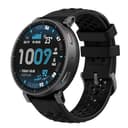
How to choose a watch you will actually sleep in
Battery is the sleep spec
Every sleep-tracking feature on every watch here is useless on a night the watch spent on a charger, and a one-day watch has to be charged every single day. In practice that means finding a window — the shower, the commute, the hour after dinner — and never missing it. Miss it and you lose the night, and a sleep trend with holes in it is a much weaker thing than one without.
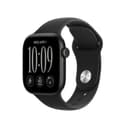
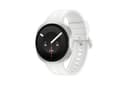
This is where the two one-day watches diverge. The Apple Watch Series 12 publishes up to 24 hours of normal use, which on paper is the same problem as the Galaxy Watch9 at about a day — but Apple also publishes a charge rate that solves it: about 30 minutes to 80 percent, and 15 minutes for up to 12 hours of normal use. A shower is enough to cover a night. Samsung publishes no equivalent figure we can cite, so on the Galaxy Watch9 the daily charge is a genuine routine rather than a quick top-up.
At the other end, the Withings ScanWatch 2 publishes up to 30 days and the Amazfit Active Max up to 25. Those are watches you charge monthly, which removes the problem entirely. The price is what they are: the Withings is a hybrid with real hands and a small grayscale sub-dial rather than a full smart display, and the Amazfit runs Zepp’s software rather than Apple’s, Google’s or Samsung’s. Both are deliberate trades, not compromises, and for a reader whose priority is the sleep data rather than the smartwatch, both are excellent.
What is in the morning report
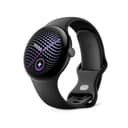
All six of these estimate sleep stages and produce a score. The differences are at the edges, and the edges are where the value is. The Apple Watch Series 12 is the most complete sensor package an iPhone can pair with: Apple publishes hypertension notifications, sleep apnea notifications, a nightly sleep score and a morning readiness score, with the optical sensor reading heart rate every five seconds and HRV sampled far more often than the previous model. The Pixel Watch 5 carries Fitbit’s sleep stack, which is the most mature consumer sleep analysis there is, with far-field skin temperature sensing — and the caveat that some insights sit behind Google Health Premium, which Google rebranded from Fitbit Premium.
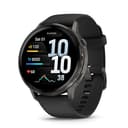
The Garmin Venu 4 and the Withings ScanWatch 2 take the opposite approach: deep overnight data with nothing paywalled. Withings adds a TempTech24/7 skin-temperature sensor and an FDA-cleared ECG app with AFib detection, in a watch that looks like a watch. Garmin gives you the sleep, HRV and recovery detail its training platform is built on, free. The Galaxy Watch9 has the broadest raw sensor set of any Wear OS watch here — ECG, SpO2, skin temperature and BIA body composition — with two conditions worth knowing: ECG requires a paired Samsung Galaxy phone, and blood pressure is unavailable in the US.
Which phone you own narrows this fast
Platform rules out more of this list than specs do. The Pixel Watch 5 is Android-only, and Google states plainly that iPhones are not supported. Samsung’s own US product page states that the Galaxy Watch8 series and later must be paired with an Android phone and never mentions iOS; its support site is more direct, saying newer models from the Watch4 on are not compatible with iOS. The Apple Watch Series 12 needs an iPhone 11 or later running iOS 27 or later, which also means an older iPhone rules it out. Garmin, Withings and Amazfit work with both platforms. We have mapped the whole iPhone side of this in best fitness trackers for iPhone.
What a wrist sensor can and cannot tell you
Worth stating plainly on a page like this: none of these watches measures sleep the way a sleep study does. They infer sleep and sleep stages from movement, heart rate and heart-rate variability, which is a model rather than a measurement, and the Cleveland Clinic is worth reading on where that model is useful and where it is not. The clinical review we cite reaches a similar place — consumer sleep trackers are reasonable at estimating total sleep time and much weaker at staging it.
That is not an argument against buying one. It is an argument for what to use it for. Trends over weeks are the valuable output: bedtime consistency, total time asleep, how your resting heart rate and HRV drift when you are under load or getting ill. Treat a single night’s stage breakdown as entertainment. And treat sleep apnea notifications for what Apple and the others describe them as — a prompt to see someone, not a diagnosis. If a watch flags something, that is a conversation with a clinician, which is also where any question about your own health belongs.
Comfort, and the light in your face
Two practical points that no spec sheet ranks. A full smartwatch is a hard object worn against a wrist for eight hours, and on a 44 or 46 mm case with a metal link bracelet it is the reason many people give up on wearing one at night. Fit a soft band before you decide the watch is the problem. The Withings, being a slim hybrid, is the least intrusive of the six to sleep in.
The other is brightness. The Galaxy Watch9, the Pixel Watch 5 and the Amazfit all publish peak brightness figures around 3,000 nits, and the Apple Watch runs an always-on display. That is wonderful outdoors and unhelpful at 3 am. Every one of these platforms has a sleep or bedtime mode that dims the screen and suppresses notifications; turn it on before the first night, not after it wakes you.
If the watch is the wrong device
Be honest about whether you want a watch at all. If the appeal is the sleep data rather than the smartwatch, a ring or a dedicated band does it better: they are lighter, they last longer, and they are designed for the one job. The Garmin Index Sleep Monitor runs up to seven nights on the upper arm with no screen at all, and the RingConn Gen 2 publishes 10 to 12 days with no subscription. We rank those in best sleep tracker bands, best smart rings and — on price rather than form factor — best sleep trackers without a subscription.