Resistance Bands vs Dumbbells
Bands get harder as you stretch them; dumbbells weigh the same all the way up. What that changes about strength, progression, travel and cost - and which one belongs in your first purchase.
A dumbbell is pulled down by gravity, so it weighs the same at the bottom of a curl as at the top. A band is pulled by its own elasticity, so it is easy at the start of the movement and hardest at full stretch. Neither is fake resistance — but they load a muscle in opposite patterns, and that is the entire comparison.
The practical questions are which one builds strength faster, which one fits a small flat and a suitcase, and which to buy first with limited money. Below, a five-band stackable set against the adjustable dumbbell pair that anchors most home gyms.
How this is funded: we earn a commission if you buy through our links, at no extra cost to you. It never changes which product we recommend, and we’ll tell you when we’d skip one. Full disclosure.
| Feature | Bands | Dumbbells |
|---|---|---|
| Resistance curve | Rises as the band stretches | Constant through the range |
| Load measurement | Estimated (varies with stretch) | Exact, in pounds |
| Progression steps | Coarse - add or swap a band | 2.5-5 lb increments |
| Storage | A drawer | A stand or a corner |
| Travel | Yes - fits hand luggage | No |
| Cost | Lowest in home strength training | Several times a band set |
| Wear items | Bands degrade and can snap | Mechanism and housing |
| Best for | Travel, rehab, small spaces, budgets | Measurable strength progress |
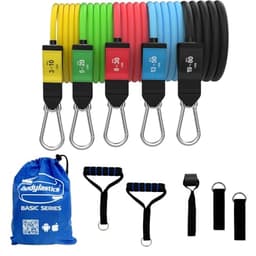
Bands
Bodylastics Stackable Resistance Bands Set
Buy this if: space, travel or budget is the constraint, or you want joint-friendly loading with no impact.
Strengths
- Stack bands to combine resistance, so one set covers a wide range
- Packs into a drawer or a carry-on - training does not stop when you travel
- Easiest resistance on the joints at the start of a movement
- Cheapest way to train pulling patterns without a rack or a bar
Trade-offs
- Resistance is uneven - light at the start, hardest at full stretch
- Load is estimated rather than measured, so progression is coarse
- Bands wear and eventually snap; anchor points can fail
Price as of October 12, 2026. #ad How we’re funded
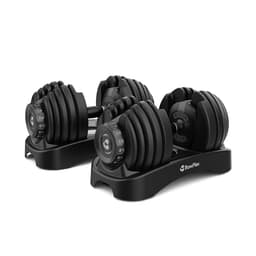
Dumbbells
Bowflex SelectTech 552 Adjustable Dumbbells
Buy this if: you want measurable strength progress and the widest range of gym-standard exercises.
Strengths
- Constant resistance through the whole range - what strength programs assume
- Load is an exact number, so progression is measurable and repeatable
- 2.5 lb micro-jumps at the low end make small increases possible
- Every standard exercise has a dumbbell version
Trade-offs
- Heavier, bulkier and far more expensive than a band set
- Caps at 52.5 lb per hand, so strong lifters outgrow it
- Not travel equipment by any definition
The resistance curve, in plain terms
On a dumbbell curl, the hardest point is where your forearm is horizontal — gravity acts straight down, so the leverage against you peaks mid-range and eases at the top. On a band curl, the hardest point is the top, because that is where the band is stretched furthest. Neither matches the other, and neither is wrong.
What this means in practice: bands are kind at the beginning of a movement and demanding at the end, which suits joints that dislike load in a stretched position — a shoulder at the bottom of a press, for instance. Dumbbells load the whole range, which is what conventional strength programming assumes when it tells you to do three sets of eight.
Progression: the real dividing line
Getting stronger requires doing measurably more over time. With dumbbells that is trivial — add 2.5 or 5 lb. With bands, you are choosing between adding another band (a large jump), standing further from the anchor (an unmeasured change), or doing more reps. That is workable, and plenty of people get strong with bands, but it is harder to track and easier to stall on.
Band tension ratings are also nominal. A band listed at 30 lb delivers something near that at a particular stretch, not throughout. Treat the numbers as relative labels within one brand’s set rather than as pounds you can compare against a dumbbell.
Space, travel and cost
A full stackable band set weighs a couple of pounds and fits in a drawer. That is not a small advantage — it is the difference between training in a hotel room and not training. It also makes bands the obvious first purchase for anyone in a shared flat or a very small space, where a dumbbell stand is a genuine problem.
On cost, a good band set runs a fraction of an adjustable dumbbell pair. If the budget is the constraint, bands plus a pull-up bar give you pushing, pulling and lower body work for well under a hundred dollars, which is the cheapest complete home setup we can honestly recommend. Our budget equipment guide builds that out.
Durability and safety
Dumbbells are permanent objects. Bands are consumables: latex degrades with UV exposure, heat and time, and a band that snaps under load recoils fast. Buy sets with a fabric sleeve or layered construction, inspect for nicks before each use, never stretch a band toward your face, and check anchors before you load them. Replace bands on a schedule rather than waiting for a failure — they are cheap.
What most people should actually do
Own both eventually; they cost different amounts and solve different problems. If you are buying once, the deciding question is where the training will happen. At home, with room for a stand: dumbbells, because measurable progression is what turns exercise into strength training. On the road, in a studio flat, or coming back from an injury: bands, without apology.
Whichever you buy, the target is the same — muscle-strengthening activity for all major muscle groups on two or more days a week, per federal guidance. The equipment that gets used twice a week beats the equipment that scores better on a spec sheet. Still deciding what to buy at all? Our machines vs free weights comparison sits one level above this one.
Frequently asked questions
Can you build muscle with resistance bands?
Yes. Muscle responds to tension and effort, not to the shape of the object supplying it, and bands can take a set close enough to failure to drive growth. The limitation is progression: adding load in small, measurable steps is harder with bands than with dumbbells.
Are resistance bands as good as dumbbells?
For general fitness, travel and rehab, they are genuinely competitive and far more portable. For structured strength training with measurable increases, dumbbells are better, because load is an exact number and resistance is constant through the range.
Which is better for bad joints?
Bands, usually, because they are lightest at the start of a movement where a stretched joint is most vulnerable, and heaviest at the end where you are strongest. That said, a light dumbbell through a comfortable range is also fine — the load that hurts is the one to change.
Do resistance band weight ratings mean anything?
Only relative to each other within one brand. A band labeled 30 lb delivers roughly that at a particular stretch, not throughout the movement, and brands measure differently. Use the labels to rank bands in a set, not to compare against dumbbell weights.
Should beginners start with bands or dumbbells?
If the equipment lives at home and there is room, dumbbells — the technique is intuitive and progress is easy to see. If space, budget or travel is the constraint, a good stackable band set plus a pull-up bar is a complete beginner setup for a fraction of the price.
Sources
- CDC — Adult Activity: An Overview — CDC on muscle-strengthening 2+ days/week, 8–12 reps, all major muscle groups (accessed July 19, 2026)
- U.S. HHS / ODPHP — Physical Activity Guidelines for Americans (2nd ed.) — Federal guideline: 150–300 min/week moderate aerobic + muscle strengthening 2+ days (accessed July 19, 2026)
Keep reading
Best resistance bands
Loop bands, tube sets and the ones that actually last, with live prices.
See the band picksBest Loop Resistance Bands
If bands are the answer, this is which loop - 12 in mini against 41 in long, and which makers publish the resistance in pounds.
See the loop picksBest adjustable dumbbells
One pair that replaces a rack, compared on range, adjustment and build.
See the dumbbell picksLoop bands vs tube bands
The two band formats compared - which one suits pull-up assistance and which suits presses.
Compare band typesEquipment on a budget
The cheapest complete home setup we can recommend without hedging.
Read the budget guide