How to choose loop resistance bands
Four questions, in this order. Get the first one right and the rest is detail; get it wrong and nothing else saves the purchase.
1. Which loop length does the job you have in mind?
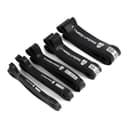
A 41 in long loop is the general-purpose strength band. Hang it from a pull-up bar and stand in it and it removes a chunk of your bodyweight from the pull-up. Loop it under a barbell and over the ends and it adds tension at the top of a squat or bench press, where you are strongest. Anchor it to a door and it becomes rows, presses and pull-aparts. It also stretches far enough to be useful for hip and shoulder mobility work. If you are buying one kind of band, buy this kind.
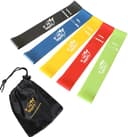
A mini loop— Fit Simplify’s are a published 12 in around and 2 in wide — does one family of jobs very well and nothing else at all. Above the knees it loads hip abduction for side-steps, clamshells and banded glute bridges. Around the ankles it does the same for kickbacks. Around the wrists or forearms it is a shoulder warm-up. It is the standard tool in physical therapy for exactly those movements, and it is also the band most likely to end up in a drawer, because the moment you want to load a squat or a row it has nothing to offer. Our loop bands vs tube bands comparison covers the third option — clip-together tubes with handles — which beats both for pressing and rowing but cannot be hung from a bar.
2. Is the resistance actually published?
This is where the money goes, and it is worth understanding why the numbers are so slippery. A band is not a weight. Its tension rises as it stretches, so a band that gives you 10 lb at a short stretch gives you 50 lb pulled to the end of its range. An honest specification therefore states a range, and Serious Steel is the only maker in this group that does it per band: 5–35 lb, 10–50 lb and 25–80 lbfor the #1, #2 and #3, each paired with the width that produces it (1/2 in, 13/16 in and 1-1/8 in). That is enough to plan with: you can pick the band that will take roughly the right amount of weight off your pull-up, and you can tell when you have progressed out of it.
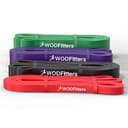
Gymreapers publishes 20–150 lb across the setof five, which tells you the ceiling but not what the band in your hand is doing — the same information a dumbbell rack gives you when it says “5 to 50 lb.” WODFitters, Te-Rich and Fit Simplify publish no figure at all, and sell their levels as colors. For warm-ups and rehab that is survivable, because the point there is movement quality rather than load. For anything you are trying to get stronger at, it is a real handicap, and if progression matters to you it is the single strongest reason to buy the set that prints its numbers.
3. Construction: layers, width and what actually fails
Long loop bands come in two constructions and only one is worth buying. A continuous-layer bandis built from many thin sheets of latex laid up as one piece — Serious Steel publishes fifteen layers at a 4.5 mm thickness, and WODFitters describes layered natural latex. A glued or spliced band joins the ends of a strip, which puts a seam in the loop and gives the band a defined place to fail. You can usually spot the difference in the product photos: a layered band shows fine striations along the inside and outside of the loop, a spliced one shows a butt joint.
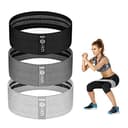
Width is the lever that sets resistance on any given length: a wider band of the same thickness is a heavier band, which is why Serious Steel’s widths line up exactly with its resistance ranges. And fabric mini loops are their own category — woven cloth with a rubber element inside, which stretches less than latex but does not roll or pinch. That is the whole reason they exist, and it is a genuine problem solved: a thin latex loop above a bare knee migrates up the thigh over a set of squats and you spend the set putting it back.
What actually fails on a band, in order: the surface dries and cracks from UV and heat, the edges nick on a rough pull-up bar or a bar knurl and then tear from the nick, and lastly the rubber fatigues from being held at near-maximum stretch. Three habits deal with most of it. Store bands out of sunlight and away from a radiator. Put a towel or a sleeve between a band and any knurled or rusty steel. And inspect the band at eye level before you hang your bodyweight in it — a nicked band is a band to retire, not to use carefully.
4. One band, or the whole ladder?
Buying a five-band set is the default and it is often the wrong call. If you know what you want the band for — usually “take enough weight off so I can do eight pull-ups” — then one correctly-sized band does the job and a set leaves you with four you do not touch. WODFitters sells its bands individually for exactly that reason as well as in the four-band set we link, so if you already know which width you want, price the single before the bundle. Buy the ladder when the job genuinely spans a range: assisted pull-ups where you intend to step down the assistance over months, or band-resisted barbell work where different lifts want different tension.
What loop bands are genuinely good at — and what they are not
Bands are the cheapest real resistance you can buy, the most packable, and the only kind that loads the top of a movement harder than the bottom. That last property is not a gimmick: on a squat or a press you are strongest near the top, and a band is the only tool that puts the most load exactly there. They are excellent for pull-up progression, for adding speed work to a barbell lift, for travel, and for the entire category of warm-up and mobility work that free weights do badly.
What they are not is a replacement for weight. Band tension is hardest to quantify at exactly the point you want precision, the resistance curve is backwards from most machines, and a band provides almost nothing at the bottom of a range of motion where many lifts are hardest. We work through that trade in resistance bands vs dumbbells, and the short version is that bands are a brilliant supplement and a frustrating primary. If bands are your whole gym because of space, a set of adjustable dumbbells is the upgrade that changes the most, and a pull-up bar is what turns a long loop band into a complete upper-body plan rather than an accessory.
The bands to skip, and why
Skip any long loop band whose photos show a spliced seam— the joint is the failure point and you are planning to stand in it. Skip sets sold with the resistance stated as a single number rather than a range, because a single number cannot be true of a band and means nobody measured. Skip thin latex mini loops for anything done barefoot on bare skin; that is precisely the use case fabric loops exist for. Skip tube bands with handles for pull-up assistance, which comes up more often than you would expect — the handles and clips are not meant to hang bodyweight and the tube is not a loop.
And a note that applies to the whole category: a band under tension stores energy and releases it towards your face if it fails or slips. Set up so that a failure sends the band away from you rather than at you, never stretch a band past roughly two and a half times its length, and keep eyes out of the firing line when you are hanging in one from a bar. None of that is a reason to avoid bands — they are the single best-value-per-dollar purchase in home strength training, and they let you hit the twice-a-week muscle-strengthening work public-health guidance asks for with something that fits in a drawer.