Loop Bands vs Tube Bands
Little flat loops for warm-ups and mobility, or clip-together tubes with handles for real strength work. Which style of resistance band actually fits how you train.
“Resistance bands” covers two quite different tools. Loop bands — here the Fit Simplify set — are small flat rings of latex you slip around your legs or arms; they’re cheap, packable, and perfect for warm-ups, glute activation and rehab. Tube bands— the Bodylastics stackable set — are cords with handles that clip together and anchor to a door, so you can stack them for genuinely heavy pressing, pulling and squatting.
They’re not really rivals so much as different jobs, and the honest answer for many people is “both.” But if you’re buying one, the choice comes down to whether you want light mobility work or a portable full-body strength kit. Both options below show a live price.
How this is funded: we earn a commission if you buy through our links, at no extra cost to you. It never changes which product we recommend, and we’ll tell you when we’d skip one. Full disclosure.
| Feature | Loop bands | Tube bands |
|---|---|---|
| Type | Flat continuous loops | Clip-on stackable tubes |
| Resistance | 5 light levels | Stackable to heavy combined loads |
| Best use | Warm-ups, mobility, glutes, rehab | Full-body strength: press, row, squat |
| Accessories | Carry bag and guide | Handles, ankle straps, door anchor |
| Safety | Simple latex loop | Inner anti-snap cord |
| Anchoring | Around limbs only | Door anchor for many angles |
| Price | Budget | Mid |
| Best for | Activation and rehab | Bands as your main strength gear |
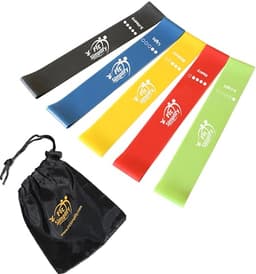
Loop bands
Fit Simplify Resistance Loop Exercise Bands
Buy this if: Warm-ups, mobility, glute activation and physical therapy — light resistance that packs into a drawer.
Strengths
- Five resistance levels for light progression
- Natural latex loops are light and packable
- Among the cheapest ways to add resistance at home
Trade-offs
- Even the heaviest loop is light for lower-body strength
- No handles or anchor for pressing and rowing
- Latex can roll or pinch on bare skin
Price as of September 20, 2026. #ad How we’re funded
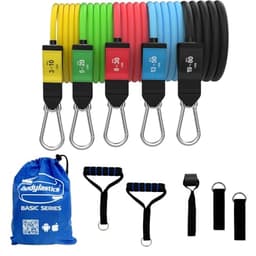
Tube bands
Bodylastics Stackable Resistance Bands Set
Buy this if: People who want bands as their main strength tool for pressing, pulling and squatting at real loads.
Strengths
- Stackable tubes dial in heavy combined resistance
- Ships with handles, ankle straps and a door anchor
- Inner anti-snap cord limits how far a failed band recoils
Trade-offs
- Clip system adds bulk versus one-piece loops
- More expensive than a set of flat loops
- Rubber tubes still wear and eventually need replacing
Price as of September 20, 2026. #ad How we’re funded
What each style is actually for
Loop bands do one thing very well: add light, controllable resistance to bodyweight and mobility movements. Slip one above the knees for squats and lateral walks, around the ankles for glute work, or around the wrists for shoulder prehab, and you’ve turned a warm-up into real activation. What they can’t do is load a movement heavily — even the “extra heavy” loop is light next to a loaded barbell — and there’s no handle to press or row against. That’s by design; they’re a mobility and activation tool, and a brilliant one for the price.
Why tube bands can be a real strength tool
Tube sets are built to replace weights, not just supplement them. Because you clip multiple tubes onto one handle, you can stack resistance up to genuinely heavy combined loads, and the included handles, ankle straps and door anchor let you mimic a whole gym — chest press, rows, lat pulldowns, squats, curls, and more. The Bodylastics set also runs an inner anti-snap cord through each tube, so if a band ever fails it collapses rather than recoiling freely, which is a meaningful safety detail on a tool you load heavily. This is the style to buy if bands are going to be your strength training, especially for travel or very small spaces.
Durability, safety and price
Loops are simple and cheap, but thin latex can roll, pinch bare skin, and eventually snap; you replace them cheaply when they wear. Tubes cost more and the clip system adds some bulk, but a good set with an anti-snap core is more robust for heavy work and comes with everything you need to anchor and grip. Neither lasts forever — rubber ages — so store both away from heat and sunlight and check for nicks before loading a band hard.
Which should you buy?
If you already lift with weights and just want to add activation and mobility, loop bands are the obvious, cheap add-on. If bands are going to carry your strength training — you travel, you’re in a tiny space, or you want a full-body kit that stores in a bag — the tube set is the one that can actually do the job. Plenty of people own both: loops for warm-ups, tubes for the working sets. See every band type, including pull-up assist bands, in our best resistance bands roundup, and where bands sit against iron in gym equipment vs free weights.
Frequently asked questions
What is the difference between loop bands and tube bands?
Loop bands are small flat rings of latex used around the limbs for light resistance — ideal for warm-ups, mobility and glute work. Tube bands are cords with handles that clip together and anchor to a door, so you can stack them for heavier pressing, pulling and squatting. Loops are for activation and rehab; tubes can serve as a full-body strength tool.
Can you build muscle with resistance bands?
Yes, particularly with tube bands you can stack and anchor. By loading presses, rows, squats and curls with meaningful resistance and training close to failure, bands can build and maintain muscle, especially for beginners and for travel or small-space training. Flat loop bands are better for activation and mobility than for heavy muscle-building work.
Are loop bands or tube bands better for beginners?
Both have a place. Loop bands are a great, inexpensive first purchase for learning movement patterns and adding light resistance safely. Tube bands with handles are the better choice if a beginner wants bands to be their main strength tool. Many people start with cheap loops and add a tube set once they want to train harder.
Are resistance bands with an anti-snap cord safer?
They add a real safety margin. An inner anti-snap cord, like the one in the Bodylastics tubes, means a failed band collapses instead of recoiling freely, which reduces the risk of a painful snap-back when you are loading a band heavily. Regardless of design, inspect bands for nicks before heavy use and store them away from heat and sunlight.
Sources
- CDC — Adult Activity: An Overview — CDC on muscle-strengthening 2+ days/week, 8–12 reps, all major muscle groups (accessed July 19, 2026)
- American Heart Association — Recommendations for Physical Activity in Adults — AHA's 150 min/week moderate aerobic + 2 days strength recommendation (accessed July 19, 2026)
- U.S. HHS / ODPHP — Physical Activity Guidelines for Americans (2nd ed.) — Federal guideline: 150–300 min/week moderate aerobic + muscle strengthening 2+ days (accessed July 19, 2026)
Keep reading
Best Resistance Bands
Loop bands, tube sets and pull-up bands compared on resistance, safety and value.
See the picksGym Equipment vs Free Weights
Where bands sit against machines and iron on cost, space and progress.
Read the guideBest Equipment for Small Apartments
Bands are the ultimate small-space strength tool — the rest of a compact kit.
Read the guideStrength Training
How bands fit alongside dumbbells, kettlebells, racks and benches.
Explore strength