Yoga Mat vs Exercise Mat
They are built for opposite jobs: one gives you grip and floor feel, the other absorbs impact. Buying the wrong one is the commonest first-mat mistake, and the giveaway is in the thickness.
How this is funded: we earn a commission if you buy through our links, at no extra cost to you. It never changes which product we recommend, and we’ll tell you when we’d skip one. Full disclosure.
A yoga mat is a grip surface and an exercise mat is a cushion, and the thickness tells you which is which. A yoga mat is thin — 4 to 6 mm — with a tacky surface, because yoga needs your hands and feet to stay exactly where you put them and needs you to feel the floor to balance. An exercise or fitness mat is thick, often 10 to 20 mm, soft, and usually smooth rather than grippy, because its job is to put padding between the floor and your spine, hips and knees.
If you buy the wrong one you will know within a week, and the symptom depends on which mistake you made. A thick fitness mat under a standing balance pose feels like trying to balance on a mattress. A thin yoga mat under a set of sit-ups feels like doing sit-ups on the floor, which is roughly what you are doing.
What each one is actually built for
The yoga mat: grip and floor feel
Everything about a yoga mat’s construction serves two requirements that pull in the same direction.
It must not let you slide. This is the engineering problem the mat makers compete on, and they publish how they solve it. Liforme publishes a three-layer build — a natural rubber base, an ultra-thin eco-polyurethane top, and between them a patented CleanGrip barrier layer that stops sweat reaching the rubber. JadeYoga takes the opposite route with open-cell natural rubber, which grips because it absorbs. Manduka publishes the honest downside of its own closed-cell PRO: because the surface “does not absorb moisture, the mat may feel slick if you’re prone to sweat”, and Manduka recommends a towel with it.
It must let you feel the floor. Balance comes from your foot sensing the ground and your ankle making hundreds of tiny corrections. Padding interferes with that, which is why yoga mats stop at around 6 mm and why the premium mats are often the thinnest. Of the mats we track, Liforme publishes about 4.2 mm and JadeYoga 3/16 in — both deliberately firmer than the 6 mm budget mats.
The exercise mat: impact and bone comfort
A fitness or exercise mat solves a different problem: bone against floor. Sit-ups put your tailbone and lumbar spine on the ground. Glute bridges put your shoulder blades there. Knee-driven work puts your kneecaps there. The answer is thickness and softness — typically NBR or similar closed-cell foam at 10 to 20 mm, far more than any yoga mat.
What it gives up is everything the yoga mat optimises for. Soft thick foam compresses unevenly under a single foot, so standing work is unstable. The surface is usually smooth rather than tacky, so a sweaty palm slides. And it is bulkier to store, because thickness is the whole product.
One straight piece of disclosure: we do not currently track a dedicated exercise or fitness mat in our product registry. Nothing in it is one, and we are not going to name a product we have not read a published specification for. What follows below is therefore a recommendation on the yoga-mat side of this comparison, plus honest guidance on how to handle the other side without us pointing at a specific box.
Which one your training needs
Work down this list and stop at the first line that describes most of your training.
- Yoga, Pilates on a reformer-free floor, barre, stretching, mobility. Yoga mat, 4–6 mm. Grip and stability decide it.
- Bodyweight circuits, dumbbell floor work, planks, press-ups. A 6 mm yoga mat does this perfectly well. You do not need a second mat.
- Sit-ups, crunches, glute bridges, hip thrusts — anything with your spine on the ground for reps. A thick exercise mat is genuinely better, and this is the one case where the thin mat is the wrong tool rather than a compromise.
- Jumping, skipping, plyometrics. Neither. A yoga mat is too thin and can slide; a foam fitness mat is too soft and unstable to land on. Jump on a hard surface with shoes on, or on proper rubber gym flooring — our guide to whether jumping rope is bad for your knees covers surface choice in detail.
- Protecting a floor under a treadmill, bike or rower. Neither, again. That is an equipment mat — dense rubber, built for static load and vibration rather than for a person.
If you have decided on a yoga mat
Three mats cover the useful range, and which one you want follows directly from the section above. The Manduka PRO is the pick if you want the firmest, most durable surface and the most cushioning a yoga mat can give you without becoming unstable — dense 6 mm PVC, 71 x 26 in, 7.5 lb, with a published lifetime guarantee and a named OEKO-TEX certificate. The JadeYoga Harmony is the pick if grip is the binding constraint, especially if you sweat: open-cell natural rubber at 3/16 in, with Jade’s own cautions that it is not for outdoor use and should not be exposed to sunlight, and that latex-allergy sufferers should avoid contact. The Gaiam Premium is the pick if this is a first mat and you want 6 mm of padding at about 3.3 lb for very little money.
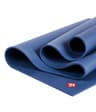
Manduka PRO - firmest and most durable, lifetime guarantee
$141.00
Amazon: Only 10 left in stock - order soon
Check Price on AmazonPrice as of October 21, 2026. #ad How we’re funded

JadeYoga Harmony - best grip if you sweat

Gaiam Premium - cheapest 6 mm, lightest here
$21.90$23.607% off
Amazon: In stock
Check Price on AmazonPrice as of October 21, 2026. #ad How we’re funded
The full ranking, with the spec tables, is in best yoga mats. If your issue is that standard mats are too short for you, start with best yoga mats for tall people instead, because length is a problem no thickness fixes.
The cheap fix that beats buying a second mat
Before you buy two mats, try the thing that solves 90% of the overlap: a folded blanket, placed only where the bone is. Under the knees for kneeling work, under the tailbone for sit-ups, under the hips for bridges. It costs nothing, you already own one, and it is strictly better than a thicker mat because it adds cushioning at the point of contact while leaving the rest of the surface thin and stable for standing poses.
This is also the answer to the most common complaint about yoga mats generally — “my knees hurt” — and it is why we would steer you away from solving that problem by buying a 10 mm mat. You will fix the knees and break the balance poses. Our thickness guide goes through that trade-off properly, and are expensive yoga mats worth it covers when the upgrade is the right call and when it is not.
Whichever you end up with, the mat is not the point. Both the CDC’s and the federal guidelines’ recommendation for muscle-strengthening work two or more days a week is satisfied on a bath towel if that is what you have — the mat exists to remove an excuse, not to create a purchase decision.
Frequently asked questions
What is the difference between a yoga mat and an exercise mat?
Thickness and purpose, and the two follow from each other. A yoga mat is thin - typically 4 to 6 mm - with a grippy surface, because yoga needs your hands and feet to stay put and needs you to feel the floor for balance. An exercise or fitness mat is thick, often 10 to 20 mm, soft and usually not grippy, because its job is cushioning your spine, hips and knees against the floor during sit-ups, planks and floor work. A thick mat is unstable to stand on; a thin mat is uncomfortable to lie on.
Can I use an exercise mat for yoga?
For gentle floor-based or restorative sequences, yes. For anything with standing balance in it, no - and this is the clearest single reason the two products are not interchangeable. A 15 mm foam mat compresses under one foot and lets your ankle roll, which is exactly what you do not want in tree pose or warrior III. The surface is usually wrong too: fitness foam is smooth rather than tacky, so a sweaty palm slides in down dog.
Can I use a yoga mat for exercise?
Yes, and most people do - a 6 mm yoga mat is adequate for planks, press-ups, dumbbell floor work and stretching. Where it falls short is repeated impact on bone: sit-ups on a hard floor through 5 mm of rubber is uncomfortable, and jumping on a yoga mat is a bad idea because the mat is thin, slippery when sweaty and can slide on a smooth floor. If your routine is mostly floor work with your spine on the ground, a thicker mat is genuinely better.
What thickness yoga mat should I get?
Four to 6 mm covers almost everybody. Below about 3 mm you have a travel mat - stable and portable but hard on the kneecaps. Above about 6 mm you start losing the floor feel that balance poses depend on. Of the mats we track, Liforme publishes about 4.2 mm, JadeYoga 3/16 in, IUGA 5 mm and both Manduka's PRO and the Gaiam Premium 6 mm. Our thickness guide works through what each band costs you in stability.
Do I need both a yoga mat and an exercise mat?
Only if you do both kinds of training regularly. If you do, the sensible setup is one good yoga mat for standing and balance work and one cheap thick mat for spine-on-the-floor work, because no single mat is good at both - the thickness that makes one comfortable makes the other unstable. If you do mostly one or the other, buy properly for that and improvise for the rest: a folded blanket under the knees or hips closes most of the gap.
Is a Pilates mat the same as a yoga mat?
No, and it sits between the two. Pilates is performed mostly lying down with the spine rolling against the floor, so a Pilates mat is usually thicker than a yoga mat and firmer than a soft foam fitness mat - cushioning without so much squash that the spine cannot find the floor. A 6 mm dense yoga mat is a reasonable compromise for home Pilates; a 15 mm soft foam mat is not, because it swallows the articulation the exercises are built around.
What should I put under a yoga mat on a hard floor?
Usually nothing, if the mat is right for you - a 6 mm mat on timber or tile is what the thickness is for. If your knees still complain, a folded blanket placed under the knees only is better than a thicker mat, because it adds cushioning where you need it without making the whole surface unstable for standing poses. On a slippery floor, the fix is a mat with a textured underside rather than padding on top.
Sources
- Manduka — PRO Yoga Mat 6mm — Manduka's own product page, and the most useful admission any mat maker makes: 'A hygienic, closed-cell surface keeps sweat, moisture, and bacteria out of your mat', and then, under Use & Care, 'Because the PRO's closed-cell surface does not absorb moisture, the mat may feel slick if you're prone to sweat. We recommend pairing it with an Equa or Yogitoes hand' towel. Manduka also rejects the folk break-in method outright - 'We don't recommend the salt method or other treatments, and no special preparation is required' - and publishes Standard 71 in x 26 in, 7.5 lb (3.4 kg), PVC crafted in Germany, latex-free, certified STANDARD 100 by OEKO-TEX (12.HUS.17706 | Hohenstein), with a lifetime guarantee (accessed October 5, 2026)
- JadeYoga — Harmony Mat — JadeYoga publishes 3/16 in thick, 24 in wide, 68 in and 74 in lengths, about 5 lb, natural rubber tapped from rubber trees, and 'no PVC, EVA or other synthetic rubber', made in the United States. Two cautions are the maker's own: the mats 'are not intended for use outdoors and should not be exposed to sunlight', and although 'Jade mats are 99% latex free... there may be trace amounts of latex proteins in the mats so we recommend persons with latex allergies avoid contact'. The page also carries JadeYoga's claim to have been 'Named Best Mat for Grip by Yoga Journal for 2024' - a third-party award, reported here as the maker's claim and not as a test of ours (accessed October 5, 2026)
- Liforme — CleanGrip Technology — Liforme's own description of the three-layer build that decides how its mat behaves wet: 'a stable, sustainably sourced natural rubber base, providing strength and cushioning', an 'ultra-thin top layer... crafted from our proprietary eco-polyurethane', and between them 'our patented CleanGrip barrier layer. A non-absorbent' sheet that stops sweat reaching the rubber. Liforme's published specification for the Original mat is 185 cm x 68 cm, approx. 4.2 mm thick, approx. 2.5 kg (accessed October 5, 2026)
- CDC — Adult Activity: An Overview — CDC on muscle-strengthening 2+ days/week, 8–12 reps, all major muscle groups (accessed July 19, 2026)
Keep reading
Best Yoga Mats
The whole field ranked on grip, thickness and material, from budget to buy-it-for-life.
See all the picksYoga Mat Thickness Guide
2 mm to 6 mm, and exactly what each band costs you in cushioning and stability.
Read the guideBest Yoga Mats for Beginners
Ranked on which mats work properly the first time you unroll them.
See the picksBest Home Gym Accessories
The low-cost items that make a floor-based home setup work, beyond the mat itself.
See the picksBest Recovery Tools
Foam rollers, massage guns and mobility balls - what belongs on the mat with you.
See the picks