Dumbbells vs Kettlebells
Two weights, two jobs. Where the load sits, what each one trains best, and which to buy first if you can only afford one.
The physical difference is small and the training difference is not. A dumbbell puts the load level with your hand; a kettlebell hangs it below and behind the handle. That offset is why a kettlebell can be swung, and why the same weight feels heavier overhead — and it is the whole reason both exist.
The practical question is which to buy first. For nearly everyone building a first home gym, the answer is dumbbells: they cover more exercises, need less technique, and one adjustable pair replaces a rack. Kettlebells earn their place second, when you want swings, carries and conditioning that dumbbells do awkwardly.
How this is funded: we earn a commission if you buy through our links, at no extra cost to you. It never changes which product we recommend, and we’ll tell you when we’d skip one. Full disclosure.
| Feature | Dumbbells | Kettlebells |
|---|---|---|
| Where the load sits | Level with the hand | Below and behind the handle |
| Exercise range | Widest - most gym movements translate | Narrower, but unique ballistics |
| Learning curve | Shallow | Steeper for swings and cleans |
| Progression | Adjustable in 2.5-5 lb steps | Buy the next bell (usually 8-10 lb apart) |
| Space | One pair, one stand | One bell per weight |
| Conditioning | Possible, not natural | Its strongest use |
| Durability | Mechanism and plastic housing | Solid iron, essentially permanent |
| Buy first if | You want general strength | You want conditioning in minimal space |
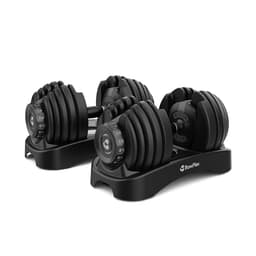
Dumbbells
Bowflex SelectTech 552 Adjustable Dumbbells
Buy this if: you want the widest range of exercises with the least technique to learn, in one purchase.
Strengths
- Covers press, row, squat, lunge, curl and more - the broadest exercise list
- One adjustable pair replaces 15 fixed pairs in the space of a side table
- 2.5 lb micro-jumps at the low end make progression gradual
- Symmetrical load is intuitive - almost no technique barrier to start
Trade-offs
- Awkward for ballistic work - swinging a dumbbell is possible but never comfortable
- Long plastic housing crowds close-grip and some pressing angles
- Caps at 52.5 lb per hand, so strong lifters outgrow it
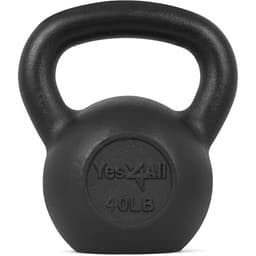
Kettlebells
Yes4All Cast Iron Kettlebell
Buy this if: you want swings, carries and conditioning, or one indestructible weight in a tiny space.
Strengths
- Offset load is built for ballistics - swings, cleans and snatches
- Single-piece cast iron with nothing to break, adjust or service
- Loaded carries and racked squats need no bench and no rack
- One bell is a complete conditioning workout in a square foot of floor
Trade-offs
- Fixed weight - progression means buying another bell
- Swings and cleans genuinely need technique before load
- Painted finish can chip and roughen a handle over time
What each one is actually better at
Dumbbells win on breadth. Nearly every barbell or machine exercise has a dumbbell version: bench press, row, shoulder press, split squat, Romanian deadlift, curl, extension. Because the weight sits level with your hand, the movements feel like the ones you already know, so the technique barrier is low and the first session is productive.
Kettlebells win on ballistics and carries. The offset center of mass lets you swing the bell from between your legs to chest height, which trains the hip hinge explosively — a genuinely different quality from slow, controlled lifting. The handle also makes carries, racked squats and Turkish get-ups natural. A single moderate bell can produce a hard, full-body, breathless session in ten minutes, which is the strongest argument for owning one.
Cost and space per useful pound
An adjustable dumbbell pair looks expensive next to one kettlebell, but compare like with like: it replaces fifteen pairs of fixed dumbbells in one footprint. Kettlebells are cheap individually and expensive as a set, because progression means buying the next size — and the jumps are large. Going from a 35 lb bell to a 44 lb bell is a 26% increase, which is why kettlebell programs progress with reps and density rather than with load. If space is your binding constraint, one or two bells beat everything; if progression is, dumbbells win. Our adjustable vs fixed comparison covers the same trade-off inside the dumbbell family, and cast iron vs adjustable kettlebell does it for bells.
Technique and safety
A dumbbell press done imperfectly is a slightly worse press. A kettlebell swing done imperfectly is a lower back complaint, because people squat the swing or lift with the arms rather than hinging at the hip and letting the bell float. That is a solvable problem — the swing is one movement, learned with a light bell — but it is a real difference in how forgiving the two tools are on day one.
The other safety note runs the other way. Kettlebell work happens on the floor with no bench, no rack and no bar over your face, which makes it the safer choice for training alone. Heavy dumbbell pressing without a spotter has its own risks, which is part of why a bench and, eventually, a rack follow dumbbells into most home gyms.
What weight to start with
For dumbbells, the useful question is what range you need rather than what single weight — our dumbbell weight guide works through it. For kettlebells, most people buy too light: the swing is a hip movement and a bell that is too light teaches you to lift with the arms. Our kettlebell weight guide covers the standard starting weights and why the first bell is usually heavier than people expect.
The honest answer for most home gyms
Start with one adjustable dumbbell pair. Train the basic patterns twice a week, which is what federal guidance asks for anyway — muscle-strengthening work for all major muscle groups on two or more days. When you want conditioning that does not involve a machine, add one kettlebell in the 26–35 lb range for most men or 18–26 lb for most women, learn the swing properly, and you have covered strength and conditioning for under the cost of a year of gym membership. Owning both is not indulgent; owning six of one before you own any of the other usually is.
Frequently asked questions
Should I buy dumbbells or kettlebells first?
Dumbbells, for almost everyone. They cover the widest range of exercises with the least technique, and one adjustable pair replaces a rack of fixed weights. Add a kettlebell second, when you want swings, carries and conditioning that dumbbells handle awkwardly.
Can kettlebells replace dumbbells?
For conditioning and hip-hinge work, easily. For the full range of pressing, rowing and isolation work — and for gradual load progression — not really, because each bell is a fixed weight and the jumps between sizes are large. Many home gyms end up with an adjustable dumbbell pair plus one or two bells.
Are kettlebell swings bad for your back?
Done as a hip hinge with a braced trunk, a swing is one of the better exercises for the posterior chain. Done as a squat with a round back, or lifted with the arms, it is a common source of lower back pain. Learn the movement with a light bell before adding load — the technique is the safety equipment.
Why does a 35 lb kettlebell feel heavier than a 35 lb dumbbell?
Because the mass hangs below and behind the handle rather than sitting level with it, so the load has a longer lever arm against your wrist and shoulder. That is most obvious overhead and in the racked position, and it is the same offset that makes swings work.
Do I need both dumbbells and kettlebells?
No, but they cover different jobs, so most people who train seriously at home eventually own both. If you must choose one, choose on your goal: general strength and progressive loading points to dumbbells; conditioning, carries and minimal space points to a kettlebell.
Sources
- CDC — Adult Activity: An Overview — CDC on muscle-strengthening 2+ days/week, 8–12 reps, all major muscle groups (accessed July 19, 2026)
- U.S. HHS / ODPHP — Physical Activity Guidelines for Americans (2nd ed.) — Federal guideline: 150–300 min/week moderate aerobic + muscle strengthening 2+ days (accessed July 19, 2026)
- BowFlex — SelectTech 552 / 1090 adjustable dumbbell recall notice — Recall conducted with the U.S. CPSC; remedy differs for units bought before vs. after April 23, 2024 (accessed July 20, 2026)
Keep reading
Best adjustable dumbbells
Weight range, adjustment speed and drop tolerance compared, with live prices.
See the dumbbell picksBest kettlebells
Cast iron, coated and adjustable bells compared on handle, finish and weight jumps.
See the kettlebell picksWhat weight kettlebell should I buy?
The starting weights that actually work, and why the first bell is usually heavier than expected.
Get the weight rightCast iron vs adjustable kettlebell
One dial-adjustable bell against a set of fixed ones, on feel, cost and durability.
Compare the two