Doorway vs Wall-Mounted Pull-Up Bar
Every doorway bar we cover is rated 300 lb and the wall mount is rated 500 lb. That 200 lb gap, the 34 in of clearance and a set of holes in your wall are the whole decision.
A pull-up bar is the highest-value piece of equipment per dollar in a home gym, and the only real decision is where it attaches. A doorway bar needs no tools, no holes and no landlord conversation; a wall or ceiling mount bolts into structure and never moves again. Those sound like lifestyle choices, and they would be, except that the published numbers are not close: the three doorway bars we cover are all rated at 300 lb, and the wall mount is rated at 500 lb on 11 gauge steel.
That 300 lb figure is the thing worth understanding before you buy, because it is not a bodyweight limit. It is a total load limit, and it includes you, anything you strap to yourself, and any dynamic load you add by moving fast. Every figure below comes from the makers’ published specifications and the listings linked under each card. We own neither bar and have tested neither.
How this is funded: we earn a commission if you buy through our links, at no extra cost to you. It never changes which product we recommend, and we’ll tell you when we’d skip one. Full disclosure.
| Feature | Doorway bar | Wall or ceiling mount |
|---|---|---|
| Published weight capacity | 300 lb | 500 lb |
| Mounting | Doorway, two-way adjustable, no screws | Wall or ceiling (wood studs or concrete) |
| Steel | Not published | 11 gauge, powder-coated |
| Grip positions | 3 (wide, close, hammer), padded | 1 (32 mm smooth straight bar) |
| Bar length | Fits frames up to 33 in wide | 53.5 in |
| Clearance behind the bar | Not published (door frame depth up to 6 in) | 34 in bracket depth |
| Product weight | 6.2 lb | 25 lb |
| Leaves marks or holes | Can mark trim; no holes | Permanent bolt holes |
| Doubles as floor equipment | Yes - push-ups, dips, sit-ups | No |
| Warranty | Not published | 1 year, not transferable (Titan) |
| Renter-friendly | Yes | No |
| Install time | Seconds, no tools | An afternoon, with a drill |
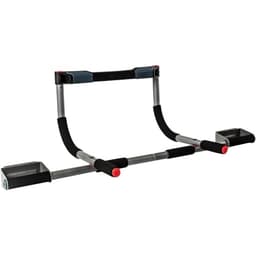
Doorway bar
Perfect Fitness Multi-Gym Pro Doorway Pull-Up Bar
Buy this if: Renters, shared homes, anyone who wants the bar out of sight between sessions, and bodyweight-only training comfortably inside the 300 lb total.
Strengths
- No screws and no holes - it comes down in seconds
- Three padded grips (wide, close, hammer) on curved ergonomic handles
- Patented door frame guard, which Perfect Fitness designs to spread load across the trim rather than two points
- Flips onto the floor at 6.2 lb for push-ups, dips and anchored sit-ups
- Two-way adjustable for frames up to 33 in wide and 6 in deep
Trade-offs
- 300 lb published capacity - and that covers you plus any added weight
- The load goes through your door trim, which is the part of the wall least built for it
- Must be set square before you hang on it, because your bodyweight is what holds a leverage bar in place
- Costs roughly twice a plain slip-in bar for the same 300 lb rating
Price as of October 13, 2026. #ad How we’re funded
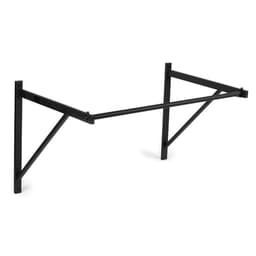
Wall or ceiling mount
Titan Fitness Ceiling & Wall-Mount Pull-Up Bar (53.5 in)
Buy this if: Garage gyms with studs or concrete, weighted pull-ups, rings and suspension trainers, kipping, and anyone whose bodyweight plus a weight belt approaches 300 lb.
Strengths
- 500 lb published capacity on 11 gauge powder-coated steel
- 34 in bracket depth - room for knees-to-elbows, rings and kipping without hitting the wall
- Mounts to a wall or a ceiling, and adjusts to 16, 32 or 52 in stud spacing
- 53.5 in bar with a 32 mm grip, and 25 lb of bar so one person can hold it up while marking holes
Trade-offs
- Permanent: it bolts into wood studs or concrete, so it is not a rental-friendly buy
- One smooth straight bar - no angled or neutral grip positions
- Titan publishes one year of warranty, and states it is not transferable
- You need a stud finder, a drill and the confidence to use both correctly
Price as of October 13, 2026. #ad How we’re funded
What the 300 lb rating actually covers
All three doorway bars we cover publish the same 300 lb capacity: the Iron Gym Total Upper Body, the ProsourceFit Multi-Grip and the Perfect Fitness Multi-Gym Pro. That consistency is not a coincidence — it is roughly what a leverage or slip-in design bearing on residential door trim can be certified for. The number is a total, not a bodyweight. If you weigh 215 lb and strap on a 45 lb plate in a dip belt, you are at 260 lb before you have moved, and a fast, explosive pull adds dynamic load on top of that. There is less headroom in that figure than it looks.
The Titan wall mount publishes 500 lb on 11 gauge steel. The same arithmetic at 215 lb bodyweight leaves you 285 lb of margin, which is the difference between a bar you have to think about and one you do not. If you are planning weighted pull-ups at all, this is the entire argument and it is settled by the spec sheet rather than by preference.
Clearance is the spec nobody checks
A doorway bar sits in a door frame, which means the wall is directly behind your hands and the door opening is directly behind your body. For a strict, vertical pull-up that is fine. For anything that swings — kipping pull-ups, toes-to-bar, knees-to-elbows, or hanging from rings — it is not, and this is where people bark their knuckles or their knees.
Titan publishes 34 in of bracket depth on the wall mount, which is the number that makes those movements possible. None of the doorway bars publish a clearance figure at all, which is honest of them: in a doorway, your clearance is whatever your door frame happens to give you. If your training is strict pull-ups and chin-ups, you will never notice. If you own gymnastic rings, you will notice on day one.
There is a second clearance question that catches garage installs, and it is the real reason to buy the Titan specifically rather than a wall-only bar. Titan’s brackets take a ceiling mount as readily as a wall mount, and in a garage with a low header above the door, the ceiling joists are often the only run of structure long enough to work with.
Grip variety goes the other way
Here the cheap option wins, and it is worth saying clearly because it cuts against the rest of this page. Doorway bars are shaped frames, so they can offer several grips in one product: the Perfect Fitness bar publishes three padded positions (wide, close and hammer), and the ProsourceFit publishes twelve, including the neutral hammer handles that most budget bars skip. The Titan is one smooth 32 mm bar, 53.5 in long. That is a strong, honest bar and it is also a single grip.
If grip variety matters to you and you want it on a permanent mount, the answer is to hang rings or a suspension trainer from the Titan — which is a thing its 500 lb rating and 34 in of clearance exist to allow, and a thing a doorway bar cannot do safely. Those two facts together are the cleanest summary of this comparison: the doorway bar gives you more ways to hold it, and the wall mount gives you more things you can do while holding it.
What each one does to your home
A leverage-style doorway bar works by bracing an upper arm against the wall above the frame, so your own bodyweight is what holds it in place. That puts a concentrated, repeated load on the trim above your door, and soft or freshly painted trim can mark or dent. The Perfect Fitness bar’s frame guard is specifically there to spread that load, and the ProsourceFit ships removable foam covers on its outer handles for the same purpose — they protect the door frame, not your hands. We have written the damage question up properly, with the numbers to measure first, in will a pull-up bar damage a door frame?
The wall mount does not mark anything. It drills four or more holes into studs or concrete and stays there. That is better for the bar and worse for the wall, and it is a decision you cannot quietly reverse before a landlord inspection. Titan also publishes one year of warranty on it and states that the coverage is not transferable beyond the original purchaser who bought direct, which is worth knowing if you are buying second-hand or planning to leave the bar behind when you move.
Can you get a doorway bar wrong?
Mostly by not measuring. The published fit ranges differ and they are narrow: the Iron Gym covers 24 to 32 in doorways (frames up to 35.4 in), the ProsourceFit covers 24 to 36 in with frames up to 6 in thick, and the Perfect Fitness covers frames up to 33 in wide and 6 in deep. Wide openings and deep period trim are the two cases that defeat a cheap bar. Measure the opening width and the trim depth with a tape before you order, and buy the bar whose published range contains both numbers rather than the one with the best photo.
The second failure mode is setting it crooked. A leverage bar relies on sitting square against the wall, and a bar that is a few degrees out is a bar that can shift under load. Check it every time you put it up. It takes five seconds and it is the only maintenance a doorway bar has.
Our call, by situation
Renting, or sharing the space: the Perfect Fitness Multi-Gym Pro. The padding and the frame guard are what you are paying double for over a plain slip-in bar, and both are the right things to pay for on a bar you use daily. Garage or basement gym you own: the Titan, mounted on whichever of the wall or ceiling gives you a clean run of studs. Bodyweight over about 230 lb, or any plans to add weight: the Titan, and this one is not really a preference. If you want the full field rather than a head-to-head, the four bars we cover are ranked in best pull-up bars— and if you cannot yet do a pull-up, a set of assist bands is a better next purchase than either bar on this page.
Frequently asked questions
Is a wall-mounted pull-up bar better than a doorway bar?
On published specs, yes, and the gap is large: the doorway bars we cover are all rated 300 lb, while the Titan wall mount is rated 500 lb on 11 gauge steel with 34 in of bracket depth. It is also permanent, needs studs or concrete, and gives you one grip position instead of three. For a renter doing strict bodyweight pull-ups, the doorway bar is the correct purchase despite the lower rating.
What is the weight limit on a doorway pull-up bar?
Every doorway bar we cover publishes 300 lb - the Iron Gym, the ProsourceFit and the Perfect Fitness Multi-Gym Pro. Read it as a total rather than a bodyweight: it has to cover you, a weight belt or vest if you use one, and the extra dynamic load of a fast pull. At 215 lb bodyweight with a 45 lb plate you are already at 260 lb standing still.
Can you do kipping pull-ups or toes-to-bar on a doorway bar?
Not safely, and the missing spec tells you why. Titan publishes 34 in of bracket depth on its wall mount precisely so your knees and feet clear the wall; no doorway bar publishes a clearance figure, because in a doorway your clearance is whatever the frame gives you - typically a few inches. Strict vertical pull-ups and chin-ups are fine. Anything that swings wants a mounted bar.
Can I hang gymnastic rings from a pull-up bar?
From the Titan wall or ceiling mount, yes - that is what the 500 lb rating and the 34 in of clearance are for. From a doorway bar, no: the bar is held in place partly by your own bodyweight pressing it square, and rings add a swinging, off-axis load that is exactly what that arrangement is worst at.
Will a doorway pull-up bar damage my door frame?
It can mark trim, and the makers design around it - the Perfect Fitness bar has a patented frame guard to spread the load, and the ProsourceFit ships removable foam covers on its outer handles to protect the frame rather than your hands. The risk is highest on soft or freshly painted trim and on a bar that is set crooked. We cover the detail, and the numbers to measure first, in our door frame guide.
What size doorway do these bars fit?
The published ranges are narrow and they differ, so measure first. The Iron Gym covers 24 to 32 in openings with frames up to 35.4 in; the ProsourceFit covers 24 to 36 in with frames up to 6 in thick; the Perfect Fitness covers frames up to 33 in wide and 6 in deep. Wide openings and deep period trim are the two situations that rule out a cheap slip-in bar.
Can a wall-mounted bar go on a ceiling instead?
The Titan can, and it is the main reason to choose it over a wall-only bar. The same brackets take a ceiling or a wall mount and adjust to 16, 32 or 52 in stud spacing. In a garage with a low header above the door, the ceiling joists are frequently the only run of structure long enough to use.
Do I need a stud finder to install a wall-mounted bar?
Yes, and it is not optional. The Titan mounts into wood studs or concrete; drywall alone will not hold a 500 lb-rated bar with a person swinging from it. The bar itself weighs 25 lb, which Titan notes is light enough for one person to hold up while marking the holes - but locating real structure before you drill is the whole job.
Sources
- Titan Fitness — Warranty policy — One-year coverage, and not transferable beyond the original purchaser who bought direct from Titan (accessed July 20, 2026)
- CDC — Adult Activity: An Overview — CDC on muscle-strengthening 2+ days/week, 8–12 reps, all major muscle groups (accessed July 19, 2026)
- U.S. HHS / ODPHP — Physical Activity Guidelines for Americans (2nd ed.) — Federal guideline: 150–300 min/week moderate aerobic + muscle strengthening 2+ days (accessed July 19, 2026)
Keep reading
Best Pull-Up Bars for Apartments
The rental-specific shortlist, including the only bar here with a patented door frame guard.
See the picksBest Pull-Up Bars
All four bars ranked on capacity, grips, fit range and what they do to your door frame.
See all the picksWill a Pull-Up Bar Damage a Door Frame?
How a leverage mount loads your trim, and the three measurements to take before ordering.
Read the guideBest Power Racks
If you want a bar plus squat and bench support, a rack replaces both options here.
See the rack picksBest Resistance Bands
Assist bands are the cheapest route to a first pull-up, whichever bar you mount.
See the band picksBest Home Gym Accessories
Straps, collars and the small hardware that goes around a bar.
See the accessories