How to choose a pull-up bar for a rental
1. Understand the two no-drill designs, because they fail differently
Every screw-free doorway bar is one of two things, and the listings rarely say which.
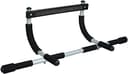
A leverage bar— the Iron Gym is the archetype — has an upper arm that braces flat against the wall above the door frame. Your bodyweight hanging on the front of the bar levers that arm into the wall, and that pressure is what holds the bar in place. It is genuinely secure when it is square, and the whole system depends on it being square: the bar must sit level before you hang on it. The cost is where the pressure goes. Soft paintwork, old plaster or a wall with a thin skim can mark, and the mark is in a spot a letting agent looks at.
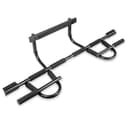
A slip-in bar— the ProsourceFit — hooks over the top of the door frame and distributes the load along the trim itself. There is nothing pressing on the wall above, which is better for paint and worse for trim: the frame is now carrying your bodyweight. On a solid timber frame that is fine. On a hollow-core or a badly fixed architrave it is not, and this is the failure mode worth taking seriously, because it comes off the wall rather than slipping.
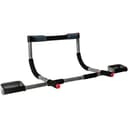
The Perfect Fitness Multi-Gym Pro is a doorway bar with a two-way adjustable fit and, critically, a patented frame guard. The guard’s whole purpose is to spread the load across the trim instead of concentrating it on two contact points. For a renter that is the single most valuable feature on this page, and it is why the bar ranks first despite sharing the same 300 lb capacity as the cheaper two.
We cover this choice in more depth in doorway vs wall-mounted pull-up bar, and the specific question of damage in will a pull-up bar damage a door frame — read that one before you order anything if the deposit matters.
2. Measure the door frame, in both directions
Two measurements, and people take one. Widthis the obvious one, and the published limits differ more than you would expect: Iron Gym covers 24–32 in doorways (frames up to 35.4 in), Perfect Fitness up to 33 in, and ProsourceFit publishes 24–36 in, which is the widest here and the reason to choose it if you have an unusually wide opening.
Frame depthis the one that catches people out. The bar has to clear the thickness of the trim, and both the ProsourceFit and the Perfect Fitness publish a 6 in limit. An older building with deep mouldings can exceed that. Measure from the face of the trim to the wall before ordering, not after.
Also look at the frame honestly. A no-drill bar is only as sound as the architrave it hangs on. If the trim moves when you push it, if the paint is cracked along the joint, or if you can see the fixings have pulled, no bar on this page is safe in that doorway and the answer is a freestanding option or the floor.
3. Assume you will hit the 300 lb ceiling sooner than you think
All three doorway bars publish 300 lb, and that figure covers your bodyweight plus everything else. A 200 lb lifter is well inside it. The same lifter with a 40 lb weight belt and a dip belt plus plates is at 260 lb and climbing, and a kipping pull-up generates a peak load well above static bodyweight.
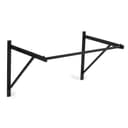
This is the point at which a doorway bar stops being the right tool rather than becoming unsafe gradually. The Titan wall-and-ceiling mount publishes 500 lb on 11 gauge steelwith a 34 in bracket depth — which is the other spec a doorway bar cannot give you at any price, because there is nothing behind a doorway bar but a doorway. That 34 in is what lets you kip, hang rings, or do knees-to-elbows without your heels finding the wall.
It is permanent, Titan says so, and that is the trade: holes in studs in exchange for the capacity and the clearance. If you own the place, or your landlord is relaxed about four bolt holes that patch easily, it is the better bar by a distance. Note also that Titan’s brackets take a ceiling mount as readily as a wall mount, which in a flat with a low header is often the only run of joists long enough.
4. Think about the floor below you
The constraint nobody lists on a spec sheet. Pull-ups themselves are quiet — it is the dismount that travels, and dropping 180 lb onto a timber floor in a converted building is a thud two floors down. Three habits fix almost all of it: step down rather than drop, land on the balls of your feet with soft knees, and put a folded mat under the doorway. The same applies to the push-ups and dips you will do when the Iron Gym or the Perfect Fitness bar is on the floor.
And a note on the bars that convert: both the Iron Gym and the Perfect Fitness lift out of the doorway and sit on the floor as a frame for push-ups, dips and anchored sit-ups. In an apartment that is a real feature rather than a gimmick, because it is a second piece of equipment in the same drawer-sized footprint.
The honest alternatives if no bar fits
Some flats have no suitable doorway, and padding the spec sheet does not change that. Two routes work.
Long loop resistance bands.A 41 in band anchored over a solid door or under a foot does rows, pull-aparts and lat work, and it stores in a drawer. It is not a pull-up, but it loads the same muscles and it leaves no mark at all. Our loop resistance bands page covers which sets publish real resistance figures.
Build the strength first anyway.Most people buying a first pull-up bar cannot yet do a pull-up, which means the bar’s most valuable use in month one is hanging and negatives rather than reps. Our guide to getting your first pull-up sets out the progression, and it works with a doorway bar and a band.
Either way, a pull-up bar is one of the highest-value purchases in a small space: it covers most of the upper-body half of the federal recommendation to do muscle-strengthening work on two or more days a week, and it occupies a doorway you already have.