How to choose a cast iron kettlebell
Start by discarding the thing most listings lead with. Weight capacity, star ratings and the number of exercises pictured on the box tell you nothing, because a lump of iron has no capacity to exceed and every kettlebell does every kettlebell exercise. What is left is four questions, in this order.
1. The finish, and why powder coat is the answer
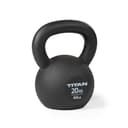
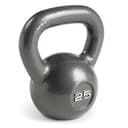
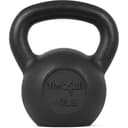
A kettlebell lives on a hard floor and gets dragged, dropped and swung through a chalked grip. The coating is the part that experiences all of that. Powder coat is a dry polymer applied electrostatically and then baked, which produces a slightly grainy, hard-wearing shell — it is the finish that holds chalk, and the one Titan uses on the bell at the top of this page. Sprayed paint and enamel are cheaper and smoother, and they are the finishes that chip first: Yes4All uses a baked paint and says it resists chipping, Marcy uses a hammertone enamel and says its purpose is rust prevention, and CAP and Amazon Basics simply say “painted.” None of those is a reason not to buy, but they are the reason a cheap bell looks rough after a year while a powder-coated one looks the same as the day it arrived.
Then there is the finish we did not pick at all: vinyl coating. A vinyl-jacketed cast iron bell is genuinely the right call in exactly one situation — a hard floor you cannot protect and light bells you set down rather than swing. Everywhere else it is a trap, because the jacket makes the handle slick when your hands are damp, it cannot take chalk, and the seam where the vinyl meets the iron is a wear point. If your worry is the floor, buy a mat and a bare bell rather than a coated one.
2. The handle, which is the only spec that matters and almost nobody prints
Handle thickness is the single most consequential dimension on a kettlebell and the one the category keeps to itself. Titan publishes 37 mm diameter through an 8 in windowon its 20 kg bell. That is a genuinely useful number: it is thick enough that heavy two-handed swings do not fold your fingers into your palm, and wide enough that both hands fit with room to spare. It is also, honestly, more handle than many people want for single-hand pressing or snatches — a thinner bar is easier to hold onto one-handed, and the heavier bells in any line get thicker handles because the casting has to carry more metal.
Every other maker here says the handle is “wide,” “textured” or a “special feature,” which is marketing rather than a measurement. If you have small hands, or you already know that a thick bar bothers you, that silence is a real risk and the Titan spec sheet is worth paying for. Two practical checks cost nothing: a bell you intend to swing two-handed needs a window wide enough for two hands side by side with no overlap, and a bell you intend to press needs a handle you can close your fingers fully around. A kettlebell you cannot grip is a kettlebell you will not use.
3. Single-piece casting, and the one weld to avoid
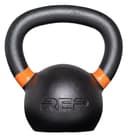
A traditional kettlebell is poured as one piece, so the handle and the ball are the same continuous metal with no joint anywhere in the load path. Titan, Yes4All and CAP all state single-piece construction; REP describes its bells as gravity-cast, which is the same idea named by the pouring method. What you are avoiding is the cheapest possible construction, a handle welded or bolted onto a body, which puts a seam at the exact point carrying the whole load through a swing. It is rare now, but it still turns up at the bottom of marketplace listings and it is worth one look at the product photos to confirm the handle flows into the ball rather than meeting it.
A flat base matters for a less dramatic reason: it lets the bell sit still for renegade rows and push-ups, and it means the bell does not tip when you set it down between sets. Titan publishes a 4.5 in base width, CAP and Yes4All state a flat bottom, and the rest leave it to the photos.
4. The size ladder, because you progress by buying another bell
This is the planning question people skip and then regret. Dumbbells progress by adding a plate or turning a dial. Kettlebells progress by picking up a heavier bell, and the jumps are big — the conventional ladder runs 8, 12, 16, 20, 24 and 32 kg, which in pounds is roughly 18, 26, 35, 44, 53 and 70. A single jump can be a 20% increase in load, which is far more than you would ever add to a barbell lift in one step.
So buy into a line with rungs close together. REP publishes seventeen sizes from 1 kg to 48 kg, which is the widest ladder here and means the next bell is always a small step with the same handle shape. Marcy publishes ten sizes in 5 lb steps from 10 to 55 lb, which is unusually fine at the light end and genuinely useful if you are pressing. Titan runs 4 kg to 32 kg. Yes4All spans 5 to 80 lb. If you have no idea where to start, our kettlebell weight guide works through the first bell, the second, and why the bell you swing is heavier than the bell you press.
What a published weight tolerance tells you
Yes4All states ±3%, and it is the only maker in this group that publishes a tolerance at all. On a 40 lb bell that is up to 1.2 lb of variance either way, which matters less than it sounds for swings and carries and more than you would think if you are chasing a one-arm press at the top of your range. The number itself is not the point — competition-grade bells hold much tighter tolerances and cost accordingly. The point is that a maker who prints a tolerance is a maker who measures, and in a category where nearly everyone declines to state anything checkable, that is information worth having.
Cast iron or adjustable?
Worth settling before you spend. A single-weight cast bell is cheaper per bell, has nothing to fail, and feels like a kettlebell should because it is one piece of iron. An adjustable bell replaces several weights in one footprint — the Bowflex SelectTech 840 covers six settings from 8 to 40 lb — which is the better answer in a small apartment, and the worse answer if you swing hard, because the body is bulkier and the mechanism is the thing you are trusting. We lay both cases out in cast iron vs adjustable kettlebell. The short version: if you have the floor space for two or three fixed bells, buy them.
And if you are still deciding what to load at all, kettlebells are not automatically the right first purchase. Dumbbells vs kettlebells is the comparison before this page, and a pair of adjustable dumbbells covers more exercises for most beginners. Kettlebells earn their place when you want swings, cleans and carries — movements a dumbbell does badly.
The bells to skip, and why
Being specific is more useful than being diplomatic. Skip any bell whose listing shows a welded or bolted handle— the seam sits in the load path. Skip vinyl-coated bells above about 25 lb, because the weights where you most want chalk and grip are exactly the weights where a slick jacket is worst. Skip sets sold as a single bundle of five mismatched weights unless the per-bell price genuinely beats buying the two sizes you will actually use; most people use two bells and store three. And be wary of any listing that states a weight only in pounds with no casting detail, no finish named and no size ladder behind it — that combination usually means a one-off import with no second bell to buy when you outgrow it.
One caution that applies to the whole category rather than any product in it: a kettlebell swing is a hip hinge performed fast, and it is the single most commonly mis-taught movement in home training. Learn the hinge before you add speed, and if the swing is the reason you are buying, the money is better spent on a lighter bell plus coaching than on a heavier bell alone. Public-health guidance asks for muscle-strengthening work twice a week; it does not ask for it to be fast.