What actually makes a rowing machine loud?
Three things, in descending order, and only one of them is the resistance.
1. The resistance mechanism.An air rower drives a fan, and a fan moving enough air to resist a hard pull is genuinely loud — it is a rush of air that gets louder the harder you row, which is exactly the wrong behavior in a flat. A water rower moves water through a tank, which is quieter in volume but rhythmic and carrying. A magnetic rower moves neither: a magnet near a flywheel produces resistance with no medium to displace, which is why every machine on this page except one is magnetic.
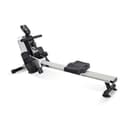
2. The seat and rail. On a magnetic rower this becomes the loudest part of the machine, and almost nobody publishes anything about it. The Stamina 1110is the exception — an aluminum beam with ball-bearing rollers — and that is precisely why it takes the top slot on a page about noise. Rollers running on a bare steel rail chatter; rollers on a bearing do not.
3. The floor underneath it. This is the one you control, and it matters more than the difference between any two machines here. A rower on a bare upstairs floor transmits structure-borne noise straight into the ceiling below. A mat under the rails fixes most of it for a fraction of the price of a quieter machine.
Should you buy magnetic or water for a quiet home?
Buy magneticif the constraint is a shared wall, a sleeping household or a downstairs neighbour. It is the only mechanism here that is quiet in both volume and character, and it stays quiet when you row hard — which an air rower emphatically does not.
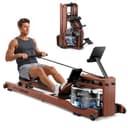
Buy water if you want the stroke feel and the noise you get is noise you do not mind. The YOSUDA wooden water roweris the pick here: a 22-litre tank with a four-blade paddle on a 30 mm FSC-certified beech frame, a 400 lb capacity — the highest on this page — and a 180-degree fold. What it sounds like is a wave, repeatedly, which is either the best or the worst thing about it depending on who else is home. Our water vs magnetic rower comparison takes that decision apart properly.
Do more resistance levels mean a quieter machine?
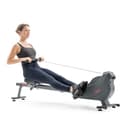
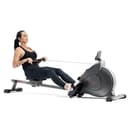
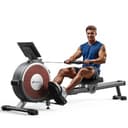
No, and it is worth saying because the level count is the number listings shout loudest. The 32 levels on the Echelon Smart Rower and the 16 on the Sunny Dual Rail and the MERACH Q1S buy you finer control over how hard the pull is, not a lower noise floor. What they do change is how long the machine stays useful: 8 levels is enough for most people starting out and can feel coarse once you are fit.
How much room does it need, and where does it go afterwards?
Two machines here publish their assembled dimensions and the rest do not, which is itself worth knowing before you order. The Stamina 1110is 60 × 22 × 27 in and stores on end; the Sunny Dual Railis 63.2 × 17.7 × 18.9 in and flips up on transport wheels. Both are short for a rower — many are 76 to 96 inches — which is part of why they suit the rooms this page is written for. If the footprint is your binding constraint rather than noise, our small-space rower roundup ranks on exactly that.
What we would buy
The Stamina Magnetic Rower 1110 for most quiet-home buyers: magnetic resistance, the only published rail construction on the page, a short 60-inch frame, on-end storage and a 3-year frame warranty. The Sunny Dual Rail SF-RW524079if you want the lowest price here with 16 levels, a 300 lb limit and the fullest spec sheet of the group. The Sunny SF-RW5515 if folding flat matters more than the level count. The MERACH Q1Sif you are heavier — 350 lb published, on a dual rail, at a budget price. The Echelon Smart Rower if guided classes are what will actually get you rowing. And the YOSUDA wooden water rowerif you want the water stroke and a 400 lb capacity, and the sound of a wave is not a problem in your house.