How do you choose a waterproof fitness tracker?
Three questions, in this order. They sort this page faster than any feature list.
1. What is the water, actually?
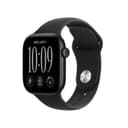
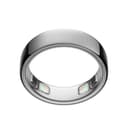
Showers and rain are a solved problem — every device here clears that by a wide margin. Pool swimmingis where the ratings start to matter, and 5 ATM or 50 m is the class that covers it on all six. Where the field splits is anything with pressure or depth behind it: only the Apple Watch Series 12publishes a depth gauge, rated to 6 m, and only the Oura Ring 5publishes a 100 m figure — with Oura’s own caveat that it covers sauna and water sports but not diving. Nothing on this page is a dive computer, and none of these makers claims otherwise.
2. Do you need the route, or just the time in the water?
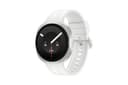
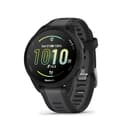
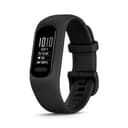
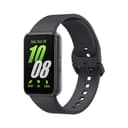
This is the question that actually decides it for most buyers, and it has nothing to do with water at all. Built-in GPSmeans the device maps an open-water swim, a paddle or a beach run on its own. Three devices here have it: the Series 12, the Galaxy Watch9 with dual-frequency L1+L5, and the Forerunner 165 with all-systems GNSS. The Galaxy Fit3 and the vivosmart 5 use connected GPS, which means your phone draws the map — and your phone is the one thing you will not be carrying into the water. The Oura Ring 5 has no GPS at all; it is a recovery and sleep device that happens to be rated to 100 m.
3. How often are you willing to charge it?
A watch that needs the charger every night is a watch you will take off before a morning swim. The two full smartwatches here are the two shortest batteries: Apple publishes up to 24 hoursof normal use for the Series 12 (with 15 minutes on the charger buying up to 12 hours back), and Samsung’s cells work out to about a day. Against that, the Forerunner 165 publishes up to 11 days in smartwatch mode, the Galaxy Fit3 up to 13 days, and the Oura Ring 5 typically 6–9 days. If your swim is at 6 a.m. twice a week, battery is a bigger practical constraint than the rating.
What the ratings mean, in plain terms
5 ATMis a static pressure test equivalent to 50 m of water column. It is the standard class for swim-safe wearables and covers pool and open-water swimming. It is not a diving rating and it is not a guarantee about hot water or high-velocity impact — which is why makers keep saunas and jet skis out of their own wording.
WR50 / 50 m to ISO 22810:2010is Apple’s phrasing for the same class, tested to a published international standard. The Series 12 adds a depth gauge rated to 6 m on top of it, which is a separate and more specific claim.
IP68is a dust and immersion rating. Samsung publishes it alongside 5 ATM on both the Galaxy Watch9 and the Galaxy Fit3, and that pairing is the useful one — IP68 on its own would tell you nothing about swimming.
Not published means exactly that. The Xiaomi Smart Band 10 and the Amazfit Active Max are good devices that we recommend on other pages; neither maker states a water rating, so neither is on this one.
What we would buy
The Apple Watch Series 12 if you carry an iPhone and want the only depth-rated device here, and you accept a daily charge. The Samsung Galaxy Watch9for the same job on an Android phone, with dual-band GPS and the MIL-STD-810H rating alongside 5 ATM. The Garmin Forerunner 165 if pool laps and running are the point and you would rather charge once a week than once a night. The Oura Ring 5if you want the highest published rating on the page and do not want a screen at all — remembering the membership. The Garmin vivosmart 5if you want 5 ATM in something you forget you are wearing, with nothing paywalled. And the Samsung Galaxy Fit3 if you are on Android and want a published rating, a real screen and 13 days for the least money on this page.