How to choose a tracker for a smaller wrist
Four questions, in this order. The first one is the one nobody asks and the one that decides whether you keep wearing the thing.
1. Does the maker publish a fit range — and in what unit?
This is the finding that organizes the page. Four makers, four different disclosures:
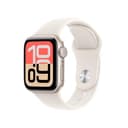
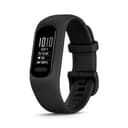
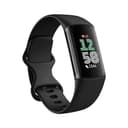
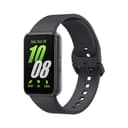
Applepublishes the wrist range the case is built for, which is the most directly useful form: the 40 mm SE 3 case “fits 130–200 mm wrists” and the 44 mm fits 140–245 mm. Put a tape measure round your wrist and you have your answer before you spend anything. Garmindoes the same thing for its band sizes — small/medium for 122–188 mm wrists, large for 148–228 mm — and publishes a printable paper sizing guide, which is the only one of its kind here. Fitbitpublishes band circumferences in inches instead (small 5.1–6.7 in, large 6.7–8.3 in) and, usefully, ships both sizes in the box, so the Charge 6 is the hardest device here to get wrong. Samsungpublishes a strap length of 122 mm rather than a wrist range, which is a different number and needs converting in your head.
Why it matters beyond comfort: wrist-based optical heart rate works by shining light into skin and reading what comes back, so a sensor that lifts off a narrow wrist during movement produces worse data. Fit is not cosmetic on a tracker — it is an accuracy input. Our guide to how accurate fitness trackers are goes into the limits in detail, and the short version is that placement and fit are the two things the wearer actually controls.
2. How heavy is it, in the figure the maker actually publishes?
The spread here is bigger than it sounds. Samsung’s Galaxy Fit3 publishes 18.5 g — and publishes the caveat with it, that the figure “refers to the body only and excludes the weight of the band.” That is an honest disclosure and also a reason not to compare it directly with Garmin’s 24.5 g or Apple’s 26.3 g, which are device weights for the band-included and case-only cases respectively. Fitbit’s Charge 6 sits around 30 g.
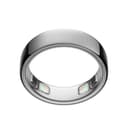
Ten grams is the difference between a band you sleep in without noticing and one you take off at night — and a tracker you take off at night does not track sleep. If sleep data is a main reason you are buying, weight is not a vanity spec. The logical end point of that argument is the Oura Ring 5, which moves the sensor to a finger: published as the thinnest ring Oura has made at 2.28 mm, with no screen to light up at 3 a.m. Our smart ring vs smartwatch comparison covers what you give up, which is most of the daytime workout features.
3. What do the cycle features actually do?
There is a real hierarchy here and it is not the one the marketing implies. At the bottom, every device logs what you type: period start, symptoms, notes. Samsung Health and Garmin Connect sit here, free, with logging and reminders.
In the middle, Fitbitadds pattern analysis across logged cycles and an estimated ovulation window, with the deeper insight tiers sitting behind Fitbit Premium — so check which half of the feature you are buying. Oura offers period prediction in its app, and the entire Oura data set requires an active membership, which is the thing to know before you buy the hardware.
At the top, Applepublishes the most: an Advanced Cycle Tracking app with fertile-window estimates, retrospective ovulation estimates and perimenopause support, included with the watch and with no subscription. Those are the published feature names, and the important caveat is in the word “estimates.” Cycle features on consumer wearables are wellness tools built on logged data and sensor trends. They are not diagnostics, they are not contraception, and nothing here replaces a conversation with a clinician about a cycle that has changed.
4. What does the data cost after the device?
Three of these five give you everything with the hardware. Garmin Connect is free, SamsungHealth is free, and the Apple Watch’s health features come with the watch. Fitbit puts its richer analysis behind Premium, and Oura requires a membership for the data the ring exists to produce. Neither of those is a scandal; both are a recurring cost that changes the real price of the device over three years. If a subscription is a dealbreaker, our roundup of fitness trackers without a subscription is built entirely around that constraint.
What a tracker is good at — and where it stops
What these devices do well is persistence. They count steps and active minutes reliably enough to tell you whether this week looked like last week, they track sleep duration well, and they put a number on resting heart rate over months, which is one of the genuinely useful long-run signals a wearable produces. That is plenty: federal guidance asks adults for 150 to 300 minutes of moderate activity a week plus muscle strengthening on two or more days, and a tracker is a good tool for noticing you are not getting it.
What they are not is instrumentation. Calorie estimates are the weakest number on any tracker. Sleep staging is an inference from movement and heart rate, not a measurement, and how accurate sleep trackers are works through what that means for the nightly score. Cycle predictions are patterns over logged data. Treat every one of those as a trend line, not a fact, and the device stays useful instead of becoming something to argue with.
Which one we would buy
If you want the most capable device and the clearest fit information, Apple Watch SE 3at 40 mm — with the caveat that it needs an iPhone, and that the SE tier leaves out ECG and blood oxygen. If you want something slim and genuinely subscription-free that works with either phone platform, Garmin vivosmart 5, accepting a monochrome screen and phone-dependent GPS. If you are not sure of your wrist size and do not want to think about it, Fitbit Charge 6 ships both bands and has the best cycle logging short of Apple. If the lightest possible band is the priority, Samsung Galaxy Fit3 — check our Android tracker roundup for the platform caveats first. And if you simply do not like wearing something on your wrist, the Oura Ring 5 is the best screen-free answer, as long as the membership is a cost you accept and you are willing to be sized properly rather than guessing.