What Size Power Rack Do I Need?
A rack either fits the room or it doesn't, and three published numbers decide it - upright height, pull-up bar height and inside depth. The fourth number that catches people out isn't on the rack's spec sheet at all: it's the barbell.
How this is funded: we earn a commission if you buy through our links, at no extra cost to you. It never changes which product we recommend, and we’ll tell you when we’d skip one. Full disclosure.
Where to buy the size you land on
Best published spec sheet
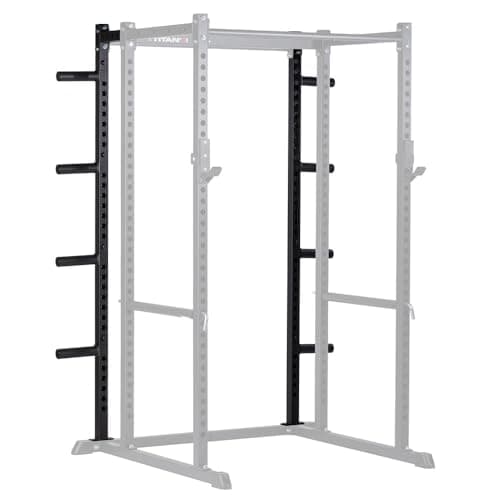
Titan Fitness T-3 Series Power Rack
Home gym lifters who want a rack-and-bench setup that handles heavy work.
$417.99 · View on AmazonFull comparisonPrice as of October 13, 2026. #ad How we’re funded
Shortest full cage
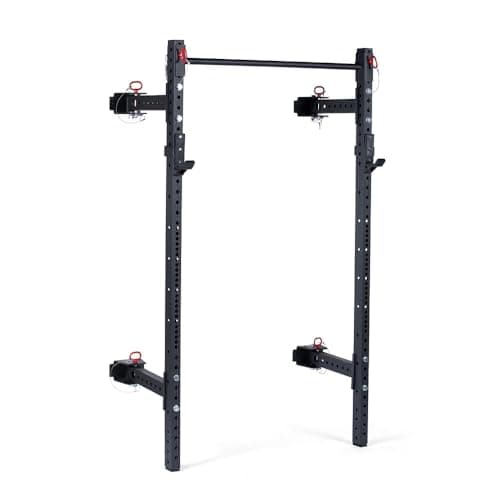
Titan Fitness T-2 Series Power Rack
Space- and budget-limited lifters who don't need the beefiest uprights.
$234.99 · View on AmazonFull comparisonPrice as of October 13, 2026. #ad How we’re funded
Most attachments included
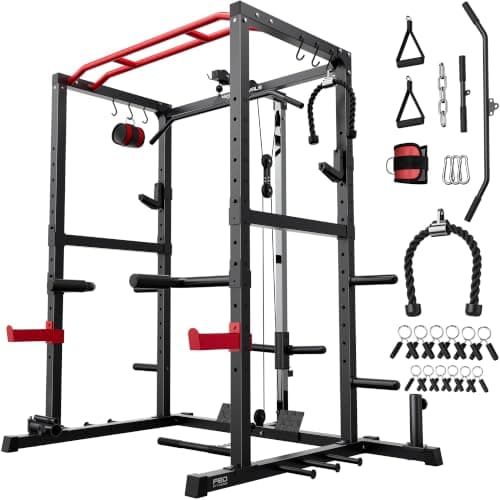
Sportsroyals 1200 lb Power Cage with Lat Pulldown
First-cage buyers who would rather have the attachments included than buy them one at a time.
Full comparison
Almost every power rack regret is a measurement problem rather than a product problem. The steel is nearly always fine; what goes wrong is that the rack arrives at 91 in into a basement with 84 in of headroom, or the pull-up bar turns out to sit below the owner’s standing reach, or the cage fits perfectly and then there is nowhere to put a plate on the end of the bar.
All four of those are avoidable from published figures, and they are the four numbers this guide works through. We use Titan’s T-3 as the worked example throughout, not because it is the only rack worth buying but because Titan publishes the most complete dimension sheet in the category — including one figure almost nobody else prints, the maximum pull-up bar height.
Number one: upright height, against the ceiling you actually have
Home racks are sold in height tiers, and Titan’s own comparison table is a good map of the range: the T-2 at 71 in and 83 in, the T-3 at 82 in and 91 in, and the heavier 3x3 in series up to 90 in and 100 in. In feet that is a spread from under six feet to over eight, and it is the single decision that most constrains the rest.
Measure floor to the lowest obstruction directly above the rack’s spot. In a garage that is usually the garage door track or the opener rail, not the ceiling. In a basement it is a joist, a duct or a light fitting. Then subtract four to six inches, for two reasons that are easy to forget on paper: a rack is assembled by lifting its top crossmembers up and over the uprights, which needs clearance above the finished height; and you want to be able to stand on a plate or a step inside the cage without your head meeting the ceiling.
Run that against a 7 ft (84 in) basement and the arithmetic is unforgiving. A 91 in rack is out. An 82 in rack leaves two inches, which is not enough to build it comfortably. A 71 in rack fits with room to spare. That is why short racks exist, and it is a legitimate buy — with one consequence, which is the next number.
Number two: pull-up bar height, which is not the rack height
A rack’s pull-up bar sits below its top, and the gap is bigger than people assume. Titan publishes a maximum pull-up bar height of 78 inon the 82 in T-3 — four inches of frame above the bar. On a 71 in rack the bar is necessarily under 71 in, which is 5 ft 11 in: below the standing reach of most adults.
The figure to check it against is not your height but your standing reach — fingertips with your arm straight up. You hang from a bar at roughly that height, and your chin comes over the bar a few inches higher. A bar below your standing reach still works, but you have to bend your knees to hang, which makes a strict pull-up awkward and a kipping or weighted one impractical. If pull-ups are a core part of what you train, and the ceiling forces a short rack, the better answer is usually a short cage plus a separate bar in the tallest doorway or wall in the house. We cover the published capacity ratings for those in the pull-up bar roundup, and the fit question in doorway vs wall-mounted.
Number three: inside depth, and the bench test
Depth is published two ways and the difference matters. For the 24 in-deep T-3, Titan publishes an inside depth of 24 in and an outside depth of 30 in, with an inside width of 42 in and an outside width of 46 in. The inside figure is the space you train in; the outside figure is the space the rack occupies. The overall footprint is published as 54 in x 32.75 in for that configuration, and 54 in x 44.75 infor the 36 in-deep one.
The decision between them comes down to a single question: does a bench live inside the cage?At 24 in of inside depth you can squat comfortably and you can bench, but the bench has to be slid in and out and there is not much room to walk a bar forward off the hooks. At 36 in a bench can stay inside permanently, you can walk a squat out and back, and the whole cage is easier to live in. The cost is about a foot of floor depth, which in a one-car garage or a spare bedroom is often the deciding factor. If a bench is part of the plan, measure it first — our weight bench picks differ by several inches in length and more than that in how far the backrest travels.
Number four: the barbell, which is wider than every home rack
This is the one that catches people out, because it is not on the rack’s spec sheet at all. A full-length Olympic bar is a published 86.75 inoverall, with 51.5 in between the sleeves and 15.25 in of loadable sleeve on each end. That is 7 ft 2.75 in of steel, against a rack whose outside width is 46 in. The bar overhangs the rack by roughly 20 in on each side, and you have to be able to get a 45 lb plate onto those sleeves and a collar on after it.
So plan the width of the space around the bar: the bar’s length plus about a foot each side to load it, which comes to roughly 8 ft of clear width. Add a walkway behind the rack for walking a squat out and you are looking at something like 8 ft by 6 ft of genuinely usable floor, with the rack’s own 4.5 ft by 2.75 ft footprint sitting inside that. A rack that technically fits against a wall in a 7 ft-wide room is a rack you cannot load.
The capacity figure to read, and the one to ignore
Rack listings advertise capacity in a way that invites a false comparison. Titan publishes two numbers for the T-3: a rackable capacity of 1,100 lb and a whole rack capacity of 4,400 lb. The first is what the J-hooks will hold — the number that describes what you can rest a loaded barbell on. The second describes the frame as a structure. Both are real; only one is relevant to a lifter, and it is the smaller one.
Keep that in mind when a cheaper cage advertises a bigger figure. A rack rated “1,200 lb” may be quoting a frame rating against another rack’s hook rating, which is not a like-for-like comparison. Two of the racks in our roundup publish no capacity figure at all, which is its own kind of answer. For context on what any of these numbers mean in practice: a lifter squatting 300 lb with the bar is nowhere near even a conservative hook rating, so for most home training capacity is not the constraint — the ceiling is.
Hole size, hole spacing and the accessory question
Two published figures decide how a rack behaves day to day. Hole spacingis how finely you can set the J-hooks and the safeties: Titan publishes 6 in side spacing through the T-3’s uprights with tighter Westside spacing through the bench and clean-pull zone, while the T-2 uses 1 in holes. Finer spacing in the pressing zone is the difference between setting the bar at the right height for a bench press and settling for half an inch too high.
Hole size— 11/16 in on the T-3 — decides which attachments fit, because dip bars, landmines, band pegs and lat towers are made for a specific hole pattern. That makes the choice of series a longer-term commitment than the choice of height. If you expect to add attachments, buy into a pattern with a range behind it; the power rack roundup notes which of our picks ship with attachments included and which expect you to buy them.
One more size question sits underneath all of this. If the honest answer to the ceiling test is that nothing fits, a cage is not the only way to train with a barbell — but it is the only one that catches a failed rep for you, which is the whole reason to own one if you train alone. Spending less on a rack that fits beats spending more on one that does not, and a shorter rack plus a separate pull-up bar is usually a better room than a tall rack you cannot assemble. Where a rack fits into the rest of the purchase order is covered in how to build a home gym.
Published dimensions on three cages we cover
Three of the five racks in our roundup publish no capacity figure and none publishes a footprint, which is why the worked example above uses the T-3. 'Not published' is the finding, not a gap in our reading.
| Spec | Titan Fitness T-3 Series Power Rack | Titan Fitness T-2 Series Power Rack | Sportsroyals 1200 lb Power Cage with Lat Pulldown |
|---|---|---|---|
| Height options | 82 / 91 in | 71 / 83 in | Not published |
| Uprights | 2 x 3 in, 11-gauge | 2 x 2 in | 50 x 50 mm, 1.5 mm wall |
| Hole spacing | 6 in, Westside in press zone | 1 in holes (Titan table) | 14 positions |
| Hole size | 11/16 in | 1 in | Not published |
| Max pull-up bar height | 78 in (82 in rack) | Not published | Not published |
| Inside depth | 24 in / 36 in | Not published | Not published |
| Rackable capacity | 1,100 lb | Not published | Not published |
| Whole-rack capacity | 4,400 lb | Not published | 1,200 lb (listing) |
Every figure above is one the maker publishes, read on the dated visit linked under each write-up below. “Not published” means the maker does not state it — we do not fill the gap with an estimate.
A note on that table: Titan’s current comparison page lists the T-2 upright as 14-gauge steel, while the figure carried on our older T-2 pages is 11-gauge. Rather than quietly pick one, we have left the gauge out of the sizing argument above entirely — nothing in this guide turns on it — and we are re-checking the T-2 against Titan’s documentation before updating the pages that quote it. The heights, hole sizes and the T-3 dimensions are all read from Titan’s own pages on the dates listed in the sources below.
Frequently asked questions
What ceiling height do I need for a power rack?
Work from the rack, not from a rule of thumb. Titan's T-3 comes at 82 in and 91 in overall and the T-2 at 71 in and 83 in, so a 7 ft (84 in) basement ceiling rules out every 91 in rack and makes an 82 in one tight. Add 4 to 6 in on top of the rack's published height for lifting the top crossmembers into place during assembly and for standing on a plate without hitting the ceiling. And measure at the spot the rack will stand - joists, lights and garage door tracks are usually lower than the ceiling itself.
Can I use a power rack in a basement with 7 ft ceilings?
Yes, with a short rack - and you will probably lose the pull-up bar. The short configurations exist for this: Titan lists the T-2 at 71 in and the T-3 at 82 in. A 71 in rack clears a 7 ft ceiling comfortably, but its bar sits below 71 in, which is under the standing reach of most adults, so pulling up means tucking your knees. If pull-ups matter more than squats inside a cage, a wall-mounted or doorway bar in the tallest spot in the house is the better buy.
How much floor space does a power rack need?
More than its footprint, because the barbell is wider than the rack. Titan publishes an overall footprint of 54 in x 32.75 in for the 24 in-deep T-3 and 54 in x 44.75 in for the 36 in-deep version - roughly 4.5 ft x 2.75 ft and 4.5 ft x 3.75 ft. But a full-length Olympic bar is a published 86.75 in, so you need something like 8 ft of clear width to hold the bar and still get a plate on each end. Allow a walkway behind for walking a bar out of the rack and you are at about 8 x 6 ft of usable space.
Is 24 in or 36 in inside depth better?
It depends on one thing: whether a bench lives inside the cage. A 24 in inside depth is enough to squat in and enough to bench if you slide the bench in and out, and it saves about a foot of floor. A 36 in depth lets a bench stay inside permanently, gives you room to walk a bar out and back, and makes the cage more comfortable for anything done inside it. In a one-car garage or a spare bedroom the 24 in version is usually the right compromise.
What does rackable capacity mean on a power rack?
It is the load the J-hooks will hold, and it is the number that matters - but it is not the number most listings advertise. Titan publishes a rackable capacity of 1,100 lb for the T-3 alongside a whole rack capacity of 4,400 lb. The bigger figure describes the frame as a structure, not what you can rest a loaded bar on. When one rack claims 1,200 lb and another 1,100 lb, check which quantity each one is quoting before you treat it as a comparison.
Does hole spacing matter when choosing a rack size?
It decides how precisely you can set bar and safety heights, which matters most for pressing. Titan's T-3 publishes 6 in side hole spacing through the upright with tighter Westside spacing through the bench and clean-pull zone, and an 11/16 in hole size; the T-2 uses 1 in holes. Hole size also governs which accessories fit, since attachments are made for a specific hole pattern - a reason to buy into a series whose accessory range you are happy with rather than the cheapest frame.
Should I bolt the rack to the floor?
Only if the maker's configuration expects it. Titan sells some series in both bolt-down and flat-foot versions and the published heights differ between them - its X-3 is listed at 80 in and 90 in bolted down, 82 in and 91 in on flat feet - because the feet add height. Flat-foot racks are designed to stand free and are the normal choice for a garage or a rented space. Bolting is a fine answer on a concrete slab you own, and a non-answer on a timber floor upstairs.
Do I need a full cage, or will a squat stand do?
A four-post cage is what lets you fail a squat or a bench press safely on your own, because the safety bars catch the barbell. If you train alone and lift anything near your limit, that is the whole argument and it is a strong one. A two-post stand takes much less floor space and less ceiling, and is a reasonable call if you press light, squat conservatively or genuinely cannot fit a cage - but it asks you to bail a failed rep rather than let the rack catch it. Our power rack roundup covers the full cages we would buy.
Sources
- Titan Fitness — T-3 Series Power Rack (82 in / 24 in) — The published dimensions a buyer actually has to plan a room around: 'Overall Height: 82-in.', 'Overall Footprint: 54-in x 32.75-in.', 'Inside Depth: 24-in.', 'Outside Depth: 30-in.', 'Inside Width: 42-in.', 'Outside Width: 46-in.', 'Material: 2 x 3-in. 11-Ga Steel', 'Hole Size: 11/16-in.' and - the figure almost no rack listing prints - 'Max Pull-Up Bar Height: 78-in.'. Titan also publishes 'Rackable Capacity: 1,100 lb.', 'Whole Rack Capacity: 4,400 lb.' and 'Product Weight: 186 lb.', with 6 in side hole spacing throughout the upright and Westside spacing through the bench and clean-pull zone (accessed October 10, 2026)
- Titan Fitness — Power Rack Comparison — Titan's own cross-series table, read for the height options a room has to clear: T-2 at 71 in and 83 in with 1 in holes, T-3 at 82 in and 91 in with 11/16 in holes and Westside spacing available, X-3 at 80/90 in bolt-down or 82/91 in flat-foot on 3x3 in 11-gauge, and the TITAN Series at 90/100 in bolt-down or 90 in flat-foot. The table also lists the T-2 upright as '2"x2" 14-Gauge steel', which does NOT match the 11-gauge figure our older T-2 pages carry - flagged in Docs/ContentLedger.md for a dedicated audit rather than changed here (accessed October 10, 2026)
- Titan Fitness — TITAN Series Power Bar — Read for the dimension a rack buyer has to plan a room around but that no rack listing mentions: the bar itself. Titan publishes 'Overall Length: 86.75-in.', 'Sleeve to Sleeve Length: 51.5-in.', 'Loadable Sleeve Length: 15.25-in.', 'Shaft Diameter: 28.5 mm', 'Sleeve Diameter: 50 mm', 'Product Weight: 20 KG (45 lb.)', 'Tensile Strength: 200,000 PSI' and 'Weight Capacity: 2,000 lb.' - i.e. a full-length bar is 7 ft 2.75 in wide, which is wider than any home rack and is what actually sets the width of the room (accessed October 10, 2026)
- Titan Fitness — Warranty policy — One-year coverage, and not transferable beyond the original purchaser who bought direct from Titan (accessed July 20, 2026)
- U.S. HHS / ODPHP — Physical Activity Guidelines for Americans (2nd ed.) — Federal guideline: 150–300 min/week moderate aerobic + muscle strengthening 2+ days (accessed July 19, 2026)
Keep reading
Best Power Racks
Once you know the size, this is which cage to buy - steel, hole spacing, capacity and what comes in the box.
See the picksTitan T-3 vs T-2 Power Rack
The two sizes in this guide, head to head: upright dimensions, hole spacing and what the extra steel buys.
Compare theseHow to Build a Home Gym
Where the rack fits in the order of purchases, plus flooring, ceiling and the bar to pair with it.
Read the guideBest Weight Benches
The bench that has to fit inside the cage - and the reason inside depth is the spec to get right.
Compare benchesBest Pull-Up Bars
If the ceiling rules out a tall rack, this is the cheaper way to keep pull-ups in the program.
See the bar picks