Titan T-3 vs Sportsroyals Power Cage
One rack publishes its steel and not its capacity. The other publishes a 1,200 lb capacity on half the wall thickness, and throws in the pulldown. Which trade is the right one for a home gym.
These two racks cost roughly the same and are built on opposite bets. The Titan T-3spends its budget on the steel and sells you the rack: 2 × 3 in uprights in 11-gauge, Westside hole spacing in the pressing zone, 5/8 in hardware, and an accessory ecosystem you buy into one piece at a time. The Sportsroyals cagespends its budget on hardware and sells you a gym: a stated 1,200 lb capacity, a high and low pulley, a wide-and-narrow pull-up frame, dip bars, a landmine, band pegs and clamps, all in the box.
The comparison is more interesting than “cheap versus good,” because of one asymmetry we did not expect. The rack with the bigger capacity number has the thinner steel.Sportsroyals publishes 1,200 lb on 50 × 50 mm tube with a 1.5 mm wall; Titan publishes 11-gauge (about 3 mm) on a bigger 2 × 3 in tube and publishes no capacity at all. Both options below show a live price.
How this is funded: we earn a commission if you buy through our links, at no extra cost to you. It never changes which product we recommend, and we’ll tell you when we’d skip one. Full disclosure.
| Feature | Titan T-3 (steel first) | Sportsroyals (hardware first) |
|---|---|---|
| Upright tube | 2 x 3 in (about 51 x 76 mm) | 50 x 50 mm square |
| Published wall thickness | 11-gauge (about 3 mm) | 1.5 mm |
| Published weight capacity | Not published | 1,200 lb |
| Hole spacing | 2 in, with 1 in Westside in the press zone | 14 height positions |
| Hardware | 5/8 in | Not published |
| Height options | 71 / 82 / 91 in | Single height |
| Pulley / lat pulldown | Sold separately | High and low, included (rope rated 500 lb) |
| Pull-up bar | Configuration dependent | Wide and narrow frame, included |
| Other attachments | Large ecosystem, bought separately | Dip bars, landmine, band pegs, foot board, clamps |
| Best for | Heavy barbell work and long-term upgrades | A complete first setup in one box |
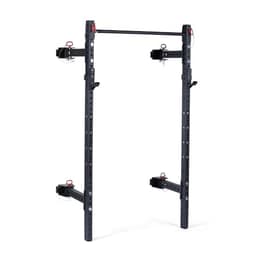
Titan T-3 (steel first)
Titan Fitness T-3 Series Power Rack
Buy this if: Lifters who will load the rack heavily, bench inside it and keep adding attachments over years.
Strengths
- 2 x 3 in uprights in 11-gauge steel - about 3 mm of wall, double the Sportsroyals figure
- 1 in Westside hole spacing through the pressing zone, so the bar catches land where you need them
- 5/8 in hardware and a large accessory ecosystem built around the hole pattern
- Three published height options (71 / 82 / 91 in), so it can fit a basement ceiling
- Can be bolted down or run free-standing as a four-post cage
Trade-offs
- Titan publishes NO weight capacity for this rack, which is the one number buyers ask for first
- Attachments are extra - the pulldown, dip bars and landmine the Sportsroyals includes are all separate purchases
- Flat-pack assembly is heavy and genuinely awkward to do solo
- Powder coat can chip during setup, which is cosmetic but annoying on a new rack
Price as of October 31, 2026. #ad How we’re funded
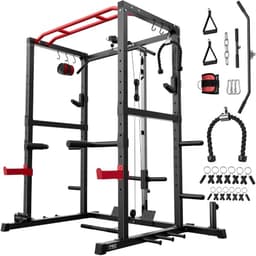
Sportsroyals (hardware first)
Sportsroyals 1200 lb Power Cage with Lat Pulldown
Buy this if: First-cage buyers who want a pulldown, dip bars and a landmine included rather than bought one at a time.
Strengths
- Published 1,200 lb capacity, with the pulley rope rated separately at 500 lb
- High and low pulley, wide and narrow pull-up frame, dip bars, landmine, band pegs, foot board and clamps all included
- 14 height positions for J-hooks and safety bars
- The cheapest route to cable work at home short of buying a second machine
Trade-offs
- 50 x 50 mm uprights at a 1.5 mm wall are roughly half the wall thickness of 11-gauge steel
- 14 positions is coarser than Westside spacing, which matters most for bench press catch height
- A published capacity on thinner tube is a number to read with the frame geometry, not instead of it
- More included parts means more bolts, more assembly time and more things to re-tighten
The steel, and the number that is missing from it
Start with what a power rack is for: holding a loaded barbell above you while you get under it. Everything about the frame follows from that, and two published figures carry most of it — the tube size and the wall thickness.
Titan publishes 2 × 3 in, 11-gauge. Eleven gauge is about 3 mm of steel wall, and a 2 × 3 in tube is the standard shape for a home rack that is expected to take real weight. Sportsroyals publishes 50 × 50 mm with a 1.5 mm wall— a slightly smaller square tube with roughly half the wall. That difference is not marketing, it is the material, and it is the reason the two racks feel different the first time you rack a heavy bar: a thicker wall rings less and flexes less at the J-hook.
Now the asymmetry. Titan publishes no weight capacity for the T-3. Sportsroyals publishes 1,200 lb. Read naively, the thinner rack wins the spec sheet. Read properly, the two statements are not comparable: a published capacity is a number a manufacturer chooses to state, with its own test conditions and its own safety factor, and nobody in this price bracket publishes the test. We have not load-tested either rack and will not pretend otherwise. What we can say is that the material figures point one way and the headline figure points the other, and that for a home lifter the practical question is almost never 1,200 lb — it is whether the frame is still square and quiet at 315.
That is also the pattern our equipment brands guide keeps finding across this site: the makers who publish the most checkable material specs are frequently the ones who publish no headline capacity, and the makers with the biggest headline numbers publish the least about the steel.
Hole spacing is the spec that decides bench press
This is the one difference that changes a workout rather than a purchase. Titan publishes 2 in spacing with 1 in Westside spacing through the pressing zone— the band of holes where a bench press starts and finishes. Sportsroyals publishes 14 height positions.
Why it matters: on a bench press the difference between the right J-hook height and one hole too high is the difference between unracking cleanly and pressing the bar out of the hooks with your shoulders already loaded. Narrow spacing in that zone means you can always find the right height; coarse spacing means you sometimes cannot, and the usual workaround is a folded towel under the bench, which is a worse answer than it sounds. If you intend to bench inside the rack, 1 in spacing is worth paying for. If the rack is mostly for squats, rack pulls and pull-ups, coarse spacing costs you very little. Our bench roundup covers the other half of that setup.
The attachments: buy now or buy later
The Sportsroyals arrives as a gym. A high and low pulley means lat pulldowns, cable rows, triceps work and face pulls — movements a barbell does badly or not at all — and the included dip bars, landmine, band pegs and clamps cover most of the accessory work a home lifter adds in the first year. The published rope rating is 500 lb, stated separately from the frame capacity, which is an honest way to publish it.
Titan’s answer is the ecosystem: the hole pattern is shared across a large accessory range, so you can add a pulldown, a landmine or dip bars later, and swap them as your training changes. The trade is real money and real sequencing — each piece is a separate purchase, and the total cost of a T-3 plus a pulley system plus dip handles lands well above the Sportsroyals. The honest way to frame it: Sportsroyals is cheaper as a complete setup today, and Titan is cheaper as a frame you keep.
Height, ceilings and bolting down
Titan publishes three heights — 71, 82 and 91 in— which is a genuine advantage in a basement or a garage with a low ceiling, because the 71 in option exists for rooms where a full-height rack simply will not stand up. Sportsroyals publishes a single height. Titan also states that the T-3 can be bolted to the floor or run free-standing, which matters if you do not own the floor or cannot drill it.
Measure before you choose either. The three numbers that decide whether a rack fits a room are the upright height, the pull-up bar height (you need head clearance above it, not just the bar) and the inside depth, plus the 86.75 in barbell that actually sets the width of the space. We work through all of it in what size power rack do I need, which is the page to read before this one if your room is tight.
Assembly, on both
Neither of these is a pleasant afternoon. Both are flat-pack, both are heavy, and both are far easier with two people. Titan’s own trade-off is noted on its listing — the powder coat can chip during setup, which is cosmetic. The Sportsroyals has more parts because it includes more hardware, so it takes longer and gives you more bolts to re-check after the first few sessions. Re-torquing every bolt after a week of use is the maintenance step that matters on any rack, and it matters more on the one with a pulley stack hanging off it.
Which should you buy?
Buy the Titan T-3if heavy barbell work is the point, if you will bench inside the rack, and if you expect to still own it in ten years. You are buying published steel and 1 in spacing, and adding hardware over time.
Buy the Sportsroyalsif this is the first rack and the goal is a complete home gym now — a cage, a pulldown, dips and a landmine for one price — and if you are training in the range most home lifters train in rather than chasing a 600 lb squat. Its steel is lighter and its stated capacity is generous; both of those statements are true at the same time.
And if you are not sure a cage is the right purchase at all, a rack is the third thing most home gyms need rather than the first. Loadable weight and a bench come first — adjustable dumbbells cover more exercises per dollar, and how to build a home gym puts the rack in sequence with everything else. Either rack here will outlast the enthusiasm of most buyers, which is the kindest thing you can say about a steel box.
Frequently asked questions
Is the Titan T-3 or the Sportsroyals cage stronger?
The published material figures favor the Titan and the published headline figure favors the Sportsroyals, which is exactly the awkward part. Titan states 2 x 3 in uprights in 11-gauge steel - about 3 mm of wall - and publishes no weight capacity. Sportsroyals states 1,200 lb on 50 x 50 mm tube with a 1.5 mm wall, roughly half that thickness. We have not load-tested either and will not claim a winner on strength; for home loads the more useful question is whether the frame stays square and quiet at the weights you actually lift.
Does 11-gauge steel matter on a home power rack?
It matters more than the headline capacity does. Eleven gauge is about 3 mm of wall, and a thicker wall flexes and rings less where the J-hook meets the upright, which is what you feel when you rack a heavy bar. For a lifter working in the normal home range, a 1.5 mm wall rack is not unsafe - it is just closer to its margin, and it is the part of a rack you cannot upgrade later.
What is Westside hole spacing and do I need it?
It is 1 in hole spacing concentrated in the pressing zone, which is the band of holes a bench press starts and finishes in. You need it if you bench inside the rack: narrow spacing means you can always set the J-hooks at exactly the right unrack height, where coarse spacing sometimes leaves you one hole too high and pressing the bar out of the hooks with loaded shoulders. For squats, rack pulls and pull-ups, coarse spacing costs you almost nothing.
Is a power cage with a lat pulldown worth it?
If you want cable work at home, it is by far the cheapest route - a high and low pulley covers pulldowns, rows, triceps and face pulls, which a barbell does badly or not at all. The Sportsroyals includes one with the rope rated to 500 lb, plus dip bars, a landmine, band pegs and clamps. The trade is that a pulley stack adds bolts, assembly time and things to re-tighten, and it is attached to the lighter of the two frames here.
Can I add a lat pulldown to the Titan T-3 later?
That is the Titan model: the hole pattern is shared across a large accessory range, so a pulley system, landmine, dip handles and more can be added as your training changes. The honest arithmetic is that a T-3 plus a pulley system plus dip handles costs meaningfully more than the Sportsroyals does with all of it included. Sportsroyals is cheaper as a complete setup today; Titan is cheaper as a frame you keep and build onto.
Do I need to bolt a power rack to the floor?
Not usually, and Titan states the T-3 can be bolted down or run free-standing as a four-post cage, which is the flexibility renters need. Bolting down is worth it if you do rack pulls, use band pegs heavily, or have a tall rack on a slightly uneven floor. If you cannot drill, load the base with plates where the design allows and keep the heaviest pulling work out of the rack.
Sources
- Titan Fitness — Warranty policy — One-year coverage, and not transferable beyond the original purchaser who bought direct from Titan (accessed July 20, 2026)
- CDC — Adult Activity: An Overview — CDC on muscle-strengthening 2+ days/week, 8–12 reps, all major muscle groups (accessed July 19, 2026)
- U.S. HHS / ODPHP — Physical Activity Guidelines for Americans (2nd ed.) — Federal guideline: 150–300 min/week moderate aerobic + muscle strengthening 2+ days (accessed July 19, 2026)
Keep reading
Best Power Racks
The whole field on published steel, hole spacing and what each maker will state about capacity.
See the picksTitan T-3 vs T-2 Power Rack
The same brand, two steel grades - the clearest illustration of what thicker tube actually buys.
Read the comparisonWhat Size Power Rack Do I Need?
Upright height, pull-up bar clearance and inside depth - measure the room before you choose a rack.
Read the guideBest Weight Benches
The other half of a rack setup, ranked on pad width, incline range and published capacity.
See the bench picksBest Pull-Up Bars
If the pull-up is the only reason you want a cage, a bar may be the cheaper answer.
See the bar picksHow to Build a Home Gym
Where a rack sits in the buying order, and what to buy before it.
Read the guide