How to choose resistance tube bands
Four questions, in this order. The first two do most of the work; the second two decide whether you will still be using the set in a year.
1. Do you want a ladder, or one tube rated for the job?
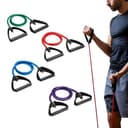
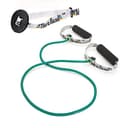
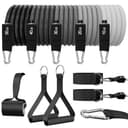
This is the fork in the category. A stackable set— Bodylastics and WHATAFIT here — gives you four or five tubes with clips at each end, so you can run one tube for a lateral raise and three clipped together for a row. It is the flexible answer and the reason sets dominate the market. A single sealed tube— SPRI and TheraBand — is one resistance, molded or bonded at both ends, with no clips and nothing to come apart.
Buy the ladder if you do not yet know what resistance you need, or if several people of different strengths will use it. Buy the rated single if you do know, because the hardware is simpler, the failure points are fewer, and you are not paying for four tubes you leave in the bag. A useful middle path: buy a cheap ladder first to find your level, then replace the two tubes you actually use with rated singles.
2. Is the resistance published, and does the figure mean anything?
Here is the physics the category papers over. A band is not a weight. Tension rises with stretch, so the only honest rating is either a range across the pull or a force at a stated elongation. Both exist in this group, and so does the meaningless version.
TheraBand publishes the gold standard: its thin yellow tube is rated 3.0 lb at 100% elongation and 4.3 lb at 200%, inside a seven-level color system where each step up is a published percentage increase. That is a measurement, and it is why rehab protocols are written in TheraBand colors rather than in pounds. Bodylasticspublishes a range per band — 3–10, 5–20, 8–30, 13–50 and 19–80 lb across its five-band set — which tells you both ends of what that tube will give you. SPRIpublishes a nominal figure per level (10, 20, 30, 40, 50 lb) and, unusually, the tube length that goes with it. WHATAFITprints a label on each of its five tubes — 10, 20, 30, 40 and 50 lb, stated to combine up to 150 lb — with no stretch attached to any of them. That is the industry norm: better than a bare set total, and still not a measurement.
The practical consequence: with a published range or a stated-stretch force you can progress deliberately, and with a set total you are guessing. If you are rehabbing a shoulder or following a written program, that difference is the whole purchase.
3. What happens when a tube fails?
Tubes fail at three places: the rubber itself cracks from UV, heat and age; the tube tears where it enters a metal clip or ferrule; and the clip or carabiner opens under load. A loop band that fails snaps back along its own line. A tube that fails sends a handle or a clip with it, which is why the single most useful feature in the category is the one Bodylastics built: an inelastic cord inside every tube, which Bodylastics says limits over-stretching and stops a torn band flying at your face. It also publishes how to confirm the cord is in there — fold back the clip webbing, shine a light down the tube, look for a black stopper ball with white cord about an inch inside. A maker that tells you how to audit its own safety claim is unusual and worth something.
Nobody else here publishes an internal cord. The two sealed tubes answer the problem differently, by having no clips at all: a molded or bonded handle cannot unclip, and SPRI markets a sleeve over the tube at the handle. The order of precautions is the same whichever you buy. Inspect before every heavy session. Never anchor a tube to anything that could release — a door anchor belongs on a door that opens away from you, with the door shut and ideally locked. Set up so a failure sends the hardware away from your face, not through it. And retire a tube at the first crack rather than using it carefully.
4. What hardware comes with it, and is the anchor any good?
A tube band is only as useful as its attachment points. The full-kit sets (Bodylastics, WHATAFIT) ship handles, ankle straps, a door anchor and a bag, which covers rows, presses, curls, kickbacks, pull-aparts and the whole standing-cable-machine vocabulary. The sealed tubes ship handles, with the TheraBand listing including a door anchor and SPRI offering one.
Two details separate good hardware from bad. The first is what the handle is attached with: a sewn webbing loop through a metal clip is the standard, and it is also the standard failure point, so look for a generous bar tack rather than a single stitch line. The second is what the anchor is made of: a door anchor is a strap with a foam or fabric ball that sits on the far side of a closed door, and the whole load passes through the stitching where strap meets ball. Neither Bodylastics nor WHATAFIT publishes a rated load for its anchor, which is a genuine gap in a component everyone uses.
What tube bands are genuinely good at — and what they are not
Tubes are the best bands for pressing and rowing, full stop. A handle in each hand lets you work at the angle your shoulder prefers, which is why the clinical world uses tubing for rotator-cuff and scapular work and why a tube set is the most useful piece of resistance equipment you can put in a suitcase. They also load the top of a press harder than the bottom, which complements free weights neatly, and they let you train horizontal pulling — rows — without owning a machine or a bar.
What they are not is a replacement for weight. The load is hardest to quantify exactly where you want precision, the resistance curve runs opposite to most machines, and no tube in this group gives you meaningful resistance at the bottom of a range of motion where many lifts are hardest. Tubes also cannot do what a long loop does: assist a pull-up, or add tension to a barbell squat. Our loop bands vs tube bands comparison works through the split job by job, and the loop band roundup covers the other half of the category. If you want the whole field in one place, the resistance bands roundup ranks loops and tubes together.
If tubes are your entire gym because of space, the upgrade that changes the most is a pair of adjustable dumbbells, and the honest comparison between rising tension and constant weight is in resistance bands vs dumbbells. Tubes remain the better travel tool either way.
The tube sets to skip, and why
Skip any set whose onlyresistance claim is a single big number for the whole kit with nothing per tube — that is a sign nobody measured, and you cannot program with it. Skip sets sold with plastic-bodied clips: the clip is the one component carrying the full load in line with your face. Skip tube bands for anything that needs a loop— pull-up assistance, banded squats, anything hung off a bar — because the handles and clips are not built to hang bodyweight. And skip the temptation to buy the heaviest set available: an 80 lb tube at full stretch is awkward to control, and most people train rows and presses better with two mid-weight tubes stacked than with one heavy one.
One category-wide note. Latex is the material that makes all of this work, and it is also an allergen; TheraBand publishes a natural-rubber-latex warning on its professional tubing, and non-latex lines exist for exactly that reason. If anyone in the house reacts to latex, buy the non-latex version rather than hoping. Beyond that, tube bands are the cheapest way to cover the muscle-strengthening work federal guidance asks adults to do on two or more days a week, and the only way to do it from a carry-on bag.