How to choose a kettlebell under $100
The $100 ceiling is not a compromise band in this category — it is most of the category. A single fixed bell at a usable beginner weight is a sub-$60 purchase from every brand on this page, and the only kettlebells that cost materially more are adjustable bells and true competition bells. So the question is not “what am I giving up?” It is “which of these five castings is the one I will still be using in five years?” Four things decide that.
1. What does the warranty actually say?
This is the row that matters most, because a kettlebell has one failure mode that matters — a handle that cracks or a casting flaw — and one that doesn’t — cosmetic wear. The terms here are wildly different. REP’s warranty page publishes “Kettlebells: Lifetime warranty*”, and the asterisk is the limit: original purchaser only, non-transferable, replacement at REP’s discretion, normal wear excluded. Marcy publishes a 2-year limited warrantyfrom the delivery date on its own product page — the Amazon listing does not state it. Amazon Basics carries a one-year limited warranty covering hardware components under ordinary consumer use, explicitly not transferable to a later owner. CAP publishes 30 days, and its exclusion list reads like a description of normal kettlebell life: paint peeling, rust, dents and bent handles are all specifically not covered. Yes4All publishes no term at all, only a 30-day refund or replacement window from receipt.
None of that makes the short-warranty bells bad. It does mean that if a bell arrives with a rough weld line or a casting void, the brand you bought from decides how much that costs you.
2. Is the weight the weight?
A kettlebell’s label is a claim, and a tolerance is the maker telling you how close to it they commit to being. Of the five bells here, only Yes4All publishes one — plus or minus 3%. On a 40 lb bell that is a window of about two and a half pounds, which sounds sloppy until you notice that the other four makers publish no figure whatsoever. For swings and goblet squats a couple of pounds either way changes nothing. It starts to matter if you are buying a pair for double-bell work, or if you are tracking loads closely enough that a 24 kg that is really a 23 kg bothers you. If that is you, the tolerance question is the whole argument for competition bells, where dimensions and tolerances are the product.
3. Paint, enamel or powder coat?
Finish is the part of a cheap bell you touch and the part that fails first, and the four words makers use are not interchangeable. Powder coat— CAP’s competition-style bell — is a baked polymer layer that is the usual choice for bells meant to be gripped with chalk. REP’s textured matte coatis applied, in REP’s own words, for grip and rust protection; that is the maker’s claim rather than something we measured, but a textured finish is the one most likely to hold chalk. Marcy’s hammertone enamel is a sprayed finish whose stated purpose is corrosion protection, not grip. Baked paint and plain paint— Yes4All and Amazon Basics — are the cheapest route, and both companies’ own materials concede the point: Yes4All says its baked paint resists chipping, and CAP’s warranty excludes paint peeling outright. Paint on a bell that gets set down on concrete twice a week will mark.
4. How many sizes does the line run?
You will outgrow your first bell. That is the normal arc of kettlebell training, and it is the reason this row is on the comparison table. REPpublishes seventeen sizes from 1 kg to 48 kg, singles or pairs — the deepest ladder here by a distance. CAP’scompetition-style line runs eleven sizes from 9 to 88 lb. Marcyruns ten sizes in clean 5 lb steps from 10 to 55 lb, which is the gentlest progression on this page and the reason it earns that slot: a 5 lb jump is manageable in a press, where the usual 4 kg (about 9 lb) jump between kettlebell sizes is not. Yes4All spans 5 to 80 lb. Amazon Basicsis the narrowest at roughly 10 to 50 lb, varying by listing. Buying into a deep line means the handle shape stays familiar as the weight climbs, which matters more than it sounds — a cleaned bell that lands differently on the forearm is a bell you will stop using.
What $100 does not buy
Three things, stated plainly.
A published handle diameter.Not one of the five bells here states how thick the bar you are gripping is, and handle thickness is the single biggest comfort variable in a kettlebell. For reference, Titan Fitness publishes 37 mm through an 8 in window on its cast iron line — the only kettlebell maker we cover that prints the figure — which is why our cast iron kettlebell roundup ranks on exactly that disclosure. Under $100 you are buying a handle you cannot measure until it arrives.
Dimensional uniformity across weights.A true competition bell is a hollow shell of fixed outside dimensions — 210 mm tall, 35 mm handle — brought to weight inside, so a 16 kg and a 24 kg feel identical in the hand. Every bell on this page is a solid casting, which physically has to get bigger as it gets heavier. CAP’s bell wears the competition shape and the squared handle window at a fraction of the price, and the listing does not claim otherwise, but it is competition-styled, not competition-dimensioned.
Adjustability.The Bowflex SelectTech 840 dials one bell from 8 to 40 lb across six settings, and it sits above this ceiling. Whether that is worth the step up depends on floor space more than on training: six fixed bells in a spare room is a storage problem, and one adjustable bell is not.
One bell or two?
For a first purchase, one. A single bell at the right weight runs swings, goblet squats, cleans, presses, rows, carries and Turkish get-ups, which is a complete full-body program by any reasonable definition — and it comfortably covers the CDC’s muscle-strengthening recommendation of two or more sessions a week alongside its aerobic target. The usual mistake is not buying too light; it is buying one bell that is too heavy to press and too light to swing. If you are not sure which weight that is, our kettlebell weight guide walks the two-test method for sizing a first bell.
The case for two is a specific one: swings want more weight than presses, so a heavy bell for the hinge and a lighter bell for overhead work is the natural second purchase. That is where the deep-ladder brands earn their premium, and where the narrow lines start to pinch.
What we would buy
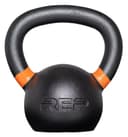
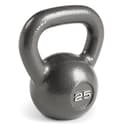
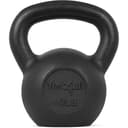
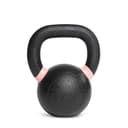
The REP Fitness bell for most people under this ceiling: a lifetime warranty on kettlebells is a term no other brand here matches, the textured matte finish is the one built for chalk, and seventeen sizes means the ladder never runs out. The Marcy Hammertoneif you want 5 lb steps and a warranty term you can read on the maker’s site, and you accept its stated home-use-only limit. The Yes4All if you want the most iron for the money and you value a published tolerance over a published warranty. The CAP competition-style bell if the squared handle window and wide flat base are what you are after and you understand it is not dimensionally uniform. And the Amazon Basics bellif you simply want one cheap bell to find out whether you like kettlebell training at all — it is the least money on this page and the least to regret.