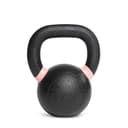
How to choose a competition kettlebell
Start by deciding whether you want one at all, because the honest answer for a lot of home lifters is no. Then there are four questions, in this order.
1. Do you actually need uniform dimensions?
Uniform size is worth real money in exactly two situations. The first is kettlebell sport— long sets of jerks, snatches and the long cycle, where the bell rests on the forearm for minutes at a time and a change in the ball diameter changes where the bruise goes. The second is owning three or more weights: if you are moving between a 16, a 20 and a 24 in the same session, one handle shape across all three is the difference between one technique and three.
If you own one bell and swing it two-handed, none of that applies, and a competition bell is the wrong purchase twice over — it costs more, and a 35 mm handle on a 210 mm ball is a bigger, thicker object than a cast iron bell of the same weight. Cast iron sizes the handle to the bell, which is genuinely nicer in one hand at light weights. Our cast iron kettlebell roundup is the right page for that buyer, and competition vs cast iron kettlebell lays the two side by side on handle, size and price.
2. The handle: 35 mm, and the 33 mm bells that are not it
The standard figure for a competition bell is a 35 mm handle, and Bells of Steel, XMark and Titan all publish it. Bells of Steel is the only one that also publishes what happens at the light end: its 4 and 6 kg bells use a 34 mm handle, which is an honest disclosure rather than a defect — a 4 kg shell cannot carry a full-size handle and still weigh 4 kg.
What to watch for is the 33 mm bell sold as competition grade. Two millimeters sounds like nothing and is not: handle thickness is the single most consequential dimension on a kettlebell, a thinner bar changes how the bell rotates through a snatch, and a 33 mm bell mixed into a set of 35 mm bells defeats the point of buying matched bells at all. Third-party roundups of the POWERT bell disagree between 33 and 35 mm and we could not find a manufacturer spec sheet to settle it, so we have left that cell blank rather than guess — that unresolved figure is exactly why it is not a higher pick.
The figure almost nobody prints is the handle width, the inside measurement of the window your hands go through. Titan publishes 190 mm, and that is the number that decides whether two hands fit side by side for swings. Bells of Steel publishes a 60 mm grip window, which is the vertical gap between the handle and the ball — a different and also useful measurement, because it decides how much room a gloved or chalked hand has. Nobody publishes both.
3. Tolerance: the spec that separates a competition bell from a shape
Here is the question the category does not want asked. A competition bell is a hollow shell of fixed outside size, so the weight has to be brought up inside a body that cannot change. How close does it land? Two makers answer.
Bells of Steel publishes ±200 g or better, tightening to ±100 g on the lightest bells, and — the detail that makes the number believable — it publishes a looser±300 g for its own powder-coated cast iron line, which is a maker drawing a line between its products rather than a marketing claim. XMark publishes ±2%. On a 16 kg bell that is up to 320 g, so despite looking like the tighter-sounding spec it is the looser one. Titan, POWERT and CAP publish no tolerance at all.
Does 300 g matter? For swings, cleans and carries, no. It matters if you are chasing a one-arm press at the edge of your range, where a bell 2% heavy is the difference between a rep and a miss, and it matters in competition, where the bell is weighed. But the broader point is the one the kettlebell brands guide keeps running into: a maker who prints a tolerance is a maker who measures.
4. What goes inside the shell — and why two makers disagree
This is the most interesting disagreement we found in the whole category, and both sides are in print. Bells of Steel states its bells are gravity cast as one piece with a hollow core containing no filler, shot or loose material— the weight is in the casting itself, which is harder to do and is what the tolerance figure is really about. XMark states the opposite approach just as plainly: fillers are used to bring each hollow bell to its competition weight.
Neither is dishonest and filler is normal in this category. What it changes is what can go wrong. A precisely cast bell has nothing inside to shift; a filled bell depends on the filler staying put and staying sealed, which is why a bell that rattles when you shake it is a return rather than a quirk. If you are choosing between two bells at the same price and one of them tells you which method it used, that disclosure is worth something on its own.
The color code, and why two bells of the same weight can be different colors
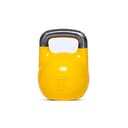
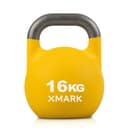
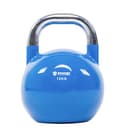
Competition bells are color-coded by weight so a judge and a lifter can read the weight across a hall. There is a conventional palette — 8 kg pink, 12 kg blue, 16 kg yellow, 20 kg purple, 24 kg green, 28 kg orange, 32 kg red — and Bells of Steel publishes its full chart against it, running from 4 kg black up to 48 kg gold. XMark states it follows the IKSF/WKSF system.
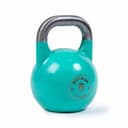
Titan is the useful counter-example: its bells are color coded, but to its ownpalette — the 24 kg is turquoise where the convention is green. Nothing is wrong with that in a home gym, where you are the only person reading the bell, and Titan laser-etches the weight in kg on the body anyway. It is only a problem if you were counting on color to tell you the weight across brands, or if you are training toward a platform where the colors are the standard. Buy colors within one brand and you are fine; mix brands and read the number.
What this costs against cast iron
Without quoting a figure that will be stale by the time you read it: a competition bell is a premium-tier purchasewhere a cast iron bell of the same weight is a budget-to-mid one, and the gap is widest at the light end, because a light competition bell is a mostly-empty full-size shell — you are paying for the geometry, not the metal. The CAP bell in this roundup is the cheapest route to the competition shape, at a price close to ordinary cast iron, and the trade is explicit: it is a solid casting, so its body grows with the weight and the line cannot be dimension-uniform. The 18 lb and the 53 lb are different sizes in the hand.
That is the decision in one line. Pay for a competition bell when you are buying several weights and want one handle shape across all of them; buy cast iron when you are buying one or two and want the most iron per dollar. If you are not sure which weight that even is, what weight kettlebell should I buy works through the first bell and the second, and why the bell you swing is heavier than the bell you press.
The bells to skip, and why
Skip any bell that uses the word competitionand publishes no handle diameter — the word is free and the diameter is the product. Skip 33 mm handles if you intend to add matched bells later. Skip solid cast iron sold as competition if you specifically want the size to stay the same as the weight climbs, because the physics makes that impossible. Be wary of the handful of listings that advertise a competition set at a price below a single named-brand bell; at that price something has been removed, and in this category the thing removed is usually the tolerance nobody published in the first place.
Two brands people search for and will not find here: Kettlebell Kings and Rogue do not surface in the Amazon listings we can verify and link, so they are absent from this page rather than ranked badly on it. The same applies to the one listing we found at the top of the price range, a bell marketed as an officially sanctioned competition model at roughly double the Titan price: we could find no manufacturer spec sheet stating its handle diameter, body size or tolerance, so we are not recommending it on the strength of a marketing phrase.
One caution that applies to the category rather than any product in it. A competition bell invites long sets, and long sets are where kettlebell technique breaks down quietly — the hinge shortens, the bell starts getting lifted with the arm, and the bruise on the forearm turns into a reason to stop training. Learn the movement at a weight that is easy before you buy the matched set, and if you are training toward a platform, the coaching is a better first purchase than the fourth bell.